Industrial Pallet Racking & High-Density Systems
Precision-engineered in our 30,000 m² Guangzhou production facility. Cold-formed profiles, certified structural steel, and robotic phosphating pre-treatments configured to international safety tolerances.
Engineering Strengths & Global OEM/ODM Capabilities
Why logistics architects, general contractors, and tier-1 material handling distributors partner with Guangzhou Heda Shelves for mission-critical warehouse builds.
Parametric 2D/3D CAD & Load Checking
Our in-house design engineering department translates warehouse footprint dimensions, SKU turnover frequencies, and material handling equipment (MHE) specs into precise layout calculations within 24–48 hours, fully compliant with RMI, FEM 10.2.02, and EN 15512 safety protocols.
Certified Metallurgy & Surface Pretreatment
Fabricated from verified high-tensile hot and cold-rolled steel coils (Q235B / Q355B). Every frame member passes through an automated 9-stage degreasing, acid pickling, and zirconium-based phosphating pretreatment to guarantee anti-corrosion bonding for electrostatic epoxy powder coats.
Seismic & Climatic Localization
From cyclonic winds and high-humidity environments across Southeast Asia to active seismic subduction fault zones in Japan, Indonesia, and the Philippines, we calculate baseplate surface footprints, heavy-duty column anchoring, and portal tie bracing to meet site-specific engineering regulations.
Export Logistics & Container Optimization
Shipping out of South China maritime hubs (Guangzhou, Shenzhen, Foshan) delivers decisive freight lead-time advantages. Proprietary 3D container software creates dense loading models that secure tall uprights and step beams, slashing ocean transport damages and ocean freight rates per pallet bay.
Complete OEM/ODM Private Labeling
We serve material handling brand manufacturers and regional distributors with contract manufacturing: custom punch patterns (teardrop, diamond, slotted), custom corporate RAL powder coating shades, branded component tagging, pre-assembled truss uprights, and client-branded install literature.
Comprehensive Accessories Ecosystem
Beyond frames and box beams, our lines fabricate wire mesh decking, heavy steel pallet support bars, row spacers, floor column protectors, safety mesh backstops, guide rails for VNA wire/rail guidance, and custom drum storage adapters that turn standard bays into universal handling points.
10-Step Quality Assurance Workflow
Every cold-formed member is monitored under rigorous SPC (Statistical Process Control) boundaries to eliminate dynamic deflection under full-rated working conditions.
Steel Inflow
Mill certificate audits & ultrasonic thickness verification on prime Q235B/Q355B coils.
CNC Slitting
High-precision uncoiling and laser/rotary shearing within tight dimensional tolerances.
Multi-Die Punch
Synchronous automated pressing ensuring exact vertical pitch spacing over 12-meter upright runs.
Cold Profiling
Continuous 22-station roll-forming lines preventing micro-fractures in high-load sections.
Robotic Weld
Multi-axis automated gas metal arc welding (GMAW) on beam connector claws and baseplates.
Surface Pre-Clean
Full-immersion industrial pickling & phosphating baths removing scaling and grease.
Electrostatic Coat
Automated powder spray tunnels providing 70–90 μm thickness with RoHS-compliant resins.
Thermal Curing
200°C continuous curing kilns ensuring impact elasticity and chemical solvent resistance.
Deflection Load
Random destructive batch testing and frame compression evaluation in structural jigs.
Export Strapping
Steel-banded moisture-proof bundling with corner protective jackets for rough maritime voyages.
Future Trends in Warehouse Racking: Automation & Engineering Shifts
A strategic breakdown for chief procurement officers and logistics operations directors navigating modern automated fulfillment centers.
ASRS & Shuttle-First Racking Geometry
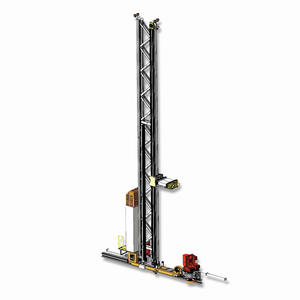
The standard warehouse profile has evolved from low-bay, broad-aisle setups into 15 to 30-meter high-bay designs integrated with Autonomous Mobile Robots (AMRs), automated 4-way shuttles, and miniload cranes. This shift demands tighter upright verticality tolerances (often sub-1.5mm deviation per 10m height) and zero-deflection guide channels to prevent high-speed robotic shuttle jamming.
Energy-Optimized Cold Chain Density
Refrigerated warehouse real estate costs continue to rise exponentially, demanding hyper-dense pallet cubes that eliminate working aisles. Modern procurement centers on semi-automated radio shuttle platforms and automated pallet flow configurations, which lower the total air volume requiring cooling by up to 55% compared to conventional selective rack layouts.
Predictive Structural Health & IoT Sensors
Forward-thinking supply chain operators are transitioning from passive scheduled inspections to active structural health monitoring. Smart strain-gauge load pins and accelerometer pods embedded at critical beam-to-column locking tabs now alert facilities managers in real time to forklift collisions, accidental point overloading, and baseplate slippage before structural failures occur.
Strategic Procurement Shifts: Near-Zero Downtime & Total Cost of Ownership (TCO)
Global procurement teams are shifting away from evaluating racking based solely on raw steel price-per-kilogram. Structural racking is an operational foundation: inaccurate frame profiling leads to repeated forklift bay-entry collisions, early paint chipping produces galvanic rust in high-humidity ambient warehouses, and non-certified steel grades fail unpredictably during seismic resonance events. Procurement managers prioritize partners providing verified traceability certificates, certified structural analysis reports (FEM/EN standards), and pre-tested installation blueprints that cut on-site assembly schedules by over 30%.
Warehouse Racking Procurement FAQ
Direct technical answers addressing engineering verification, safety standards, and project fulfillment.
How do you verify rack load ratings and prevent upright deflection?
Every system is calculated using Finite Element Analysis (FEA) based on EN 15512 and RMI standards. We test actual cold-formed steel sections under physical hydraulic presses to identify elastic buckling limits, ensuring a structural safety factor of 1.4 to 1.65 above rated capacities.
What structural adjustments are made for facilities in high seismic zones?
For seismic areas across the Pacific Rim, our engineers increase upright profile thicknesses (up to 2.5mm or 3.0mm), expand anchor bolt counts from 2 to 4 per footplate, add diagonal frame truss bracing, and provide structural engineering calculation sheets for local municipal building approvals.
What are the main surface treatment differences for humid or cold store facilities?
Ambient dry environments use a standard 70–90 μm electrostatic polyester powder coating. For cold storage and coastal facilities with high humidity, we offer hot-dip galvanization (HDG per ISO 1461) where parts are immersed in 450°C molten zinc, creating a metallurgically bonded shield immune to rust.
What initial technical data is required to produce an accurate 3D warehouse layout?
We require your facility's architectural CAD floor plan (showing clear heights, building columns, dock door locations, and emergency egress corridors), specific pallet specifications (length, width, overhang, full load weight), and your forklift fleet model with its mast turning radius and reach heights.
How do you manage international container packing to minimize freight damage?
Uprights are nested and secured with reinforced steel banding, wooden dunnage, and corner-wrap cushioning. Beams are bundled on dedicated pallets to eliminate surface scratching. We generate custom container stowage diagrams to fully utilize container volume while preventing load shifting at sea.
Do you supply white-label packaging and OEM engineering for regional distributors?
Yes. Over 40% of our capacity supplies private-label programs. We manufacture custom teardrop, hexagonal, or diamond punching patterns, provide branded packaging with your part numbers and company logo, and follow strict non-disclosure terms to safeguard your regional market exclusivity.