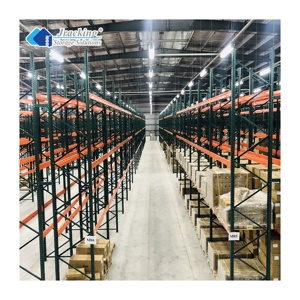
US Standard
Precision-engineered using high-tensile Q235B/Q355B structural steel, strictly compliant with ANSI MH16.1, FEM 10.2.02, and EN 15512 safety protocols.
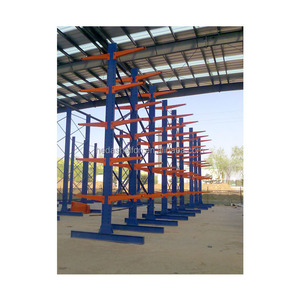
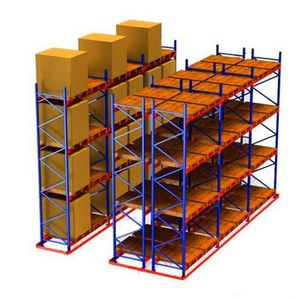
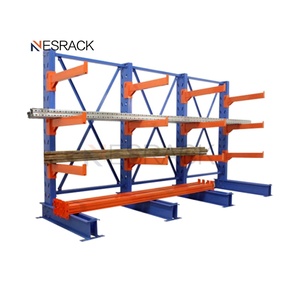
Full-lifecycle control from certified metallurgy selection to automated laser profile punching and container shipment optimization.
Every cantilever column and arm is manufactured under ISO 9001:2015 management (Cert #18624Q00169R0M) and bears verified CE Marking (No. 2435-CPR-8605159). We provide finite element structural calculation reports verified by third-party testing.
Avoid costly on-site layout revisions. Within 24 to 48 hours, our structural engineering team delivers comprehensive AutoCAD layouts, realistic 3D spatial simulations, and precise column base-plate shear calculations tailored to regional seismic requirements.
All structural components undergo hot-rolled coil testing, CNC cold-roll bending, robotic plasma welding, acid pickling, phosphating, and electrostatic resin coating to ensure over 1,000 hours of continuous salt-spray rust protection.
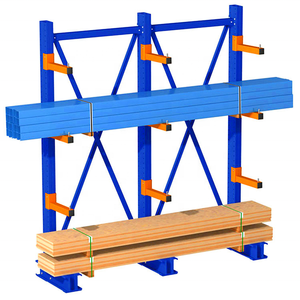
Cantilever racking systems are specifically intended to resolve the mechanical limitations of traditional upright frames when storing non-standard, long-profile items such as structural H-beams, PVC pipelines, timber crates, plasterboards, and automotive chassis. Eliminating front vertical columns removes the pick-face horizontal obstruction, allowing unobstructed side-loading via counterbalanced forklifts, side loaders, or automated cranes.
Roll-Formed Profiles (Light to Medium Duty): Cold-formed from continuous steel coils (typically 2.0mm to 3.5mm thickness). These systems feature teardrop or slotted adjustable patterns on 76.2mm or 100mm centers. They provide superior cost-effectiveness for indoor commercial storage reaching up to 1,000 kg per arm.
Hot-Rolled Structural I-Beams (Heavy Duty): Utilizing certified hot-rolled structural steel profiles (IPE or HEA sections) welded directly to robust base plates. These structures achieve exceptional impact resistance and can support point loads exceeding 3,000 kg per arm, making them optimal for harsh exterior industrial settings and seismic environments.
In strict accordance with international logistics standards, the vertical deflection of an individual cantilever arm under uniform distributed load (UDL) must not exceed L/200 (where L equals nominal arm length). Unbalanced deflection across adjacent arms creates structural eccentricity and dangerous tipping vectors.
Base stability formulas require that the base length must always equal or exceed the nominal projection of the cantilever arm (Base Length ≥ Arm Length) to prevent overturning moments during sudden dynamic braking of lift equipment.
| System Classification | Standard Arm Length | Max Load Per Arm (UDL) | Structural Steel Grade | Recommended Application |
|---|---|---|---|---|
| Light-Duty Roll-Formed | 600 mm – 1000 mm | 200 kg – 500 kg | Q235B Cold-Rolled | Plastic Conduit, Extrusions, Light Timber |
| Medium-Duty Modular | 800 mm – 1200 mm | 500 kg – 1,200 kg | Q235B / Q355B | Furniture Packs, Tubing, Medium Profiles |
| Heavy-Duty Structural I-Beam | 1000 mm – 2000 mm | 1,200 kg – 3,500 kg | Hot-Rolled IPE/HEA Sections | Steel Billets, Oilfield Pipes, Heavy Sheet Packs |
| Exterior Roof-Integrated | 1200 mm – 1800 mm | 1,000 kg – 2,500 kg | Hot-Dip Galvanized Q355B | Outdoor Lumber Yards, Uncovered Steel Stacks |
The global procurement landscape for industrial warehouse infrastructure is shifting from fragmented vendor purchasing to end-to-end turnkey OEM/ODM engineering integration.
Enterprise procurement divisions are bypassing regional intermediaries, demanding direct technical interaction with factory CAD/BIM engineers to reduce engineering errors and shave 15-25% off project CAPEX.
With volatile maritime freight indices, buyers require customized nested packing designs. Our engineers model full 40ft HQ container stowage plans, achieving 98%+ volumetric efficiency and lowering shipping cost per linear meter.
Municipal zoning boards globally require comprehensive documentation. Modern orders demand raw steel mill test certificates (MTC), non-destructive weld testing, and ISO 14001 environmental compliance certificates for fast local permit clearance.
High land valuation and escalating warehousing labor costs are driving major technological updates in cantilever racking designs:
Mounting heavy-duty cantilever columns onto electronically synchronized motorized wheel bogies allows rows to glide along embedded floor rails, eliminating multiple service aisles and instantly boosting warehouse storage capacity by up to 80%.
Modern cantilever systems are increasingly adapted with precision optical alignment plates, continuous arm sensor brackets, and guide rails for four-directional multidirectional automated forklifts and crane-retrieval systems.
Hot-dip galvanization conforming to EN ISO 1461 with zinc bath thickness ≥85 microns is replacing standard powder paint in coastal distribution zones and outdoor storage yards across the Gulf and Southeast Asia.
Detailed answers addressing engineering feasibility, seismic certification, container logistics, and site preparation.
Send us your warehouse CAD floor plan, load dimensions, and forklift lift profile. Our structural engineering department will furnish a 2D CAD layout, 3D rendering, and comprehensive commercial quotation within 24 hours.