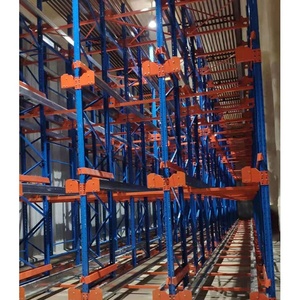
 Heavy Duty
Customized Steel Pallet Rack Stacking Racks & Shelves Warehouse Storage Rack Heavy Duty Shuttle Racking
Q235B Steel
1000–3000 kg/Tier
Modular Base
Explore heavy-duty, boltless, customizable, and automated high-density rack modules manufactured under rigorous ISO 9001:2015 and CE standards for demanding global logistics operations.
Heavy Duty
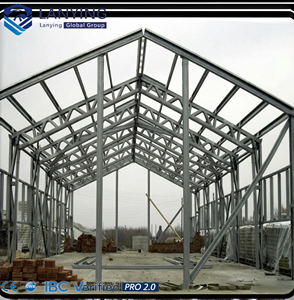 Turnkey Plant
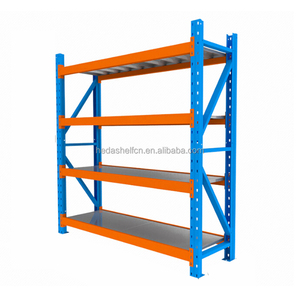 Rapid Assembly
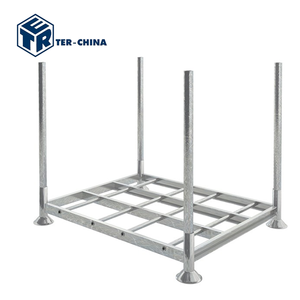 Stackable
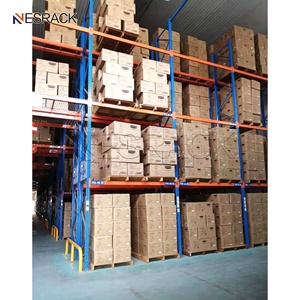 Multi-Tier
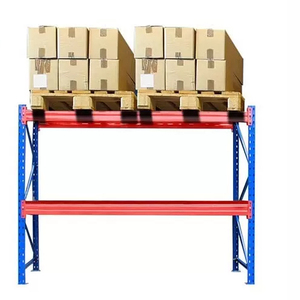 High Selectivity
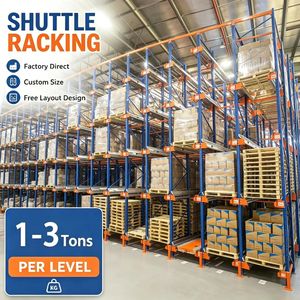 Semi-Automated
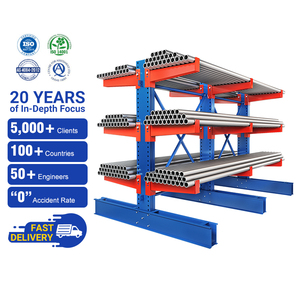 Long Materials
In contemporary high-density distribution and manufacturing hubs, stack racks (also identified as portable stack racks, post pallets, or nesting modular racks) represent the vital intersection of high cubic density and material handling agility. Unlike stationary bolted selective racking systems anchored permanently to concrete slabs, portable stack racks deliver dynamic unit-load maneuverability. Designed primarily around cold-formed structural steel tubing and certified Q235B to Q355B base structural profiles, industrial stack racks enable facility managers to establish 3 to 6-high vertical block-stacking zones without relying on external building structural columns or dedicated wall supports.
As leading warehouse operators navigate surging commercial real estate rents across Southeast Asia, North America, the Middle East, and Europe, the operational requirement to eliminate static, vacant aisle space has intensified. Modular stack racks achieve up to 75% volumetric footprint utilization during high-inventory seasonal influxes. Conversely, during low-volume periods, demountable posts and nesting cradles collapse into 4:1 or 7:1 packing configurations, reclaiming floor surface area for staging, cross-docking, and assembly operations.
| Performance Specification | Light to Medium Duty Post Racks | Heavy-Duty Industrial Stack Racks | Radio Shuttle & Multi-Tier Systems |
|---|---|---|---|
| Nominal Load Rating | 500 kg to 1,200 kg per pallet base | 1,500 kg to 3,000 kg per pallet base | 1,000 kg to 2,500 kg per storage lane |
| Structural Metallurgy | Cold-Rolled Mild Steel (Q235B) | High-Strength Low-Alloy Structural Steel | High-Precision Roll-Formed Profiles (Q355) |
| Stacking Capability | 3 to 4 Units Loaded Vertically | 4 to 6 Units Loaded Vertically | Vertical bays up to 16–24 meters height |
| Surface Protection | Standard Epoxy Polyester Powder Coat | Multi-stage Pickled Phosphating + Powder | Hot-Dip Galvanized (ASTM A123) / RoHS |
| Target Industrial Footprint | Retail stockrooms, textiles, automotive tier-3 | Heavy manufacturing, foundry, chemical drums | Automated cold storage (-30°C), FMCG DCs |
From an engineering physics standpoint, the load-bearing integrity of a stacked modular assembly depends decisively on upright socket nesting tolerances, cup-foot stamping consistency, and base corner joint weld quality. Guangzhou Heda Shelves Co., Ltd. applies robotic laser profiling and automated circumferential welding across all corner target receptacles. This rigorous method ensures structural verticality and prevents eccentricity stresses from translating down the stacking column under dynamic warehouse conditions.
The global logistics landscape is undergoing structural realignments driven by high warehouse lease rates, tightening regional seismic safety mandates, and widespread warehouse management system (WMS) modernization. Professional procurement officers at major 3PLs, cold-chain operators, and retail conglomerates now evaluate storage equipment through lifecycle cost analysis rather than initial purchase price alone. Key purchasing shifts include:
Global operations demand racking designs compatible with ISO standard 1200x1000mm, Euro 1200x800mm, and regional wooden/plastic slip pallets without structural deflections or risk of slipping.
With volatile ocean freight costs, buyers insist on demountable, knock-down post designs and nesting bases that maximize 40ft High Cube container payload space to sharply reduce shipping expense per pallet position.
Import authorities increasingly require accredited certification before release. Valid CE marking (EN 15512), ISO 9001:2015 traceability, and mill test certificates are now essential prerequisites for cross-border contracts.
The manufacturing of industrial stack racks has advanced far beyond traditional cut-and-weld steel fabrication. Technological investments in automated production lines, intelligent surface chemistry, and digital modeling have elevated both structural reliability and operational lifespan:
1. High-Strength Ultra-Light Alloys: Modern stack racks increasingly utilize micro-alloyed structural steels treated with vanadium or niobium grain refinement. This produces higher yield strength (up to 355–420 MPa) with reduced wall thicknesses, keeping deadweight low for manual handling while maintaining safety factors above 1.5 to 2.0 under full rated load conditions.
2. Surface Chemistry & Anti-Corrosion Advances: Standard single-dip paints are quickly being replaced in modern factories by automated, multi-stage conversion lines. Steel profiles undergo hot alkaline degreasing, ultrasonic water rinsing, zinc-iron phosphating, and electrostatic deposition of outdoor-grade TGIC polyester powders cured at 200°C. For sub-zero pharmaceutical cold stores (-30°C) or humid equatorial ports, deep immersion hot-dip galvanizing (conforming to EN ISO 1461 / ASTM A123) delivers complete metallurgical zinc-iron bonding that permanently resists flaking and oxidation.
3. Automated Cold Bending and Robotic Welds: Automated roll-forming machines yield uniform column punchings and tight post tolerances (+/- 0.5 mm). Multi-axis industrial robots perform consistent structural welds along joint intersections, eliminating incomplete penetration or cold welds that could otherwise trigger systemic failure in high vertical stacks.
Complete end-to-end production under one roof at our Guangzhou factory guarantees traceable quality, precise dimensional tolerances, and predictable delivery timetables.
Spectrometric tensile and grade verification of certified Q235B coils.
CNC precision steel cut-to-length with clean, burr-free edges.
High-speed automatic punching machines establish uniform slot patterns.
Multi-roller forming creates high-yield load-bearing structural angles.
Precision calibration of base channels and nesting corner cups.
Shot blasting and abrasive deburring to eliminate spatter.
Argon-shielded automated welding delivers deep structural penetration.
Acid pickling and conversion coating to ensure powder adhesion.
Electrostatic spray lines apply 60–90µm cures for high impact resistance.
Pre-shipment dimensional checks, sample load tests, and export packaging.
Founded in 2001 in Guangzhou, China, Guangzhou Heda Shelves Co., Ltd. has grown into an international supplier of custom warehouse racking, heavy-duty stack racks, and mezzanine floor solutions. Our 30,000 square meter integrated facility and 300+ skilled personnel unite engineering design, precision roll forming, robotic welding, and automated surface finishing under one roof. Our primary competitive strengths include:
Before issuing quotes, our in-house engineering team reviews your site plan, clear ceiling height, pallet dimensions, and forklift lift profiles to prepare detailed 2D CAD layouts and 3D structural models at zero charge.
All load ratings conform to established international standards. We maintain active CE Certification (No. 2435-CPR-8605159), ISO 9001:2015 Quality Management compliance, and RoHS certifications on all powder formulations.
From seismic structural calculations for the Philippines, Indonesia, and Japan to enhanced hot-dip galvanized anti-corrosion treatments for tropical ports across ASEAN and the Gulf, our designs are tailored to local installation environments.
Technical guidance, structural insights, and ordering specifics straight from our senior storage system engineering department.
Connect directly with HEDA Shelves' technical engineering department. Share your facility drawings or unit load requirements to receive a complimentary 2D CAD layout, 3D structural rendering, and factory-direct price proposal within 24 hours.