Featured Industrial Pallet Racking & Stacking Systems
Standardized modular components and fully customized structural steel systems tailored to load weight, facility ceiling clearances, and automated material handling workflows.
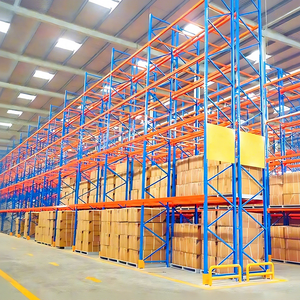
Selective Pallet Racking Commercial Heavy Duty Storage Racks
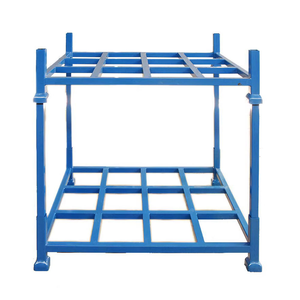
Customized Adjustable Detachable Galvanized Post Stacking Rack
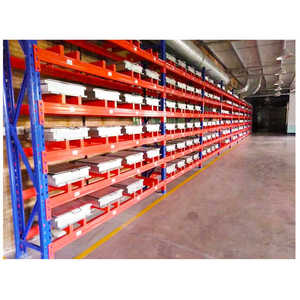
High-Density Drive-In Pallet Rack for Narrow Lane Warehousing
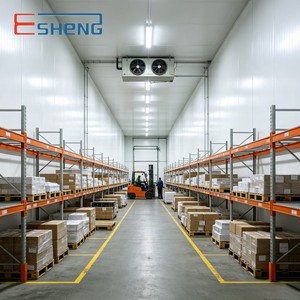
Automated High-Bay Cold Storage Racks (-25°C to 0°C FIFO AS/RS)
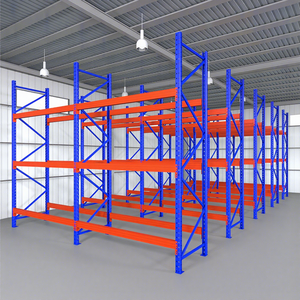
Heavy-Duty Stackable Industrial Warehouse Pallet Racking Frame
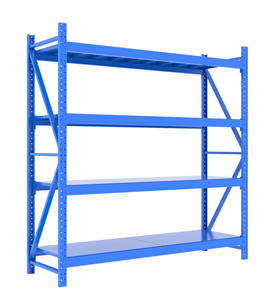
4-Layer Steel Garage & Maintenance Stacking Rack Systems
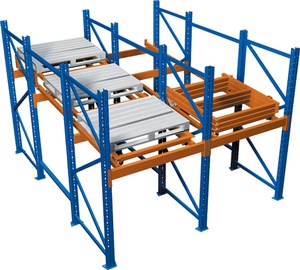
Nested Cart Push-Back Pallet Rack for Dynamic Intensive Storage
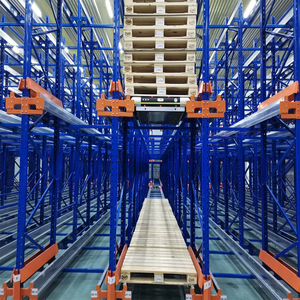
Semi-Automated Radio Pallet Shuttle System with CE Certification
Structural Metallurgy, Cold-Roll Forming & Deflection Mechanics
In modern warehousing, selecting an OEM/ODM pallet racking manufacturer is a high-stakes structural engineering decision rather than a mere catalog transaction. Storage systems must carry hundreds of metric tons of dynamic and static dead weight while resisting seismic oscillations, forklift accidental impacts, and torsional fatigue over multi-decade operational cycles. Our manufacturing plant in Guangzhou approaches every rack installation under strict international design codes, including RMI ANSI MH16.1, EN 15512:2020, and AS 4084:2023.
Upright Column Geometries and Cross-Section Section Modulus
Upright columns represent the structural spine of any warehouse frame. To maximize vertical axial capacity and prevent local Euler buckling under eccentric pallet placement, our continuous roll-forming lines bend steel sheets through 12 to 18 progressive cold-rolling stands. This imparts complex Omega ($\Omega$) or multi-rib cross-sectional geometries featuring return-lip flanges and internal stiffening ribs. Standard column profiles include 80×60mm, 90×70mm, 100×70mm, 120×95mm, and 140×95mm with steel thicknesses from 1.5mm up to 3.0mm, accommodating frame load capacities surpassing 30,000 kg per bay.
Box Beams, Step Beams & Connector Kinematics
Horizontal beam tiers bear bending moments calculated against extreme vertical deflection criteria. Under European FEM and American RMI codes, maximum permissible elastic deflection must never exceed $L/200$ (or $L/300$ for automated AS/RS applications), where $L$ is clear beam span length. Our box-beam sections feature automated double-interlocking robotic continuous seam welding of twin C-profiles, ensuring structural homogeneity and extreme torsional stiffness.
Beam ends are fitted with heavy-gauge precision-stamped 3-prong, 4-prong, or 5-prong connection brackets. These brackets feature tapered, wedge-action slotting hooks that mate securely into precision CNC-punched column drop-holes. This wedge mechanism translates downward live loads into tighter frictional grip against the column, drastically reducing beam end loosening. Every connector is locked with an automated spring safety pin capable of resisting upwards forklift extraction forces of over 10 kN per beam end.
Technical Comparison Matrix: Industrial Storage Architectures
System selection requires balancing floor space footprint, capital investment per pallet position, selectivity, and SKU turnover velocity. The empirical data below reflects operational averages across thousands of global installations engineered by our technical center:
| Storage Architecture | Space Utilization | Pallet Selectivity | Inventory Flow | Aisle Width (m) | CapEx / Pallet Position | Best Suited Application |
|---|---|---|---|---|---|---|
| Standard Selective Rack | 100% Direct Access | FIFO / LIFO Flexible | 3.0 - 3.8 m | High SKU variety, 3PLs, general retail fulfillment. | ||
| Double-Deep Racking | 50% Direct Access | LIFO | 3.0 - 3.4 m | Medium batch manufacturing, seasonal fast-moving items. | ||
| Very Narrow Aisle (VNA) | 100% Direct Access | FIFO / LIFO Flexible | 1.6 - 1.9 m | High land-cost logistics hubs, pharmaceutical DCs. | ||
| Drive-In / Drive-Through | Last Pallet In Only | LIFO (Drive-In) / FIFO | Eliminates Aisles | Cold storage, beverage bottling, bulk homogeneous SKUs. | ||
| Push-Back (Nested Carts) | Front Lane Accessible | LIFO (Gravity Return) | 2.8 - 3.2 m | 2-6 pallet deep buffering, cold rooms, stage consolidation. | ||
| Gravity Pallet Flow | Front Lane Only | Strict FIFO Rotation | Load/Unload End Only | Perishable food, dairy, chemicals with strict expiration. | ||
| Radio Pallet Shuttle | Automated Lane Call | FIFO or LIFO Switchable | Single Access Face | Unmanned cold chain, ultra-dense FMCG shipping docks. | ||
| AS/RS Automated High-Bay | 100% Computerized | Dynamic WMS / WCS | 1.4 - 1.6 m (Crane) | Lights-out warehouses, e-commerce giants, aero spares. |
10-Step Automated Production & Quality Control Workflow
Vertical integration ensures dimensional tolerance control down to ±0.5mm across all beam hooks, hole pitches, and upright roll-formed profiles.
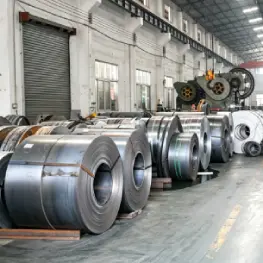
Raw Steel Coil Inbound Testing
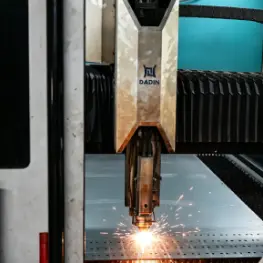
CNC Slitting & Precision Shearing
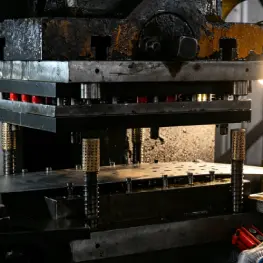
Continuous Drop-Hole Punching
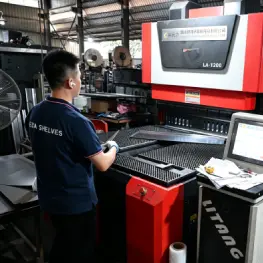
Progressive Cold Roll-Forming
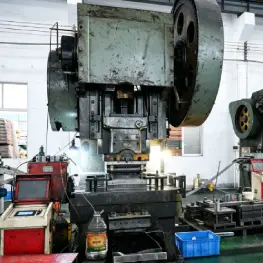
Flying-Saw Cut & Calibrating
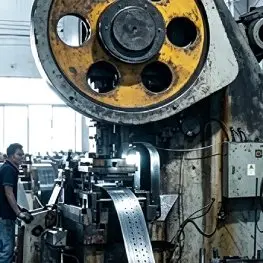
Surface Deburring & Polishing
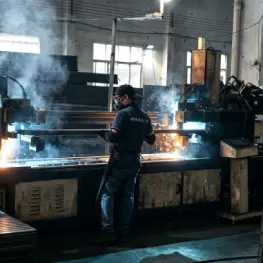
Automated Robotic Seam Welding
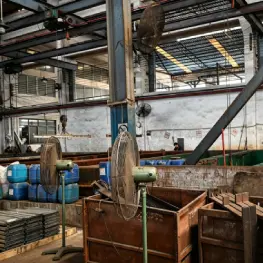
Pickling, Degreasing & Phosphating
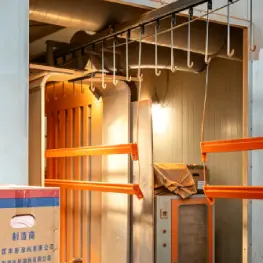
Electrostatic Powder Coating
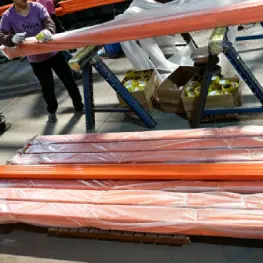
CMM Tolerance Check & Packing
Surface Pretreatment Superiority: Why Our Coatings Do Not Flake
Unlike basic factories that apply powder over oily or flash-rusted steel, every HEDA component undergoes full immersion pickling, degreasing, neutral water rinse, and hot zinc-phosphating. This chemical conversion process micro-etches the steel crystal substrate to establish an interlocking mechanical bond with electrostatic thermosetting powder cured at 180°C to 200°C.
Future Procurement Trends & Technological Evolutions
Supply chain disruption, astronomical warehouse land costs in metropolitan centers, and escalating labor costs are shifting procurement requirements across Europe, the Americas, the Middle East, and Asia-Pacific. Engineering specifications are shifting rapidly toward six pivotal trends:
1. Automation-Ready Racking Tolerances
Manual forklift operations accept dimensional tolerances of ±3mm. However, deployment of Autonomous Mobile Robots (AMRs), AGVs, and Automated Storage/Retrieval Systems (AS/RS) demands structural tolerances under ±0.8mm over 20-meter vertical spans. Global buyers now contract OEM factories equipped with continuous laser-guided punching and robotic welding to prevent sensor guide faults.
2. Sub-Zero Cold-Chain Metallurgy
Booming biologics, vaccines, and frozen food logistics have surged cold-room construction (-25°C to -35°C). Standard structural steel undergoes brittle transition at low temperatures, causing sudden cleavage fractures under dynamic shock loads. Modern OEM procurement mandates modified low-silicon manganese steels or duplex pre-galvanized finishes that retain high Charpy V-notch impact toughness without zinc flaking.
3. Seismic Performance Simulation (FEA)
Earthquake-prone regions across the Pacific Rim, Southeast Asia, and the Mediterranean enforce strict dynamic load building regulations. Procurement tenders now require dynamic Finite Element Analysis (FEA) evaluating P-Delta second-order moments, column torsion, baseplate chemical anchor shear forces, and floor anchor embedment depths before structural fabrication commences.
4. Green Steel & Eco-Compliant Coatings
Corporate ESG guidelines and European Carbon Border Adjustment Mechanism (CBAM) mandates are transforming tender specifications. Tier-1 buyers require Scope 1 and 2 emissions documentation from steel suppliers, non-heavy-metal zirconium chemical pretreatment over toxic chromates, and 100% TGIC-free thermoset powder coatings certified RoHS compliant.
5. Hybrid Mezzanine & High-Density Racking
With industrial ground rent hitting all-time highs in urban hubs like Singapore, Dubai, Rotterdam, and Los Angeles, warehouse operators are abandoning single-level layouts. Multi-tier rack-supported mezzanines (2 to 4 tiers) integrated with carton flow and overhead belt sorters allow simultaneous ground pallet buffering and high-velocity upper-level split-case e-commerce picking.
6. OEM Standard Modular Interchangeability
Regional racking distributors and material handling contractors increasingly demand OEM interchangeability. Rather than locking end-users into proprietary profiles, contract factories produce 50mm, 75mm, and 76.2mm (3-inch teardrop) pitch patterns matching standard European, Australian, and North American cross-sections, allowing effortless bay extensions.
Frequently Asked Technical & Commercial Questions
Definitive engineering answers to assist supply chain managers, warehouse directors, and industrial contractors in evaluating OEM/ODM manufacturing partnerships.
1. What primary parameters are required to calculate structural load ratings and layout designs?
To produce precision 2D CAD architectural plans, 3D spatial models, and structural calculation reports, our engineering team requires:
• Architectural DWG Floor Plan: Exact building perimeter dimensions, clear internal eaves height, building column grids, dock door locations, and fire exit clear paths.
• Slab Capacity: Concrete compressive strength (typically 25 to 35 MPa), slab thickness, reinforcement mesh layout, and maximum permitted point floor loading (kN/m²).
• Pallet Load Profiles: Pallet dimensions (Length × Width × Height inclusive of cargo overhang), maximum gross pallet weight, and deflection-sensitive cargo details.
• Forklift / MHE Data: Lift truck type (Counterbalance, Reach truck, VNA turret, Stacker), mast collapsed and maximum lift heights, outer turning radius, and minimum required operating aisle width (AST).
2. How does HEDA Shelves engineer racking systems for high-risk seismic zones?
For installations situated in seismically active geographic regions—such as Indonesia, the Philippines, Japan, New Zealand, or Chile—our structural engineers run full spectral modal dynamic analysis following Eurocode 8 (EN 1998) or IBC/RMI criteria.
Engineering modifications typically include: widening column profiles to thicker gauges (e.g., 2.5mm or 3.0mm Q355B high-tensile steel), integrating continuous welded back-to-back portal ties across double racks, designing heavy-duty oversized ductile baseplates, specifying mechanical wedge anchors or chemical epoxy capsules with high embedment depth, and reinforcing longitudinal horizontal and vertical cross-bracing bays.
3. What is the difference between Hot-Dip Galvanizing and Electrostatic Powder Coating?
Electrostatic Powder Coating (Epoxy-Polyester): Standard for temperature-controlled indoor dry warehouses. Provides smooth aesthetics, custom corporate RAL colors, and excellent impact resistance against minor scratches. Application thickness ranges from 60 to 90 microns.
Hot-Dip Galvanizing (HDG per ISO 1461 / ASTM A123): Essential for outdoor storage yards, coastal warehouses exposed to salt-laden airborne chloride mist, chemical fertilizer storage, and harsh sub-zero cold stores prone to condensation. Components are submerged in molten zinc at 450°C, forming a metallurgically bonded iron-zinc alloy layer 70 to 100+ microns thick, delivering cathodic sacrificial protection lasting 25 to 50+ years.
4. What quality control documents and test reports are provided with factory shipments?
Every commercial production batch is accompanied by an exhaustive Quality Dossier containing:
1. Mill Test Certificates (MTC) proving mechanical tensile strength, yield limits, and chemical heat analysis of all raw carbon steel coils.
2. Pre-treatment chemical bath titration logs and dry film thickness (DFT) cross-hatch adhesion test results.
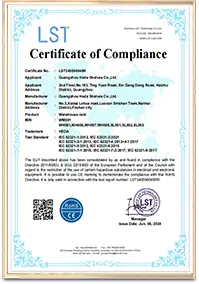
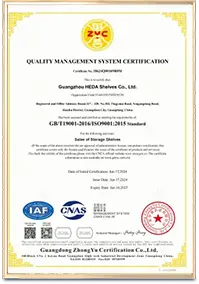
3. Full-bay physical destructive/non-destructive load test reports verifying compliance with CE Standard EN 15512 and ISO 9001:2015 traceability.
4. Export container packing lists with photologs detailing anti-collision bundle banding and container weight distribution optimization.
5. What are the advantages of OEM / ODM contract manufacturing with HEDA Shelves?
Operating a dedicated 30,000 m² factory equipped with multiple automated roll-forming lines, Panasonic robotic welders, and automatic powder-coat tunnels allows us to offer:
• Private Labeling & Custom Branding: Laser-cut logos, specialized corporate color schemes matched to any RAL code, and custom warning/capacity rating load plaques.
• Custom Tooling & Pitch Configuration: Fabrication of custom upright geometries, unique beam step depths, and slot patterns matching legacy systems for seamless distributor inventory expansion.
• Competitive Landed Unit Cost: Direct manufacturer pricing without broker or trading house markup, optimized for full container load (FCL) packing efficiency.
Guangzhou HEDA Shelves: 25 Years of Factory Direct Precision
Founded in 2001 in Guangzhou, China, HEDA Shelves has expanded into an internationally acknowledged manufacturing authority, supplying heavy-duty racking systems to logistics operators, government projects, and distributors across 120+ countries.
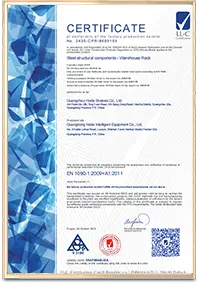 CE Certified Structural Steel
Certificate No. 2435-CPR-8605159
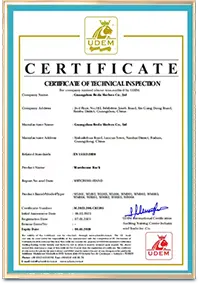 ISO 9001:2015 Registered
Certificate No. 18624Q00169R0M
 RoHS Compliant Coatings
Heavy Metal Free Surface Finish
 Certified Load Test Reports
Third-Party Lab Destruction Verified
Request Free 2D/3D CAD Layouts & Direct Factory Quotes
Send your warehouse architectural drawings or project parameters. Our veteran intralogistics engineering team delivers full structural CAD layout drawings, 3D visual renderings, and complete Bill of Materials (BOM) load calculations within 24 to 48 hours.
- Zero-Cost 3D Layout Modeling
- Full Seismic & Deflection Check
- Direct Factory Pricing (FOB/CIF)
- Global Container Loading Plans
Connect with Project Engineers
Access our comprehensive 2026/2027 industrial storage systems technical catalog and design guide.
Get Catalog