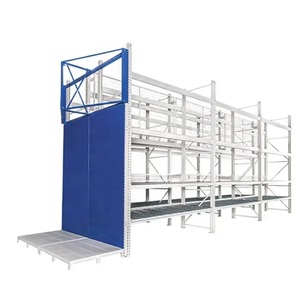
 Cold Chain Storage
Warehouse Industrial Heavy Duty Pallet Refrigerator Storage Rack
- Low-Temp Structural Steel
- Anti-Condensation Coating
- Multi-Tier Pallet Loads
Direct manufacturer supply with precision CNC punching, automated roll-forming profiles, and custom load-tested configurations tailored to international intralogistics standards.
Cold Chain Storage
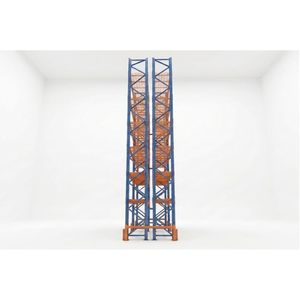 Heavy-Duty Q235
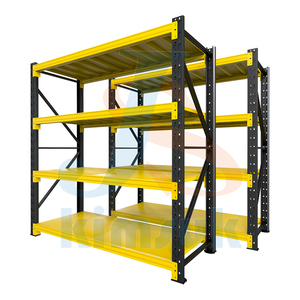 Medium-Duty Shelving
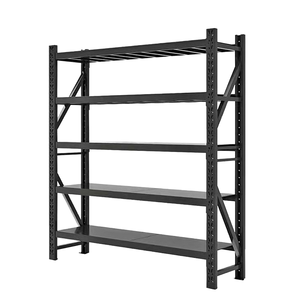 Corrosion Protected
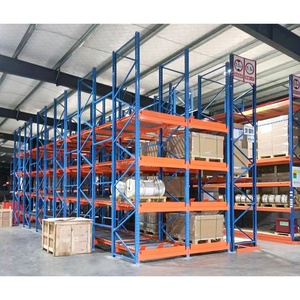 FIFO Live Storage
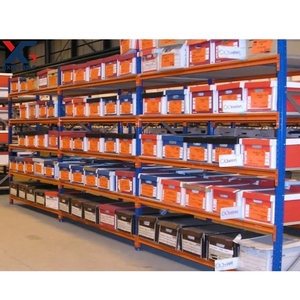 Quick Assembly
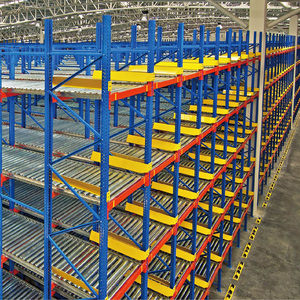 Dynamic Racking
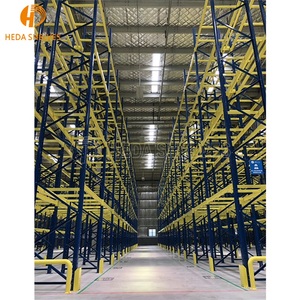 Industrial Shelving
A rigorous comparative framework examining structural footprint, inventory turn rates, forklift clearances, and capital expenditure dynamics for global supply chains.
Modern intralogistics facility planning demands a transition away from standard low-density selective storage toward mathematically verified, volumetric-efficient racking systems. In high-value industrial hubs, distribution center footprint expenses demand a floor space utilization rate exceeding 75%. Selecting the optimal racking geometry requires assessing critical operational metrics: SKU diversity index, throughput velocity, inventory handling conventions (First-In-First-Out vs. Last-In-First-Out), and local seismic hazard classifications.
| System Typology | Space Utilization | SKU Selectivity | Pallet Turnover Rate | Inventory Flow Mode | Structural Load Rating | Typical Application Sector |
|---|---|---|---|---|---|---|
| Selective Pallet Racking | 40% – 45% (Aisle Dependent) | 100% Direct Access | High Velocity (Forklift direct) | FIFO / LIFO Independent | 500 – 4,000 kg / beam tier | General 3PL, FMCG E-commerce, Spare Parts |
| Drive-In / Drive-Through | 65% – 75% High Density | Low (Per Lane Homogeneous) | Moderate (Batch handling) | LIFO (Drive-In) / FIFO (Drive-Thru) | 1,000 – 2,000 kg / pallet slot | Cold Storage Facilities, Beverage Bottling |
| Gravity Flow (Live Pallet) | 70% – 80% Maximum Volumetric | Medium (One SKU Per Lane) | Very High (Automatic roll-up) | Strict FIFO Guaranteed | 800 – 1,500 kg / pallet unit | Pharmaceutical Cold Chain, Fresh Perishables |
| Radio Shuttle Automation | 80% – 85% Deep Lane Ultra-Density | High (Multi-tier semi-automated) | Rapid Automated Traversing | Programmable FIFO / LIFO | 1,000 – 2,500 kg / carrier rail | Mass Distribution Hubs, Controlled Freezers |
| Push-Back Cart Racking | 60% – 70% Deep Storage (2-6 Deep) | Moderate (Per lane variety) | High Handling Efficiency | LIFO (Single aisle staging) | 1,000 – 1,500 kg / nested cart | Buffer Storage, Cross-Docking Staging Areas |
Operating temperature regimes spanning -25°C to -40°C present severe metallurgic challenges, particularly low-temperature embrittlement in structural carbon steel. Standard Q235 cold-rolled sections require precise manganese balancing and specialized alloying chemistry to prevent micro-fissuring under continuous dynamic loads.
Our refrigerated cold storage pallet racks incorporate premium low-stress yield profiles coupled with heavy-duty phosphate pre-treatment and cryogenic-grade thermoset powder coatings. For humid transition anterooms, batch hot-dip galvanizing per ISO 1461 guarantees complete internal tube corrosion suppression.
Gravity flow systems eliminate internal forklift access corridors, utilizing an engineered gradient typically calibrated between 3.0% and 3.5%. Pallets traverse hardened cylindrical steel rollers equipped with internal planetary centrifugal speed controllers.
This setup prevents uncontrolled pallet acceleration while end-lane separation stops isolate the front extraction unit from trailing pallet hydraulic pressure. The result is total FIFO inventory adherence without electrical energy consumption, lowering logistics operational carbon output by up to 28%.
Warehouses in active seismic belts across Indonesia, the Philippines, Japan, and the Pacific Rim require advanced finite element structural modeling (FEA) compliant with FEM 10.2.02, EN 15512, and RMI MH16.1 specifications.
We calibrate column-to-baseplate torsional moment resistance through thickened structural anchor shoe assemblies, high-tensile anchor studs, and closed-box omega cross-section vertical uprights. This engineering integrity protects personnel and prevents progressive collapse events during minor and major seismic tremors.
Technological convergence, automation retrofitting, and environmental lifecycle accountability are reshaping industrial racking capital investments.
Procurement teams are moving away from single-purpose static racks toward modular structural frameworks engineered for automated guided vehicles (AGV), autonomous mobile robots (AMR), and stacker crane integration. Upright column punch tolerances must maintain an accuracy within ±0.5mm over a 12-meter vertical elevation to accommodate optical guidance and laser ranging systems.
Future-proof warehouse racking specifications increasingly demand standardized beam slots compatible with top-running shuttle rails, busbar power conduits, and sensor mounting brackets without requiring field welding or structural re-certification.
Environmental, Social, and Governance (ESG) compliance has shifted from corporate rhetoric to a decisive tender criterion. Multinational logistics firms are demanding certified Environmental Product Declarations (EPD) and verifiable carbon accounting across raw steel supply chains.
Energy-efficient induction roll forming, complete closed-loop powder recovery systems, and toxic chromate-free surface conversions (such as zirconium-based nano-ceramic pretreatment) are replacing legacy chemical baths. These improvements significantly reduce embedded emissions per finished metric ton of steel racking.
The risk of catastrophic warehouse collapses caused by unseen forklift beam strikes is driving rapid adoption of IoT-enabled impact sensor arrays. Modern high-density installations feature real-time wireless accelerometer pods attached to vulnerable corner upright columns.
These structural monitoring devices feed live torsional stress and impact data into the facility's Building Management System (BMS) or warehouse digital twin, enabling predictive maintenance and prompt replacement of compromised structural components before critical shear failure can occur.
Integrated manufacturing capabilities, rigorous metallurgical verification, and global supply chain logistics delivered directly from our South China manufacturing base.
Operating across our 30,000 m² production complex, our team of over 300 experienced engineers and manufacturing specialists manages every fabrication phase in-house. From raw structural strip uncoiling, high-precision hydraulic punch stamping, continuous roll forming, robotic welding, to automatic electrostatic powder coating, we maintain complete operational oversight under one roof.
Eliminating third-party subcontracting ensures strict cross-sectional dimensional stability, reliable hole pitch alignment (±0.1mm tolerance), and consistent protective paint thickness (60 to 90 microns) across multi-container shipments.
HEDA Shelves products are verified under global certification standards, including CE certification (No. 2435-CPR-8605159), ISO 9001:2015 Quality Management Systems (No. 18624Q00169R0M), and environmental RoHS-compliant surface coatings.
Every custom production batch undergoes rigorous quality assurance protocols: incoming steel tensile testing (verifying yield strengths of ≥235 MPa for Q235B and ≥355 MPa for Q355B), automated ultrasonic weld seam inspection, cross-hatch paint adhesion checks, and simulated destructive load testing to confirm safety factors exceeding 1.5.
We supply specialized international distributors, warehouse integrators, and engineering contractors worldwide. Our experienced design office provides complementary 2D AutoCAD equipment layouts, 3D parametric visualizations, and structural load calculations within 24 to 48 hours of initial project scoping.
With customized beam profiling, custom RAL color formulations, bespoke branding embossments, and ocean-freight container packing designed to prevent maritime transit friction, we serve as an agile manufacturing partner for warehouse installations globally.
Direct engineering and commercial answers to simplify your project planning, structural verification, and international procurement processes.
Connect directly with our Guangzhou factory engineering team. Request a detailed 2D/3D CAD equipment layout, structural load verification, and competitive factory-direct pricing for your project.