Featured Industrial Racking & Prefabricated Systems
Precision roll-formed, robotic-welded, and electrostatically coated warehouse racking configurations engineered for global distribution hubs, third-party logistics (3PL), and manufacturing supply chains.
Engineering Principles & Metallurgy of Racked Warehouse Procurement
Navigating structural integrity, raw coil sourcing, yield strength dynamics, and life-cycle economics when contracting China wholesale racking manufacturers.
In modern industrial supply chain architecture, modern industrial warehousing has decisively evolved from static ground-level storage into vertically consolidated, dynamic intralogistics engines. For global logistics infrastructure directors, procurement engineers, and general contractors sourcing direct from China wholesale racking factories, the primary metric of structural qualification goes far beyond raw price per kilogram. Sourcing structural steel storage racks involves navigating rigorous structural engineering principles, structural load elasticity, and adherence to international engineering frameworks including FEM 10.2.02 (European Federation of Materials Handling), ANSI MH16.1 (Rack Manufacturers Institute - RMI), and AS 4084-2012 (Australian Standard for Steel Storage Racking).
A precision-engineered racked warehouse functions as a static load-bearing structure subjected to profound dynamic stress: recurrent material handling equipment (MHE) impact cycles, non-uniform pallet positioning, continuous seismic harmonics, and thermal deflection shifts in temperature-controlled cold chains. Sourcing factory-direct from certified manufacturers like Guangzhou Heda Shelves Co., Ltd. (HEDA Shelves) provides direct transparency into structural cold-forming processes, steel coil metallurgical provenance, and automated electrostatic powder coating adhesion metrics that define a 20-year structural lifespan.
Metallurgical Foundations: Q235B vs. Q355B Hot-Rolled & Cold-Formed Steel
The foundational integrity of any racking structure resides in the parent coil grade. HEDA Shelves utilizes certified Q235B and Q355B structural carbon steel procured exclusively from first-tier domestic mills including Baosteel and Shougang. Under tensile load testing, Q235B exhibits a guaranteed yield point of $\sigma_s \ge 235 \text{ MPa}$ with an ultimate tensile strength between $370 - 500 \text{ MPa}$ and elongation $\delta_5 \ge 26\%$, offering superior ductility that absorbs operational shock loadings without brittle fracture propagation. For high-bay rack systems exceeding 12 meters or heavy-duty cantilever columns handling multi-ton structural loads, high-strength Q355B ($\sigma_s \ge 355 \text{ MPa}$) provides the requisite load resistance while trimming dead weight, mitigating ground-slab settlement stresses.
The roll-forming profile design of the upright is paramount. Rather than simplistic channel bends, HEDA utilizes continuous 14 to 18-stage cold-roll-forming lines to engineer complex multidirectional Omega (Ω) cross-sections with intermediate stiffening ribs along the web and flanges. This sophisticated geometric cross-section counters torsional buckling and Euler column lateral deflection under axial compression, achieving safety factor coefficients exceeding 1.65 under maximum working capacity load ratings.
Industrial Warehouse Racking Systems: Architecture & Performance Metrics
Engineering parameters, floor-space volumetric density, aisle requirements, and operational dynamics across major racked warehouse topologies.
| Racking Topology | Aisle Clear Width (MHE) | Storage Density Factor | Pallet Selectivity | Structural Load Rating | Target Operational Dynamic |
|---|---|---|---|---|---|
| Selective Pallet Racking | 3,000mm – 3,500mm (Counterbalance) | 40% – 50% (Volumetric) | 100% Direct Access | 1,000 – 4,500 kg / beam level | High SKU proliferation, fast FMCG rotation |
| Double Deep Pallet Racking | 3,100mm – 3,400mm (Deep-reach pantograph) | 60% – 65% (Volumetric) | 50% Immediate Access | 1,000 – 3,200 kg / beam level | Consolidated multi-pallet batches, cold rooms |
| Drive-In / Drive-Thru Racking | Eliminates picking aisles (Internal truck lane) | 75% – 85% (High Density) | FILO / Strict Batch LIFO | 1,000 – 2,000 kg / pallet slot | Homogeneous bulk stock, cold blast freezing |
| Radio Shuttle Automation | Central staging lane (Semi-automated car) | 85% – 92% (Ultra-High Density) | Automated FIFO / LIFO options | 500 – 1,800 kg / runner lane | Industrial food, pharma, automated cold chain |
| Heavy Duty Cantilever System | 3,200mm – 4,500mm (Sideloader / Multi-directional) | Linear length dependent | 100% per horizontal tier | 500 – 3,000 kg / arm point | Pipes, aluminum extrusions, timber, steel plate |
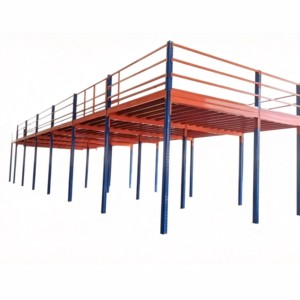
| Rack-Supported Mezzanine Floor | Custom pedestrian + AGV transit paths | 200% – 400% (Vertical Multi-Tier) | Complete multi-level sorting | 300 – 1,000 kg / m² deck load | E-commerce fulfillment centers, automotive spares |
Future Procurement Trends in Industrial Warehouse Racking (2026–2035)
Macro shifts impacting international procurement strategies: warehouse automation interfaces, cold-chain energy optimization, and circular steel traceability.
Semi-Automated Shuttle Densification & AGV/AMR Interface Compatibility
Sub-Zero Cryogenic Coating Resilience & Galvanized Thermal Resistance
Carbon Boundary Adjustment (CBAM) Compliance & Structural Modular Reusability
Total Cost of Ownership (TCO) in Wholesale Racking Procurement
A strategic breakdown of procurement costs: dissecting raw material volatility, precision fabrication tolerances, container cube optimization, and installation risk mitigation.
A frequent error made by overseas buyers when sourcing industrial storage racks from China is evaluating commercial quotations solely on raw metric tonnage or ex-works unit cost. In complex capital infrastructure projects, ex-works fabrication constitutes only 55% to 65% of the operational Total Cost of Ownership (TCO). Incompetently packaged shipments that waste container volume, excessive profile dimensional deviations that delay field installation, or deficient pre-treatment that induces premature corrosion can rapidly eradicate initial factory purchase savings.
1. Steel Index & Thickness Integrity
Sub-tier suppliers often undercut quotes by offering negative thickness tolerances (−0.2mm to −0.3mm below nominal coil thickness). A reduction from 2.0mm to 1.8mm upright wall thickness reduces load-bearing safety limits by over 18%. Certified procurement specifies mill test certificates (MTCs) and ultrasonic thickness verification prior to slitting.
2. Container Volumetric Packing Ratio
Structural steel components can be bulky. Unoptimized bundling leads to dead air space, forcing international ocean freight bills upward. HEDA's engineering department develops 3D container nested pack-schemes using specialized dunnage, high-tensile steel strapping, and profile nesting that achieves over 95% 40HQ cube-fill efficiency, drastically lowering per-pallet ocean freight costs.
3. Field Erection & Connector Fit
Beam connector brackets must mate precisely into upright column teardrop or diamond perforations. Stamping dies worn past allowable tolerances produce misaligned beam claws, necessitating manual site grinding or mallet forcing that escalates overseas local installation labor costs. High-precision CNC tooling guarantees drop-in snap-fit locking with zero play.
4. Surface Pretreatment Longevity
Electrostatic powder coating without rigorous multi-stage chemical pretreatment will flake within 24 to 36 months under standard warehouse humidity. Sourcing from factories with automated 5-stage pickling, iron/zinc phosphating, and deionized water rinsing lines provides exceptional salt-spray test endurance (>500 hours ASTM B117), preserving client assets long-term.
Guangzhou HEDA Shelves: State-of-the-Art Manufacturing Base
Founded in 2001, Guangzhou Heda Shelves Co., Ltd. represents South China's benchmark in high-capacity pallet racking, automated mezzanine platforms, and bespoke storage solutions.
30,000 m² Integrated Campus
Spanning raw material coil bays, automated longitudinal slitting, continuous roll-forming workshops, robotic welding cells, and continuous powder coating tunnels, our facility in Guangzhou executes end-to-end quality control under a single corporate roof.
Free 24-48h CAD & 3D Modeling
Our engineering department of 30+ licensed structural draughtsmen prepares comprehensive warehouse spatial layouts, forklift turning radius simulations, dynamic load charts, and photorealistic 3D renders within 24 to 48 hours from receipt of building blueprints.
CE & ISO 9001:2015 Accredited
We hold CE Certification (No. 2435-CPR-8605159) for structural steel conformity, rigorous ISO 9001:2015 quality management accreditation (Certificate No. 18624Q00169R0M), and full RoHS compliant certification for environmentally safe powder coat resins.
Global Engineering Delivery
With over 10,000 projects completed across Southeast Asia (Thailand, Indonesia, Philippines, Vietnam, Malaysia), the Middle East (UAE, Saudi Arabia, Qatar), and the Americas, our multi-lingual project engineering team provides overseas installation supervision.
10-Step Industrial Production & Quality Control Workflow
Every beam, upright column, and structural bracing element passes through our documented fabrication methodology to ensure dimensional accuracy and structural compliance.
Raw Steel Inspection
Spectrometric verification of Q235B/Q355B coils.
Precision Slitting
Automated coil edge trimming and strip shearing.
CNC Web Punching
High-speed mechanical punching for 50/75mm pitches.
Multi-Roll Bending
Progressive cold-forming of Omega profile uprights.
Beam Roll-Forming
Interlocking box beam and step beam profile extrusion.
Robotic Welding
CO2 shielded automated connector-to-beam joining.
Chemical Pickling
Multi-tank acid immersion to eradicate scale and oxides.
Phosphatizing
Micro-crystalline phosphate conversion coating.
Powder Coating
Automated electrostatic spray with 200°C curing oven.
QA & Dunnage Pack
Coating thickness testing, palletizing & container loading.
Frequently Asked Technical & Procurement Inquiries
Direct answers addressing technical specifications, seismic zoning, installation verifications, and overseas trade terms for racked warehouse procurement.
1. What engineering parameters are mandatory to generate a certified warehouse racking layout?
2. How does HEDA Shelves design and certify racking for active seismic zones (e.g., Philippines, Japan, Indonesia, Western USA)?
3. What are the maximum allowable deflection limits for pallet racking beams under full load?
4. What quality controls verify powder coating adhesion and rust prevention in tropical or humid climates?
5. What is the difference between roll-formed steel and structural steel racking systems, and when should each be specified?
6. How does factory-direct procurement from Guangzhou Heda Shelves save costs compared to regional distributors?
7. What safety accessories are recommended to prevent rack collapse and ensure OSHA/HSE compliance?
8. What international trade terms (Incoterms) and payment structures does HEDA offer for bulk projects?
9. How does HEDA support remote installation and project commissioning across overseas facilities?
10. Can existing warehouse racking systems be extended, altered, or retrofitted with HEDA components?
Accelerate Your Racked Warehouse Project Today
Collaborate directly with our licensed structural engineers. Provide your facility parameters to receive a complimentary 2D CAD spatial layout, structural load analysis, and firm container-direct price quotation within 24 to 48 hours.
- Complimentary 2D CAD & 3D Modeling
- Seismic Load & Deflection Reports
- ISO 9001 & CE Certified Factory Direct
- Optimized 40HQ Container Load Schemes
Request Factory Project Support
Connect immediately with our Guangzhou senior engineering desk to review technical specs or submit your warehouse floor plan.
Send an Inquiry