Featured Industrial Gravity Flow & Dynamic Racking Systems
Explore our heavy-duty carton flow and pallet gravity roll tracks, precision-formed from Q235B/Q355B high-tensile structural steel for seamless fulfillment and cold-chain resilience.
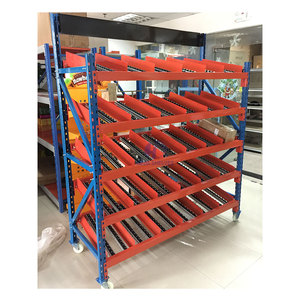
Customized Warehouse Pallet & Carton Flow Racking
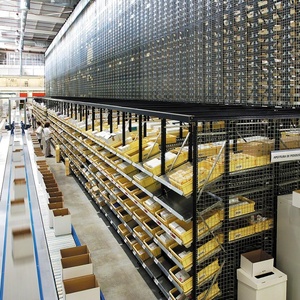
5-Layer Adjustable Carton Gravity Flow Rack
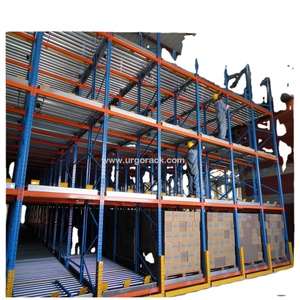
Gravity Flow Roller Order Picking Racking System
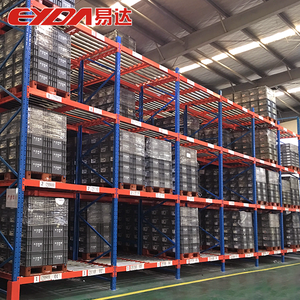
5-Layer Industrial Pallet Flow Storage Racking
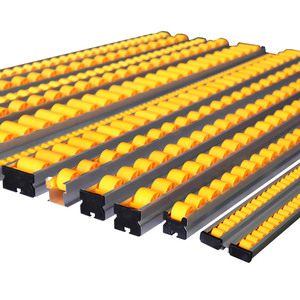
Gravity Flow Rail Roller Track (200kg Load)
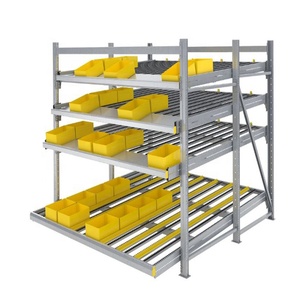
Customized FIFO Roller Dynamic Carton Flow Rack
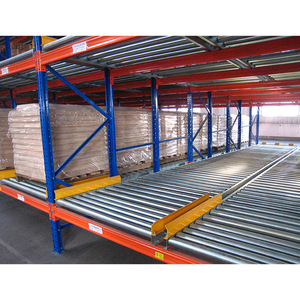
High-Efficiency Deep-Lane Gravity Pallet Flow Rack
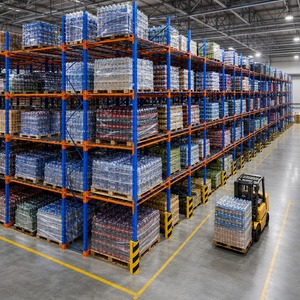
Q235B Steel Pallet Flow Racking for Chemical Plants
Physics & Structural Mechanics of Gravity Flow Racks
Understanding incline geometry, dynamic friction coefficients, and mechanical kinetic regulation in industrial first-in, first-out (FIFO) storage.
Incline Gradient Calibration
Gravity flow systems rely on an exacting incline equilibrium, typically engineered between 2.5% and 4.0% (1.5° to 2.3°). Too low a grade results in kinetic stall and hang-ups; too steep a grade produces runaway momentum that overpowers pallet stops. At HEDA Shelves, we analyze pallet runner deformation, surface deflection, and static friction ($\mu_s$) against dynamic rolling resistance ($\mu_r$) to guarantee uniform rolling velocity below 0.3 m/s.
Centrifugal Brake Controller Rollers
For deep-lane systems extending 4 to 20 pallets deep, uncontrolled terminal speed poses safety risks to personnel and racking structure. We integrate centrifugal speed controllers (magnetic eddy-current or friction clutch) staggered at exact intervals along the rail. These internal gears engage automatically when rotational speed exceeds pre-set limits, damping velocity and maintaining safe, consistent descent without electrical wiring.
Pallet Separation Mechanisms
Line pressure in deep gravity lanes creates dangerous back-pressure on the discharge face. A 10-pallet lane with 1,000 kg pallets produces up to 9,000 kg of static force pushing against the extraction position. HEDA implements mechanical separator lockouts that isolate the first pallet from the trailing queue. When a forklift extracts the lead pallet, the trigger disengages, advancing the secondary queue safely one position forward.
| System Classification | Typical Incline Range | Load Limit (Per Lane) | Roller Track Construction | Target Handling Medium |
|---|---|---|---|---|
| Carton Flow (Split-Case) | 3.0% – 4.5% | 30 – 120 kg / linear meter | Virgin PE / ABS dual-flanged wheels on steel tracks | Totes, plastic bins, corrugated shipping cartons |
| Lineside Gravity Roller | 2.0% – 3.5% | 150 – 400 kg / layer level | Continuous galvanized steel rollers with ball bearings | Sub-assembly kits, manufacturing Kanban totes |
| Standard Pallet Flow (FIFO) | 2.8% – 3.5% | 500 – 1,500 kg / pallet slot | 3-track triple roller beds with centrifugal dampers | Euro (1200x800), ISO (1200x1000), GMA pallets |
| Chemical / Heavy Duty Flow | 2.5% – 3.0% | 1,200 – 2,500 kg / pallet position | Heavy-wall zinc-plated carbon steel with entry guides | Liquid IBC containers, chemical steel drums, metal crates |
Future Procurement Trends in Warehouse Flow Systems
Macroeconomic pressures, real-estate costs, and warehouse automation are fundamentally shifting how logistics operators specify flow systems.
Escalating Cold-Chain Densification
With refrigeration energy rates climbing over 22% globally, cold-room square footage represents the highest-cost cubic space in logistics. Procurement directors are systematically shifting from static selective racking to deep-lane dynamic flow racks. By eliminating aisles, chilled cubic footprints contract by up to 60%, drastically slashing compressor energy loads and thermal dissipation costs.
Hybrid AGV & AMR Integration
Modern flow rack procurement now prioritizes automated guided vehicles (AGVs) and autonomous mobile robots (AMRs). Front discharge stops and loading aprons are equipped with photoelectric bracket notches, precision centering funnels, and optical target markers so robotic lift equipment can drop and pick pallets without human operators.
Low-Carbon Q235B Sourcing & ESG
International enterprise tenders require verified carbon accounting across racking lifecycle frameworks. HEDA's manufacturing operations utilize continuous closed-loop coils of domestic prime high-tensile steel, paired with zero-VOC epoxy electrostatic powders that eliminate volatile solvents and satisfy stringent European RoHS, REACH, and LEED standards.
Modular Lineside Flexibility (Kanban)
E-commerce SKU churn and flexible lean manufacturing require shelving reconfigurability. Buyers increasingly demand boltless roller-bed drops that allow lineside carton flow tracks to be adjusted in 50mm increments by on-site technicians without specialized tooling or welding, adapting warehouse bays within hours.
Technological Advancements in Dynamic Racking Mechanics
The convergence of advanced materials science, dampening physics, and structural design in modern warehouse racking.
Cryogenic Low-Temp Bearing Polymers
Standard industrial skate wheels and zinc bearings seize under negative temperature cycling due to moisture condensation and grease thickening. HEDA engineers dynamic flow tracks with specialty silicone-impregnated polyamide bearings functional down to -35°C (-31°F), enabling frictionless gravity travel in blast freezers without lubrication breakdown or roller flat-spotting.
Contactless Eddy-Current Speed Braking
Traditional mechanical friction brake rollers degrade over time due to continuous shoe wear and rubber heat buildup. Next-generation gravity flow lanes leverage permanent neodymium magnets configured inside aluminum roller housings. As speed escalates, magnetic eddy currents produce opposing counter-torque, guaranteeing completely wear-free, zero-maintenance speed regulation indefinitely.
Integrated Smart IoT Lane Monitoring
Logistics 4.0 is converging on the physical rack face. By deploying autonomous wireless strain gauges and micro-switch roller sensors along flow lanes, operations management gains real-time FIFO compliance telemetry, live stock depletion alerts, buffer capacity visualization, and predictive maintenance diagnostics without requiring manual visual inspection audits.
Guangzhou HEDA Shelves: 25 Years of Engineering Prowess
Headquartered in Guangzhou since 2001, Guangzhou Heda Shelves Co., Ltd. operates as a vertically integrated tier-one warehouse storage equipment manufacturer.
30,000 m² Production Base
Our facility in Guangzhou hosts 8 automated roll-forming lines, computerized multi-station punching presses, robotic CO2 shielded welding bays, and continuous phosphating wash tunnels capable of generating over 30,000 metric tons of steel racking annually.
Verified Global Certifications
Every racking upright, load beam, and roller assembly is certified under strict international testing benchmarks, holding CE Certificate No. 2435-CPR-8605159 and ISO 9001:2015 Certificate No. 18624Q00169R0M for load performance, structural safety, and coating durability.
Global Turnkey Execution
With successful projects across 120+ countries—spanning Southeast Asia, the Middle East, the Americas, and Europe—we provide end-to-end support including free 2D/3D CAD layouts within 24 hours, sea container packaging math, and certified bilingual field engineering supervisors.
10-Stage Precision In-House Quality Control Workflow
Spectro Analysis
Incoming steel coil yield and chemical composition testing (Q235B/Q355B).
Slitting & Uncoiling
High-speed CNC slitting lines maintain slit tolerance within ±0.05mm.
Upright Punching
Continuous pitch automated presses ensure pitch accuracy across full upright lengths.
Roll Forming
22-station precision cold-roll mills form Omega profiles without residual stresses.
Robotic Welding
Dual-torch robotic CO2 shielded welding guarantees deep penetration on all beam connectors.
Surface Pickling
Multi-tank chemical degreasing and acid pickling completely remove mill scale and oxidation.
Phosphating Wash
Zinc-phosphate chemical bath seals steel pores, priming surfaces for powder adhesion.
Electrostatic Coat
Automated reciprocal guns spray epoxy powders at 60–80μm uniform dry film thickness.
200°C Curing Oven
Tunnel thermal curing polymerization creates scratch-resistant, impact-absorbing finishes.
Load Test & Packing
Hydro-mechanical deflection testing, protective corrugated wrapping, and palletization.
Flow Racks Procurement & Engineering FAQ
Detailed engineering answers to the most common questions raised by procurement managers, warehouse contractors, and system integrators.
How do we calculate the exact incline gradient for different pallet types? +
The standard incline calculation relies on identifying the exact friction coefficient of the load surface. For brand-new wooden GMA or Euro pallets running on steel rollers, an incline angle of 3.0% (approximately 1.72 degrees) provides an optimal balance between self-starting gravity flow and controlled descent.
Plastic pallets require extra attention: smooth plastic runners exhibit lower friction coefficients but suffer greater mid-span deflection under full static payload. If bottom runners sag by more than 5mm between roller axles, the pallet will stall in the lane. We recommend a 3.2% to 3.5% incline for plastic skids, paired with tighter roller center pitches (typically 75mm or 100mm center-to-center instead of 150mm).
What are the critical pallet bottom criteria required to prevent gravity flow stalls? +
Unlike selective rack systems where pallets bridge across two static structural beams, gravity flow requires continuous uniform contact across a multi-roller bed. The three non-negotiable criteria are:
1. Longitudinal Runner Direction: The bottom boards/skids must run parallel to the direction of gravity travel, never perpendicular.
2. Structural Integrity: Broken, splintered, warped, or cracked bottom boards will catch between roller gaps and stop the lane. In applications with variable pallet qualities, continuous three-track or full-width roller layouts are specified over skate wheels.
3. Runner Width: Standard bottom runners should measure at least 90mm in width to ensure continuous bearing contact across multiple roller wheels simultaneously.
How does HEDA prevent pallet back-pressure and crushing in deep-lane systems? +
In lanes accommodating 5 to 20 pallets deep, the cumulative weight of trailing pallets exerts tremendous forward pressure on the front discharge pallet. To prevent damage to cartons, product crushing, or dangerous pallet ejection during extraction, HEDA integrates a heavy-duty mechanical Pallet Separator Valve.
This floor-mounted structural trip lever holds all trailing pallets approximately 400mm behind the front extraction slot. The front pallet rests isolated at the discharge stop with zero back-pressure, allowing the forklift operator to pick the pallet cleanly and safely. Once the front pallet is removed, the separator release resets and advances the queue by one position.
What in-rack fire sprinkler accommodations (NFPA 13 / EN 12845) are needed? +
Because gravity flow pallet lanes form solid high-density blocks without transverse flue spaces, international fire codes (such as NFPA 13 in North America or EN 12845 in Europe) require specific engineering provisions. Racks over 25 feet (7.6m) high generally require in-rack sprinkler pipework.
HEDA's upright frames are pre-punched with internal vertical clearance runs to integrate horizontal sprinkler feeder pipes directly behind the structural uprights, protected from forklift and rolling pallet impact. Additionally, dedicated 150mm longitudinal flue spaces can be engineered between double-lane blocks to satisfy local building inspector guidelines.
How do you guarantee corrosion protection in humid Southeast Asian and Gulf climates? +
High humidity, coastal salinity, and tropical monsoon cycles in markets like Vietnam, Indonesia, Malaysia, and Saudi Arabia accelerate standard steel oxidation. HEDA resolves this through a comprehensive two-stage anti-corrosion process:
First, components undergo a continuous multi-stage chemical pretreatment that removes grease, picks off all scale, and applies a heavy zinc-phosphate micro-crystal conversion coating. Second, we electrostatically apply automotive-grade outdoor thermoset polyester powder coating cured at 200°C, producing a non-porous 70–80 μm shield that withstands 500+ hours of continuous salt-spray testing. For cold rooms or open marine platforms, Hot-Dip Galvanizing (HDG) to ASTM A123 standards is provided upon specification.
What is the typical lifespan and maintenance schedule for brake and speed controllers? +
HEDA's centrifugal brake rollers feature sealed, self-lubricating internal gears engineered for a rated operational life exceeding 8 to 10 years under standard two-shift warehouse cycles. Because the internal mechanism is completely sealed against dirt, dust, and cardboard fiber ingress, daily maintenance is zero.
We recommend a visual inspection every 6 months to ensure no stretch wrap or banding straps have wound around the roller shafts, along with a quick test run to verify smooth speed damping across all active lanes.
Get a Free 2D/3D Warehouse Flow Rack Layout in 24 Hours
Send us your warehouse dimensions, pallet specifications, and daily throughput requirements. Our senior engineering team in Guangzhou will deliver complete AutoCAD floor plans, 3D renderings, and certified static load calculations within 24 to 48 hours.