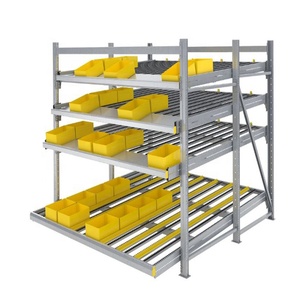
 Dynamic Flow
Customized FIFO Roller Racking Dynamic Storage Rack Carton Flow Rack For 2024 Promotion
- Strict FIFO First-In First-Out Rotation
- High-durability aluminium roller tracks
- Ideal for split-case fulfillment & lineside
Continuous cold-rolled Q235B/Q355B structural steel profiles, customized load matrices, and high-cube configurations engineered directly for high-volume 3PL distribution and intelligent cold storage.
Dynamic Flow
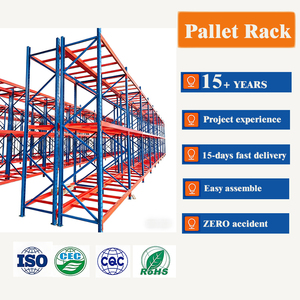 Top Industrial Seller
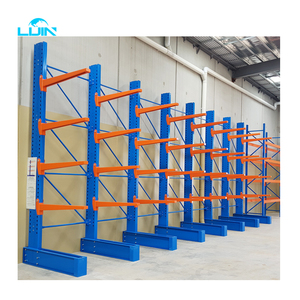 Heavy Profile
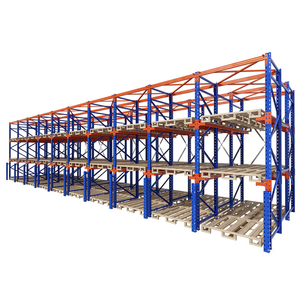 High Density
 Smart Fulfillment
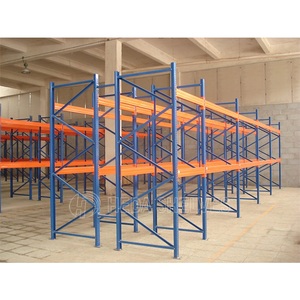 Euro Standard
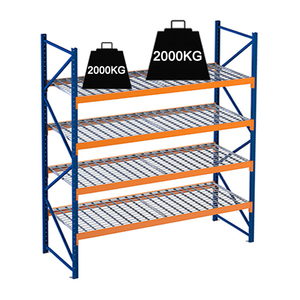 Modular Stacking
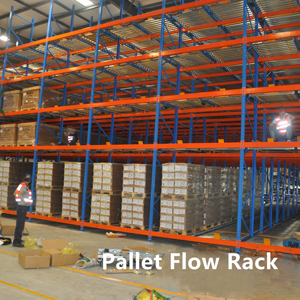 Gravity Feed
Founded in 2001, Guangzhou Heda Shelves Co., Ltd. operates a 30,000 m² modernized plant equipped with automated roll-forming lines, 12-stage chemical surface conversion tunnels, and precision laser punching units delivering turnkey warehouse structures globally.
Complimentary 2D CAD layout design, 3D structural rendering, and warehouse volumetric simulations generated within 24 to 48 hours for precise pallet allocation.
Upright profiles and baseplates calculated against dynamic seismic coefficients (UBC Zone 4, EN 16681) for seismic zones across Southeast Asia, Japan, and the Middle East.
Industrial pickling and phosphating pre-treatment followed by thermoset electrostatic polyester powder coating, exceeding 500-hour neutral salt spray (ASTM B117) standards.
Direct logistics dispatch from Nansha and Huangpu ports ensures minimized sea transit times, full container load optimization, and reduced freight costs across 120+ export territories.
Standardized manufacturing procedures governed by CE (No. 2435-CPR-8605159) and ISO 9001:2015 quality standards.
Spectrometric assay & tensile verification of raw Q235B/Q355B coils.
Automated uncoiling and laser width shearing with ±0.1mm tolerance.
Synchronous high-speed progressive punching of 50mm/75mm pitches.
Multi-stand continuous precision roller passes to form omega uprights.
Shielded gas automated seam welding of double-C beam interlocking flanges.
Mechanical scale removal and surface conditioning for coating bonding.
Immersion degreasing and rust neutralization tanks to clean steel pore structure.
Dense microcrystalline conversion film applied for lifetime anti-corrosion.
Automated powder spray cure at 180°C–200°C for durable non-peeling finish.
Custom container dunnage and strap strapping ensuring scratch-free ocean transit.
When storage heights exceed 12 meters—reaching up to 30 meters in VNA and clad-rack configurations—engineering tolerances shift dramatically from static gravity loads to second-order global stability and P-Delta moments.
Tall racking frames experience substantial horizontal displacement caused by mast accelerations, eccentric pallet loading, and wind/seismic actions. Our structural engineers design according to FEM 10.2.02 and EN 15512 limit states, verifying that elastic sway drift remains below H/500 to prevent structural buckling under extreme dynamic stresses.
Narrow aisle systems exceeding 14 meters require strict adherence to DIN 18202 Table 3 Group 4 / TR34 DM2 concrete surface profiles. Tall upright baseplates are engineered with oversized footprint flanges (up to 300x250x16mm) paired with heavy-duty chemical drop-in anchors to dissipate concentrated point loads exceeding 250 kN into the slab.
We utilize high-yield Q355B and Q460 structural steel coils with minimum yield strengths exceeding 355–460 MPa. The micro-alloyed carbon profile minimizes self-weight while elevating torsional rigidity across deep multi-tier framework columns.
| Storage Architecture | Typical Height Window | Volumetric Aisle Utilization | Forklift / MHE Profile | Seismic & Structural Rigidity Standard |
|---|---|---|---|---|
| Standard Selective Tall Rack | 8m – 12m | 35% – 42% | Reach Trucks / Counterbalance | RMI MH16.1 / EN 15512 |
| Very Narrow Aisle (VNA) | 12m – 18m | 55% – 65% | Wire-Guided / Rail-Guided Man-up VNA | FEM 10.2.02 / TR34 DM2 |
| Radio Shuttle High-Bay | 10m – 22m | 70% – 82% | Semi-automated carrier + Forklift | EN 16681 Seismic |
| Automated AS/RS High-Cube | 18m – 35m | 85% – 92% | Rail-Mounted Stacker Cranes (SRM) | FEM 9.831 / DIN EN 528 |
Global supply chain disruptions, rising urban land prices, and warehouse operational costs are actively reshaping international racking procurement. Forward-looking facility planners are prioritizing high-cube volumetric expansion over ground-level footprint expansion.
Enterprise buyers are eliminating standard structural building columns. The racking system itself serves as the structural skeleton supporting exterior wall cladding and roof trusses, reducing civil construction timelines by 30% and capitalizing on zero wasted perimeter dead-space.
Traditional single-operator reach truck handling is declining. Procurements now favor hybrid tall racking outfitted with bi-directional radio shuttles at upper levels coupled with Autonomous Mobile Robots (AMRs) operating at base mezzanine interfaces for continuous carton sorting.
Major institutional developers across North America, Europe, and the Middle East now enforce Environmental Product Declarations (EPD). Chinese top-tier mills provide documented lifecycle carbon footprint tracking and recycled scrap content verification to meet LEED warehouse standards.
Smart sensors, strain gauges, and vibration detection units embedded into tall vertical uprights are becoming mainstream. Facilities monitor real-time beam deflection, forklift collision shocks, and seismic shifts to prevent catastrophic structural rack failure.
Direct technical answers from HEDA Shelves senior engineering team covering steel certifications, international design standards, shipping containerization, and site anchoring parameters.
Provide your warehouse floor dimensions, ceiling clearance, and pallet specifications. Our senior structural design engineers will produce a 2D CAD floor plan, 3D realistic rendering, and verified load matrix within 48 hours—direct from our Guangzhou manufacturing facility.