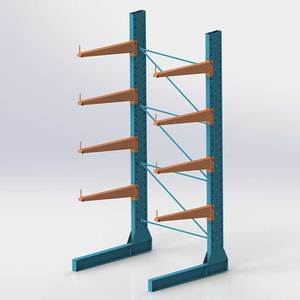
 Double-Sided
Heavy Duty Double Sided Cantilever Racking System
Cap: 1000–3000 kg/arm
Q235B Steel
Adjustable Pitch
Global Engineering Whitepaper & Strategic Sourcing Guide: Cold-Formed vs. Structural H-Beam Cantilever Systems, Dynamic Roll-Out Automation, and Direct Sourcing from Certified Guangzhou Facilities.
Engineered to handle long profiles, steel tubes, extruded plastics, lumber, and irregular heavy loads. Cold-rolled Q235B and structural hot-rolled H-beam designs custom-calculated to warehouse seismic parameters and load profiles.
Double-Sided
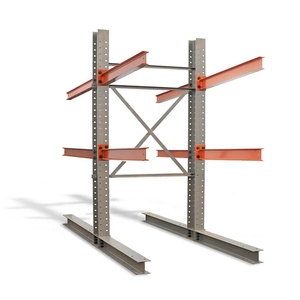 Dynamic / Motorised
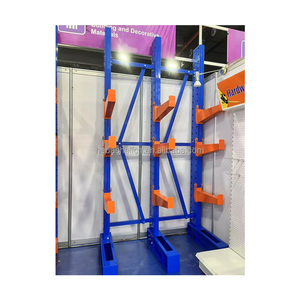 Industrial Grade
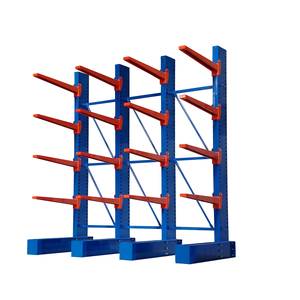 Pipe & Lumber
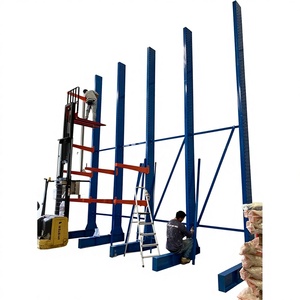 Standard Heavy Duty
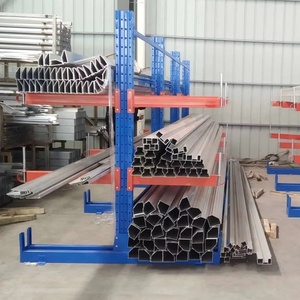 Multi-Tier Warehouse
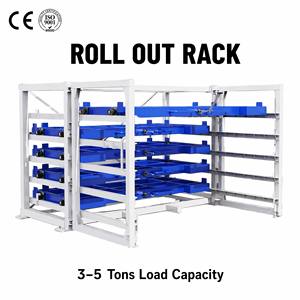 Multi-Layer Config
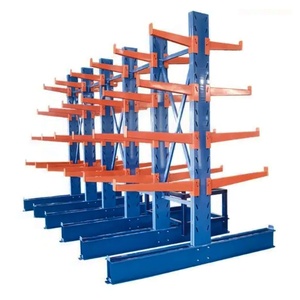 Single-Sided Wall
Operating a dedicated 30,000 m² smart fabrication base in Guangzhou since 2001, Guangzhou Heda Shelves Co., Ltd. resolves the core failure points in heavy material handling through precision automated roll-forming and CE/ISO 9001 certified engineering.
Selecting column mechanics governs lifetime warehouse safety. Roll-formed uprights (C-profile) suit light to medium tubing, plastic conduits, and carton storage up to 800 kg per arm. Structural hot-rolled H-beams (GB/T 11263 or European IPE/HEA sections) deliver superior torsional strength against forklift impacts and withstand dynamic payloads up to 3,000+ kg per arm.
Tropical climates across Southeast Asia and coastal Middle Eastern logistics hubs cause premature structural rusting. HEDA deploys an automated 10-step surface finishing line starting with chemical acid pickling and immersion phosphating, followed by electrostatic epoxy resin powder baking at 180°C–200°C.
Cantilever structures present unique cantilever moment forces and column deflection ratios. HEDA’s in-house engineering team calculates stress distribution via finite element analysis (FEA) compliant with FEM 10.2.09 and EN 15512 safety codes, balancing arm deflection against column leaning under loaded conditions.
The global heavy material storage landscape is transitioning from passive manual racking to semi-automated dynamic modules and IoT-monitored high-density footprints. Factor these shifts into your 5-year capital expenditures.
Manual aisle turning radiuses consume up to 65% of warehouse clear area. Emerging procurement models favor motorised roll-out cantilever modules where arms extend 100% via remote push-button or automated PLC controllers. This enables direct, single-operator crane rigging and cuts required aisle space from 5 meters to zero.
Traditional counterbalance forklifts are being replaced with high-reach multi-directional sideloaders and Autonomous Guided Vehicles (AGVs). Sideloaders maneuver 12-meter steel bundles within 2.2-meter narrow aisles, prompting factories to source structural cantilever towers reaching heights above 10 to 14 meters.
Supply chain leaders now require built-in strain gauges and optical deflection sensors integrated directly on top cantilever arm joints. These IoT sensors interface with Warehouse Management Systems (WMS) to prevent asymmetric overloading and provide early warnings before structural fatigue occurs.
Essential engineering and international procurement inquiries evaluated by our technical project managers.
Load ratings assume Uniformly Distributed Loads (UDL). If an arm is rated at 1,000 kg, weight must be evenly spaced along the arm length. Concentrating weight at the outer tip roughly doubles the cantilever bending moment at the upright joint, risking structural failure. Always state your load center of gravity during CAD planning.
Specify roll-formed uprights for non-impact, light-to-medium indoor loads under 800 kg per arm level (e.g., molding, lightweight extrusions, plastic conduits). Specify hot-rolled structural steel (IPE/H-beam profiles) for heavy outdoor stockyards, raw lumber bundles, steel plate pallets, and heavy piping exceeding 1,000 to 3,000 kg per arm.
Double-sided racks distribute opposing cantilever moments through a central column, resulting in balanced compression forces on the slab. Single-sided racks rely entirely on the rigidity of the bolt-together or welded base-to-upright joint and anchor bolting. Single-sided bases must be anchored to concrete slabs meeting minimum C25/C30 specs.
Long cantilever columns (typically up to 11.8 meters for 40ft High Cube containers) are nested horizontally with protective corrugated buffers and steel strapping. Small components (arms, bracing bars, bolts, and base plates) are palletized and stretch-wrapped in heavy film to prevent transport shifting and ocean moisture exposure.
Submit your material dimensions (length, outer diameter, weight per bundle), ceiling clearances, and forklift capabilities. HEDA’s Guangzhou engineering office will generate an accurate 2D CAD warehouse footprint, 3D render, and structural stress check at zero cost.