Track-Guided Racking Systems & Pallet Logistics Solutions
From floor-embedded guide tracks to dynamic roller lanes and heavy-duty mobile carriages, our systems optimize footprint, access efficiency, and structural safety.
High-Density Pallet Racks On Tracks: Technical Architecture & The Australian Logistics Landscape
An authoritative evaluation of driven floor tracks, mobile chassis stability, seismic engineering, and compliance metrics driving modern Australian warehousing.
Operational Imperative: Mitigating Industrial Land Costs Across Sydney, Melbourne & Brisbane
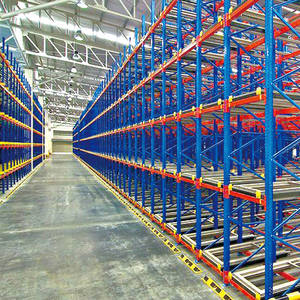
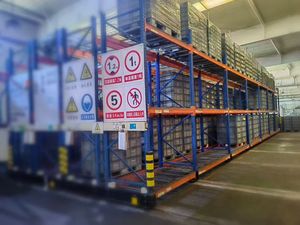
Across eastern seaboard distribution hubs, industrial square meter rental rates have increased by historic margins. Warehouse operators face a stark architectural choice: secure additional expensive land plots or multiply cubic volume capacity. Traditional selective racking wastes between 50% and 60% of horizontal floor space entirely on static forklift transit aisles. By contrast, Pallet Racks On Tracks (Motorized Mobile Pallet Racking) mount conventional racking superstructures onto motorized electro-mechanical wheel carriages that travel on recessed floor tracks. A single dynamic operating aisle unlocks up to 85% to 90% space utilization efficiency, doubling total pallet capacity within the identical operational envelope.
AS 4084-2023 Structural Compliance
Unlike standard generic international racking codes, the Australian Standard AS 4084:2023 (Steel Storage Racking) enforces stringent seismic design coefficients, upright perforation fatigue limits, load sign specifications, and minimum floor connection tolerances. Our track-mounted systems are finite-element analyzed to handle dynamic inertial loads triggered during carriage acceleration and emergency braking sequences.
Standard CHEP & Loscam Pallet Dimensions
Australia utilizes the distinct 1165 mm × 1165 mm hardwood pallet footprint (AS 4068), deviating from the European 800×1200 mm and North American 40×48 inch standards. HEDA Shelves engineers each track channel, wheel spacing, and support beam depth (typically 1250 mm or 1300 mm frames) specifically around Australian pallet overhangs and bottom-board support demands.
Floor Inset & Precision Leveling Tracks
Track-guided operations require minimal track deflection under extreme point loads (up to 24 metric tons per carriage base). We deliver induction-hardened, cold-drawn steel rails (guide rails and flat load rails) embedded directly into floor screeds or post-cut concrete recesses, anchored with expansion chemical studs to counter horizontal dynamic forces.
Where Track-Mounted Pallet Racking Excels in Australia
Tailored operational configurations responding to the climate, commodity sectors, and labor costs of Australian enterprise.
Cold Storage & Temperature-Controlled 3PL
In facilities operating between -18°C and -28°C across Victoria and Queensland, cooling power constitutes the primary ongoing overhead. By eliminating static aisles, pallet racks on tracks compress cooled air volume by 45%, delivering dramatic kilowatt-hour reductions per stored pallet position while safeguarding full SKU selectivity for grocery distributors.
Mining Equipment, Machinery & Spare Parts
Western Australia and South Australia mining logistical chains manage thousands of heavy, irregular machinery parts, motors, and hydraulic gears. Mobile track-guided racking configured with heavy-duty decking and retention bars organizes critical spares into clean, secure blocks accessible on demand via industrial PLC remote controls.
Wine, Spirits & High-Value Agricultural Export
Australian vintage cellars and export facilities (Barossa Valley, Hunter Valley, Margaret River) require vibration-dampened storage that prevents bottle agitation while maintaining dense bulk storage. Variable frequency drives (VFD) guarantee smooth, soft-start, and soft-stop carriage movement along the tracks.
Trends Shaping Pallet Racking Procurement in Australia (2025–2030)
From carbon footprint metrics to semi-automated warehouse workflows.
Decarbonization & Scope 2 Mandates
Australian listed supply chain corporations face rigid emissions targets under federal climate legislation. Reducing warehouse spatial footprints cuts building embodied carbon, decreases concrete usage, and drastically drops cooling electricity consumption—positioning on-track systems as green-certified logistics components.
Integration with Autonomous Mobile Equipment
Modern mobile racking units deployed across Melbourne supply corridors are increasingly interfaced with WMS networks and Automated Guided Forklifts (AGVs). Radio-frequency remote controls and optical photoelectric interlocks command carriage motion automatically before driverless reach trucks arrive at the row.
Stringent SafeWork Compliance Audits
Regulatory authorities in NSW, Victoria, and Queensland require rigorous adherence to machine guarding codes. Optical light curtains, trip-bars along mobile carriage skirts, acoustic start sirens, and localized emergency shutoffs are now mandatory baseline inclusions on all commercial installations.
Factory-Direct Quality, Engineering Depth & Reliability
Operating since 2001 with full in-house production control from raw coil processing to electro-mechanical integration.
Full In-House Lifecycle
No outsourced roll-forming. We control raw Q235B/Q355B structural steel slitting, continuous automated cold-roll forming, robotic automated beam welding, 10-stage pre-treatment, and electrostatic polyester powder coating. Every lot holds complete metallurgical mill certificates.
Complimentary 3D CAD & Load Calculations
Prior to contractual sign-off, our technical engineering office produces complete 2D layout drawings, 3D parametric renderings, building column clash assessments, dynamic wheel point-load evaluations, and AS 4084 compliance calculation summaries within 24 to 48 hours.
Fast Sea Logistics to Australian Ports
Departing directly from South China deepwater ports (Guangzhou / Nansha / Shenzhen), maritime container transits to Sydney (Port Botany), Melbourne, and Fremantle average only 14 to 20 days. Every container is pre-planned using algorithmic loading software to prevent in-transit scratching and maximize space.
Frequently Asked Questions by Australian Buyers
Clear, engineering-backed answers addressing structural codes, slab requirements, delivery, and installation.
How does HEDA Shelves ensure compliance with Australian Standards (AS 4084:2023)?
What concrete slab tolerances are required for installing floor tracks?
Can your systems support Australian standard 1165 mm × 1165 mm timber pallets?
What safety features protect personnel working inside active mobile aisles?
How are installation and ongoing maintenance managed in Australia?
Request an Engineered Layout & Australian Project Estimate
Submit your warehouse layout, required pallet capacity, and forklift specifications. Our engineering team will supply full 2D CAD plans, 3D models, and structural quotations within 24–48 hours.
Contact Us