[email protected] Serving Southeast Asia, South Asia & the Middle East
EN
Direct Factory Engineering & Export

Industrial Warehouse Racking Manufacturers & Exporter serving the Mexico City market

Engineered for Valley of Mexico Seismic Zone III, High-Density Nearshoring Logistics Hubs (CTT Corridor), and Class-A Distribution Facilities.

Precision Engineered Storage Fleet

Industrial Racking & High-Density Pallet Systems for CDMX Facilities

Cold-rolled from certified Q235B/Q355B structural steel, tailored to Mexican standard 48"×40" pallet configurations, NFPA 13 in-rack fire suppression clearances, and specialized material handling units.

Structural Geotechnical Engineering White Paper

Seismic-Resilient Racking Design for the Geotechnical Valley of Mexico

Why standard international racking specifications fail in CDMX without local soil mechanical adaptation and compliance with Normas Técnicas Complementarias (NTC-CDMX).

The Lacustrine Dynamic: S-Wave Amplification & Geotechnical Zone III

The Greater Mexico City Metropolitan Area (ZMVM) sits atop an ancient lake basin characterized by saturated lacustrine soft clays with moisture contents exceeding 300% to 400% in Zone III (Zona de Lago). When seismic energy propagates from the Cocos-North American subduction zone off the Pacific Coast, these soft soils act as resonant acoustic filters. Rather than dissipating, long-period seismic waves ($T_s \approx 1.5 - 3.5\text{ seconds}$) are massively amplified, inducing extreme harmonic oscillations in high-bay structures.

Standard selective pallet racks with typical 90mm×70mm upright sections calculated solely under static European EN 15512 or mild RMI standards experience excessive lateral inter-story drift under these low-frequency resonance conditions. When loaded to full design capacity, unadapted industrial uprights face catastrophic ductile bucking, beam connector disengagement, or foundation anchor pullout.

Over-Engineered Baseplates

We upgrade standard 120×100mm baseplates to high-surface heavy ductile plates (up to 200×180×12mm) featuring four-hole anchoring configurations. This diffuses dynamic shear forces safely into warehouse concrete slabs without causing micro-fissures or core spalling.

Modified Seismic Frame Bracing

Standard cross-bracing is replaced with heavy-gauge closed-tube K-bracing and X-bracing designs along down-aisle and cross-aisle directions. This controls the system ductility reduction factor ($Q=2.0$ or $Q=3.0$) compliant with Mexico's CFE Seismic Design Manual.

Triple-Hook Safety Connector Pins

Under vertical seismic pulse accelerations, pallet racking beams can experience momentary zero-gravity uplift. Our high-tensile 5-point claw beam connectors with mechanical auto-locking safety spring bolts prevent beam ejection during severe seismic shaking.

Structural Parameter Standard Non-Seismic Storage HEDA CDMX Zone III Seismic Specification Operational Impact in Mexico City
Steel Grade Commercial Grade Q235A / SS400 Certified Q235B / Q355B with Guaranteed Charpy Impact Eliminates brittle failure during winter temperature swings & dynamic ground shock.
Upright Profile & Gauge 1.5mm - 1.8mm Open C-Channel 2.0mm - 2.5mm Multi-Omega Roll-formed Profile Increases torsional rigidity by 38% under asymmetrical seismic forces.
Baseplate Anchoring 1x M10 Wedge Anchor per post 2x to 4x M12/M16 Chemical Capsule or Heavy Mechanical Anchors Prevents concrete pullout failure in low-strength floor slabs under high uplift tension.
Top Tie & Portal Bracing Optional, only on high aspect ratios Mandatory Aisle Ties & Structural Portal Cross-Bracing Ties parallel racking rows together to form a monolithic load-damping structure.
Calculations & Validation Basic Static Load Deflection ($L/200$) Dynamic Response Spectrum Analysis (CFE / NTC-CDMX) Full structural calculation memory ready for DRO (Director Responsable de Obra) sign-off.
Strategic Regional Deployment

Optimized for Mexico City's Critical Industrial & Logistics Corridors

From Class-A speculative mega-developments in the northern gateway to high-density inner-ring urban logistics conversions, we engineer systems adapted to local real estate realities.

The CTT Macro Corridor

Cuautitlán, Tultitlán & Tepotzotlán

The industrial engine of Central Mexico. Massive fulfillment parks hosting global e-commerce and tier-1 3PL operations face record low vacancy rates (<1.5%).

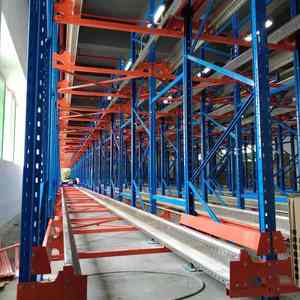
System Matches: VNA High-Bay Racking (up to 15m), Radio Shuttle Pallet Channels, Carton Flow Picking Mezzanines.

Urban Last-Mile Node

Vallejo & Azcapotzalco Industrial Zones

Brownfield conversions and revitalized urban warehousing inside the CDMX boundary require maximizing existing low-ceiling structures with zero horizontal expansion room.

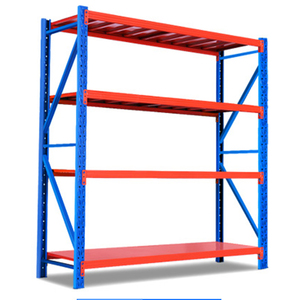
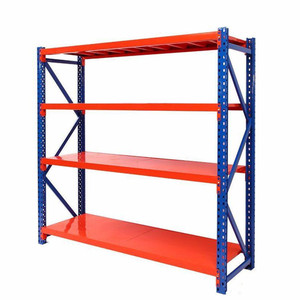
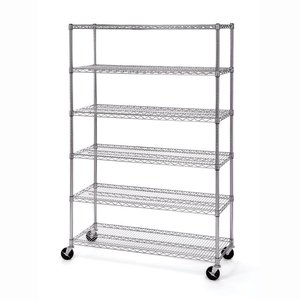
System Matches: Rack-Supported Multi-Tier Mezzanine Platforms, Heavy Longspan Pick Modules, Boltless Shelving.

Automotive & Heavy Industry Hub

Toluca-Lerma & Naucalpan Belt

Tier-1 automotive component manufacturing and pharmaceutical processing requiring custom heavy die storage, long bar racks, and clean industrial coatings.

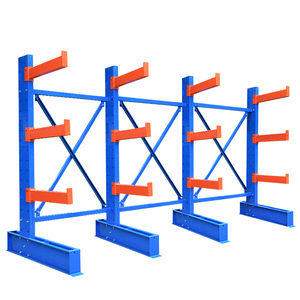
System Matches: Heavy Duty Structural Cantilever Systems, Mold Racks, Wire Decking-Equipped Pallet Racks.

Vertical Sector Customization Across Central Mexico

1. Cold Chain & Food Distribution (Central de Abasto Ecosystem)

Cold storage energy costs in Mexico City are among the highest in Latin America. Our Drive-In and Radio Shuttle systems concentrate pallets into high-density cubes, slashing chilled air dissipation and cutting power refrigeration expenditure by up to 35%.

2. Nearshoring Automotive Components (Bajío-CDMX Axis)

Suppliers under USMCA rules of origin face high turnaround speeds. We deploy heavy-duty cantilever racks for metal extrusions, roll-formed tubing, exhaust assemblies, and sheet metal coils, paired with color-coded safety zones.

3. Cross-Border E-Commerce & Retail 3PL Fulfillment

Handling peak volumes during Buen Fin and Hot Sale demands rapid split-case sorting. Our carton live-storage flow racks paired with multi-tier rack-supported mezzanine floors quintuple pick faces per square meter.

4. Chemical & Lubricant Storage (Hazardous Materials)

Engineered for chemical plants in Estado de México with custom drum cradle supports, galvanized containment sumps, and open wire mesh decking preventing fluid accumulation and ensuring emergency water drainage.

World-Class Manufacturing Authority

Factory-Direct Production & Quality Engineering Since 2001

Guangzhou Heda Shelves Co., Ltd. provides Mexican logistics operators, general contractors, and procurement direct access to ISO 9001 and CE-certified manufacturing without middlemen markups.

25+
Years Industry Experience
30,000m²
Modern Manufacturing Base
30,000Tons
Monthly Steel Output
10,000+
Global Projects Completed

Automated In-House Roll-Forming & Surface Treatment

Every upright, beam, and bracer undergoes automated continuous roll-forming on proprietary CNC cold-bending rolling lines. Dimensional punch tolerances are maintained within ±0.1mm, guaranteeing structural integrity when bolting and locking upright frames in Mexico City warehouses.

Our 10-stage automated pre-treatment includes hot acid pickling, zinc phosphating, high-pressure rinsing, and automatic electrostatic polyester powder curing at 200°C. This impenetrable polymer barrier resists airborne pollution and volcanic ash particulate common in the Valley of Mexico.

Container Packing & Pacific Logistics Corridor

Exporting to Mexico demands specialized container packing engineering to survive trans-Pacific maritime shipment without deformation. Structural beams and upright bundles are packed on custom steel frames with protective edge boards, desiccants, and waterproof shrink film.

We ship routinely from Guangzhou / Shenzhen to Puerto de Manzanillo (Colima) or Lázaro Cárdenas (Michoacán), with scheduled 21-day direct sailing routes, followed by bonded intermodal rail straight to Terminal Intermodal Pantaco inside Mexico City.

Need an engineered racking quotation with a free 2D CAD floor plan and 3D layout simulation for your Mexican project?

Contact Us
Strategic Market Intelligence

Trends Shaping Industrial Warehousing Across Greater Mexico City

Understanding macroeconomic shifts, land scarcity, and operational imperatives driving storage modernization in Central Mexico.

Verticalization Beyond 14 Meters

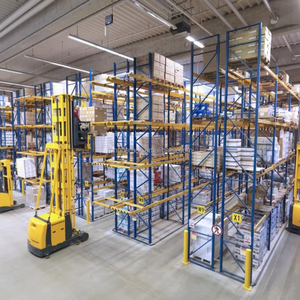
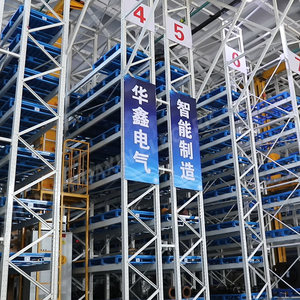
Industrial land acquisition costs in the CTT corridor have surged past historic benchmarks ($180–$250 USD/m²). Modern logistics developers (Prologis, FIBRA Uno, Vesta) are constructing clear heights exceeding 12.5m to 14.5m. Operators must transition from traditional 4-tier reach truck layouts to 6-to-9-tier Very Narrow Aisle (VNA) or automated AS/RS storage to double pallet capacity over the same square footage.

Nearshoring Automotive Influx

Mexico's nearshoring momentum has created severe supply chain bottlenecks for Tier-1 and Tier-2 component vendors supplying plants in Puebla, Toluca, and Bajío. Warehouse managers are rapidly discarding traditional ground stacking in favor of heavy selective racking and longspan cantilever systems to maintain strict JIT (Just-In-Time) sequence inventory.

Semi-Automation Over CapEx-Heavy AGVs

While full robotic AS/RS installations carry multi-million dollar price tags and 18-month lead times, Mexican warehouse operations are extensively deploying Radio Shuttle Pallet and Carton Flow systems. These deliver 85% of automated storage density at less than 30% of total CapEx, providing an accelerated ROI of 14–18 months.

Procurement Knowledge Base

Frequently Asked Questions for Mexican Warehouse Managers & Contractors

Detailed answers addressing Mexican customs, customs clearance brokers (Agentes Aduanales), seismic certifications, and local standards compliance.

Can HEDA provide a structural calculation memory (Memoria de Cálculo) signed for Mexico City building permits?
Yes. For installations within Mexico City (CDMX) and the State of Mexico (Edomex), municipal planning departments and civil protection authorities often require a Memoria de Cálculo Estructural. HEDA provides comprehensive structural calculation books based on finite element analysis (FEA), factoring in dead load, live load, seismic coefficients compliant with NTC-CDMX (Normas Técnicas Complementarias), and CFE seismic guidelines. We work cooperatively with your local structural engineer or Perito / Director Responsable de Obra (DRO) to supply all steel metallurgy sheets, deflection models, and connection proofs required for structural validation.
How does shipping and customs clearance work when importing from your factory to Mexico City?
Shipments are packed into 40ft High Cube (40HC) containers at our Guangzhou plant and routed via major shipping lines directly to Mexican Pacific ports—primarily Puerto de Manzanillo (Colima) or Lázaro Cárdenas (Michoacán), with an ocean transit time of roughly 18 to 22 days. Upon port arrival, your designated customs broker (Agente Aduanal) clears customs under the appropriate HS Code (typically 7308.90 for structural steel structures and parts). The containers are then transported either via Ferromex / CPKC intermodal rail to the Terminal Intermodal Pantaco in Azcapotzalco or straight via bonded flatbed trucks directly to your warehouse dock in Cuautitlán, Tepotzotlán, or Tultitlán.
Are your pallet racks compatible with the standard Mexican pallet (Tarima Estándar Mexicana 48"×40")?
Absolutely. The Mexican industrial and grocery market heavily utilizes the 48"×40" inch (1200×1000mm) four-way wooden pallet (frequently known as the standard GMA/IMEC tarima). We custom-engineer beam spans specifically to accommodate this profile: 2,300mm for two-pallet bays, 2,700mm to 2,800mm for three-pallet bays, and frame depths at 1,000mm or 1,100mm with integrated wire mesh decks or support bars. We also accommodate European pallets (1200×800mm) or oversized automotive packaging containers (1200×1200mm, plastic collapsible totes) on identical upright profiles through adjustable connector beam heights.
How do you ensure compliance with Mexican Fire Protection standards and NFPA 13?
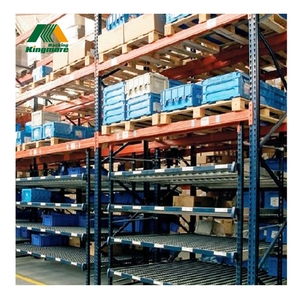
Modern logistics parks across Greater Mexico City operate under strict insurance guidelines (such as FM Global) and local fire codes aligned with NFPA 13 (Standard for the Installation of Sprinkler Systems). Our engineering layouts maintain mandatory transverse and longitudinal flue spaces (typically 3" to 6" / 75mm to 150mm clear openings between back-to-back pallets). Furthermore, we supply electro-galvanized or powder-coated waterfall wire mesh decking with open areas exceeding 50% to 70%, allowing in-rack ESFR (Early Suppression Fast Response) sprinkler water to cascade uninhibited through all lower storage levels.
What steel specifications and powder coating durability do you provide for high-altitude CDMX environments?
Mexico City is situated at 2,240 meters above sea level, characterized by high ultraviolet radiation, distinct dry/wet seasonal shifts, and ambient volcanic particulate. HEDA constructs all upright frames and load beams using certified high-tensile Q235B and Q355B structural steel (equivalent to ASTM A36 and ASTM A572 Grade 50). Prior to coating, steel members undergo multi-stage ultrasonic degreasing, acid pickling, and micro-crystalline phosphatizing, followed by thermosetting polyester epoxy powder coating cured at 200°C. This delivers 500+ hours of salt-spray resistance, zero flaking, and outstanding impact toughness against forklift scrape abrasion.
Can local Mexican installation crews assemble your racking systems without proprietary tools?
Yes. All HEDA racking systems are engineered with modular, boltless interlocking beam-to-column connections. Every export shipment includes full 2D layout drawings, 3D exploded assembly diagrams, part piece-marking schedules, and torque requirement specifications for baseplate anchor bolts. Any certified industrial warehouse maintenance contractor or racking installer in Mexico can erect the system quickly using standard metric tools, impact wrenches, and laser levels. We also provide remote real-time video engineering support throughout your installation phase.
What documentation is provided to satisfy Mexican import authorities and SAT tax compliance?
We furnish an exhaustive export documentation package required for Mexican customs clearance: Commercial Invoice (Factura Comercial) detailing unit values and steel weights, Packing List (Lista de Empaque) breakdown by container, Bill of Lading (B/L), Certificate of Origin, Mill Test Certificates (MTC) proving raw steel tensile and yield properties, and ISO 9001 / CE compliance certificates. Your customs agent will have every document needed to generate the import petition (Pedimento Aduanal) smoothly under Mexican foreign trade regulations.
Fast-Track Engineering Response

Accelerate Your Mexico City Warehouse Fit-Out Today

Send us your warehouse CAD floor plan, target pallet loads, and clear building heights. Our senior racking structural engineers will generate an optimized 2D layout plan, 3D visualization, and complete FOB/CIF quotation within 24–48 hours.