Engineered Industrial Racking & High-Tolerance Storage Systems
Heavy-duty structural storage configurations designed, cold-rolled, and load-tested in Guangzhou to protect critical inventory while seamlessly integrating column guards, aisle barriers, and automated handling robotics.
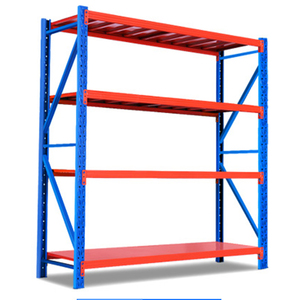
HUAWU 200kg Boltless Shelving Q235 Steel Storage Rack HD036
Precision-punched rivet shelving featuring interlocking Q235 carbon steel uprights. Engineered for manual fulfillment cells, archival tiers, and order-picking bays requiring clean-profile collision corner shielding.
- 200 kg certified UDL capacity per shelf
- Boltless snap-in post connection geometry
- Corrosion-resistant epoxy-polyester coat
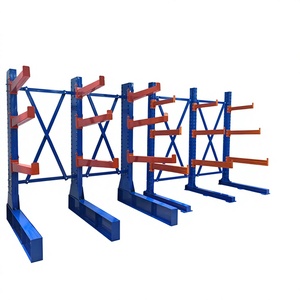
Heavy Duty Single/Double Side Cantilever Rack System
Free-standing structural columns equipped with pivot-mounted adjustable arms for timber, extruded aluminum, structural tubes, and rebar bundles, fortified with heavy base anchors and run-end impact deflector shoe assemblies.
- 1,000–3,000 kg arm load capacity rating
- Tapered column design counteracts deflection
- Hot-dip galvanized available for outdoor bays
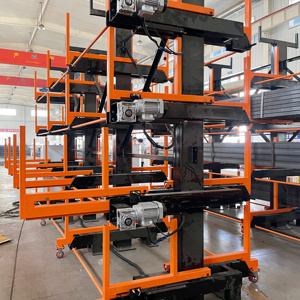
Automatic PLC Telescopic Electric Cantilever Storage Rack
Motorized extending cantilever arms manipulated by an industrial PLC interface. Eliminates wide forklift turning radiuses, enabling safe overhead crane loading while shielding delicate mechanical drivetrains behind steel safety curbs.
- Full 100% telescopic arm extension stroke
- Integrated photoelectric safety zone sensors
- Heavy duty geared motor with mechanical brakes
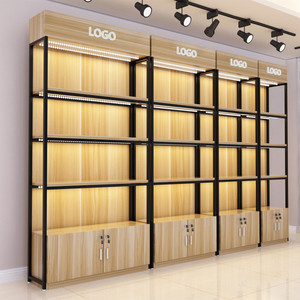
Supermarket Wooden & Steel Retail Display Shelving Unit
Hybrid aesthetic display blending reinforced steel back-panels with decorative solid timber accents. Features low-profile front foot impact plates to prevent floor scrubber and shopping trolley damage in high-traffic retail aisles.
- Modular pitch spacing for variable tier depths
- Reinforced base kicks prevent mop impact
- Eco-certified scratch-resistant wood veneer
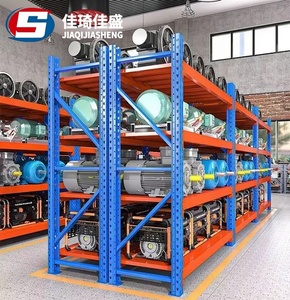
Long Span Industrial Boltless Shelving Rack (500kg Capacity)
Heavy step-beam profiles combined with drop-in steel or wire mesh panels for multi-tier carton fulfillment mezzanines. Includes bolt-on column reinforcement channels to resist pallet jack flank strikes.
- 500 kg uniformly distributed load per deck
- Pre-galvanized or epoxy baked surface coats
- Compatible with rack-mounted guide channels
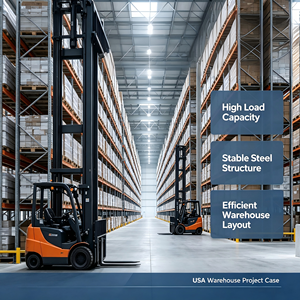
North America Standard Heavy Duty Teardrop Pallet Rack
Fully compatible with standard North American interchangeable teardrop upright profiles. Features cold-formed stiffening ribs along upright flutes to resist cross-aisle twisting from material handling equipment.
- Compliant with RMI MH16.1 & ANSI guidelines
- Patented safety pin lock prevents dislodgement
- Pre-drilled footplates for heavy anchor studs
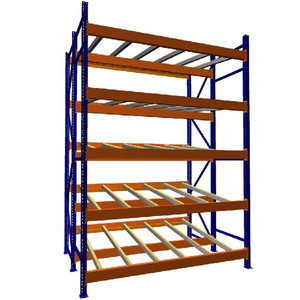
High-Density Dynamic Carton Flow Rack System
Integrated inclined aluminum roller tracks that utilize gravity feed for first-in, first-out (FIFO) logistics. Heavy entry/exit steel impact stops prevent roller lane distortion during aggressive bin replenishment.
- Strict FIFO inventory rotation dynamics
- Heavy duty polyurethane low-friction rollers
- Reduces picking operator travel time up to 60%
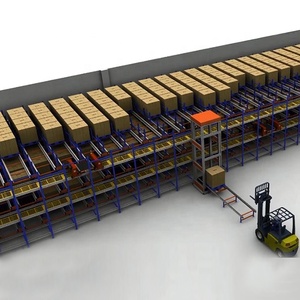
Automatic Radio Shuttle Deep-Lane Storage System (CE)
High-density semi-automated deep-lane pallet shuttle racking. Forklifts remain outside the racking channels, dramatically mitigating upright collision risks while high-precision entry bull-nose guide bars center the robotic shuttle.
- CE Certified under Directive 2006/42/EC
- Accommodates up to 1,500 kg unit pallets
- Direct interface with WMS via RF controller
Euler Buckling Dynamics & Impact Dissipation in Modern Warehouses
Why a localized 3mm dent on an unprotected upright column precipitates catastrophic structural collapse under full working load, and how calibrated impact barriers preserve warehouse safety factors.
| Protection Category | Material Engineering | Energy Absorption | Fixing / Anchoring Architecture | Ideal Application Zone |
|---|---|---|---|---|
| Heavy Steel Floor Guards | Q235B / Q355B Heavy Structural Channel (4.5–6.0mm) | 4× M16 Wedge/Drop-in chemical floor anchors | Aisle entry end-frames, main thoroughfares, AGV turn points | |
| Direct-Attach Column Guards | Cold-rolled steel with internal shock-absorbing rubber pads | Clamped directly to upright flute (no floor drilling) | Interior intermediate pallet locations, narrow aisles | |
| Heavy End-of-Aisle Barriers | Structural pipe ($\varnothing 114\text{--}140\text{mm}$) with reinforced base plates | Multi-point anchored through 150mm reinforced concrete slab | High-traffic dual-entry rack row ends, dock staging zones | |
| Engineered Polymer Protectors | High-density flexible polymer (HDPE/Polyurethane blends) | Friction fit snap-on or decoupled floor anchor sleeves | Cold storage (-30°C), food processing, non-marking floors |
ANSI / RMI MH16.1 Compliance
Mandates that bottom upright sections vulnerable to forklift impact withstand a minimum static load of 3,000 lbs (13.3 kN) in both transverse and longitudinal directions at an 18-inch elevation without structural detachment.
EN 15635 Damage Tolerances
Establishes the European classification of Green (surveillance), Amber (hazardous wear requiring repair within 4 weeks), and Red (immediate rack unloading). Certified rack guards eliminate up to 90% of red-level critical notifications.
Decoupled Dissipation Architecture
Superior floor-mounted crash shields transmit dynamic kinetic collision shockwaves directly into the concrete foundation slab rather than transferring shearing vectors into delicate cold-formed racking upright struts.
Future Procurement Trends Transforming Industrial Protection
How progressive logistics directors, 3PL giants, and supply chain procurement executives evaluate safety infrastructure investments across the 2026–2030 horizon.
AMR & AGV Trajectory Shielding
Autonomous vehicles maintain precise navigational courses with millimetric operating clearances. Floor barriers now feature ultra-low profile deflection contours and integrated LiDAR reflectors to prevent sensor blindness while providing rigid fallback stops.
Cold-Chain Cryogenic Resilience
Sub-zero blast freezers (-30°C) induce ductile-to-brittle metallurgical transitions. Global procurement mandates high-impact micro-alloyed steel formulations and modified polymer dampers tested down to -40°C without micro-fissuring or brittle shattering.
Scope 3 Circularity & Modularity
Traditional welded crash systems necessitated entire frame disposals post-strike. Modern buyers specify modular sacrificial strike zones and remountable segmented sacrificial shoes, drastically cutting Scope 3 replacement steel consumption and downtime.
IoT Telemetry & Shock Sensing
Smart upright guards embedded with triaxial accelerometers immediately alert facility managers upon impacts surpassing calibrated shock thresholds, synchronizing with CCTV to identify reckless drivers and trigger proactive structural inspections.
Global Authority in High-Density Storage Engineering Since 2001
From raw high-grade coil slitting to fully automated electrostatic powder coating, our Guangzhou production facility operates with complete vertical integration, ensuring absolute metallurgical control, rigorous CE/ISO traceability, and custom structural fabrication.
Free 2D/3D Engineering Layouts
Within 24–48 hours, our in-house engineering team provides precise CAD drawings, detailed pallet position counts, and 3D architectural models calibrated to your specific forklift turning radius and column spacing.
Rigorous International Credentials
Fully accredited under CE Certification (No. 2435-CPR-8605159), ISO 9001:2015 Quality Management (No. 18624Q00169R0M), and full RoHS compliance for environmentally safe, heavy-metal-free thermosetting coatings.
Seismic Analysis & Calibrations
Engineered calculations tailored to high-seismic regions (Philippines, Indonesia, Japan, Taiwan). Upright sections, dynamic bracing geometry, base plate dimensions, and anchor bolt depth are validated for peak spectral acceleration.
South China Shipping Gateway
Direct shipping from South China ports guarantees expedited transit times across Southeast Asia, South Asia, and the Middle East, with container loading plans optimized by specialized logistics engineers to prevent freight damage.
Our 10-Step Precision Manufacturing & Quality Control Workflow
Every beam, upright section, and protective crash barrier undergoes rigorous multi-stage physical and chemical testing within our Guangzhou facility.
Frequently Asked Technical & Commercial Questions
Clear, authoritative guidance from our structural engineering and export compliance team to inform your racking procurement specifications.
What is the definitive mechanical difference between floor-anchored steel guards and upright-clamped protectors?
Floor-anchored steel guards are completely decoupled from the racking framework. When an MHE unit collides with the guard, the dynamic kinetic impact is redirected directly into the concrete floor slab through heavy-duty anchor bolts (such as M12 or M16 wedge anchors). The pallet rack upright experiences zero mechanical shear stress.
Conversely, upright-clamped protectors wrap directly around the post profile and rely on internal elastomeric or polyurethane cushioning. While they offer superior space efficiency in narrow aisles, significant collisions can still transmit residual twisting torque into the vertical upright. Therefore, engineering best practices recommend floor-anchored guards for all exposed aisle corners and end-of-rack frames, while clamped polymer protectors are optimal for internal rack positions.
How do tropical and high-humidity environments impact coating longevity, and how is corrosion prevented?
In humid tropical regions (such as Southeast Asia), moisture penetration beneath standard spray-painted coatings causes rapid under-film creep corrosion, leading to premature flaking and structural section loss. At HEDA Shelves, all cold-formed racking and protection components undergo a rigorous chemical pre-treatment cycle: acidic pickling to eliminate scale, degreasing, and zinc-phosphating.
This conversion coating creates an impermeable microscopic crystalline layer that bonds with our automated electrostatic epoxy-polyester powder coating (70–90 microns). For high-salinity coastal areas, blast chillers, or outdoor open-air storage yards, we specify hot-dip galvanization conforming to ASTM A123 / ISO 1461, yielding over 50 years of maintenance-free cathodic protection.
Can your pallet racking and protective structures be customized to pass local seismic building permits?
Yes. Many of our projects are deployed in seismically active circum-Pacific regions including the Philippines, Indonesia, Japan, and Taiwan. Our structural design division performs site-specific finite element analysis (FEA) and dynamic modal simulations based on regional building codes (IBC, Eurocode 8, or local standards).
We tailor the upright section profile, increase steel wall thicknesses, configure cross-aisle X-bracing patterns, integrate enlarged baseplates, and calculate specific concrete expansion anchor depths to resist seismic shear and overturning moments. Complete structural calculation reports are provided for statutory permit approval.
What exact data is required to generate a certified 2D CAD layout and 3D structural quotation?
To deliver an accurate architectural CAD layout and load calculation within our 24–48 hour turnaround window, our engineering department requests:
- Facility Floorplan: Architectural CAD drawing (.dwg) or dimensioned sketch indicating building columns, ceiling clear height, wall offsets, egress paths, and dock door locations.
- Load Unit Characteristics: Pallet dimensions (width, depth, overall height including cargo overhang) and maximum gross pallet weight.
- Handling Equipment (MHE): Specific forklift model, chassis width, mast collapsed height, maximum lift elevation, and manufacturer-specified minimum right-angle stacking aisle width ($A_{st}$).
- Storage Strategy: Expected throughput rates, total SKU counts, and environmental requirements (ambient, cold chain, hazardous chemical segregation).
What factory inspection and international testing certifications accompany shipments?
Every export shipment from our Guangzhou production plant is accompanied by a certified quality dossier, including CE Declaration of Conformity (No. 2435-CPR-8605159 under the Construction Products Regulation), ISO 9001:2015 Quality Management Certificate (No. 18624Q00169R0M), and mill test certificates (MTC) verifying raw material chemical composition and tensile mechanical properties.
Additionally, we supply factory load deflection test logs, powder coating cross-hatch adhesion test verifications, container loading inspection manifests, and sequential step-by-step 3D assembly shop drawings for local installation crews.
Plan Your Storage System with Professional Engineering Verification
Whether you are engineering a regional automated fulfillment hub, outfitting a cold-storage facility, or seeking private-label OEM manufacturing distribution, our Guangzhou engineering team delivers verified CAD layouts, capacity calculations, and factory-direct pricing within 24–48 hours.