Featured Storage & Warehouse Material Handling Systems
Discover our primary heavy-duty systems engineered for ultra-dense pallet consolidation, dynamic carton picking, and automated warehouse integration. Factory-certified load tolerances engineered to international logistics safety standards.
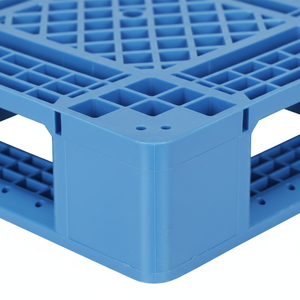
1400x1100mm Heavy Duty Plastic Pallet Grid Rack Use
Engineered grid-matrix virgin HDPE/PP pallet designed specifically for edge-rack deflection limits. Tested for 1,500 kg rack load and 6,000 kg static capacity across high-bay beams.
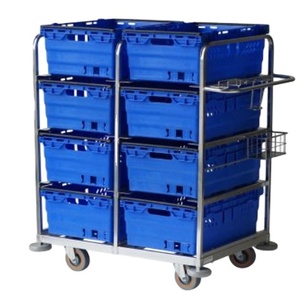
4 Tier Storage Wire Mesh Containers Warehouse Roll Trolley
Reinforced electro-galvanized tubular frame with folding mesh sides. Facilitates rapid order consolidation and staging between very narrow aisle pick faces and shipping docks.
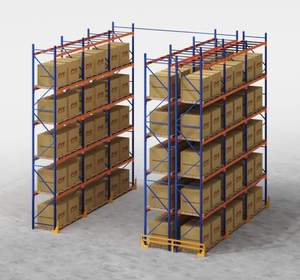
Conventional Single Row Pallet Racking System
High-tensile cold-formed Q235B steel upright frame offering 100% selective accessibility. Readily configured with guide rail packages to convert directly into narrow aisle operations.
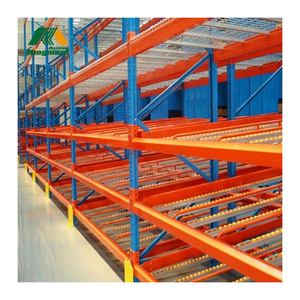
Industrial Automation Gravity Carton Flow Rack
Aluminum-alloy roller tracks with adjustable pitch dividers. Enforces strict FIFO stock rotation, reducing picking travel times by up to 60% within multi-tier logistics hubs.
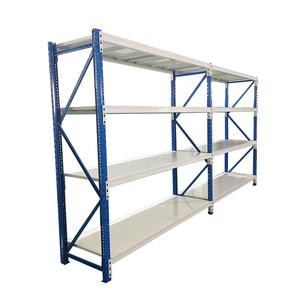
Middle Duty Style Industrial Selections Shelf
Boltless step-beam shelving accommodating 300 kg to 800 kg per tier. Modular design with steel or wire decking, optimal for intermediate replenishment and manual SKU fulfillment.
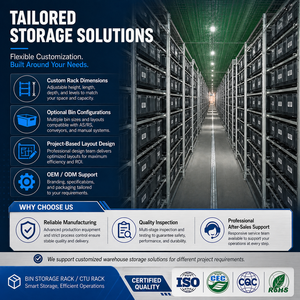
Mini Load ASRS Tote Storage Racking System
High-precision automated crane-compatible racking built to ultra-tight structural tolerances. Maximizes vertical cube utilization for rapid automated tote retrieval.
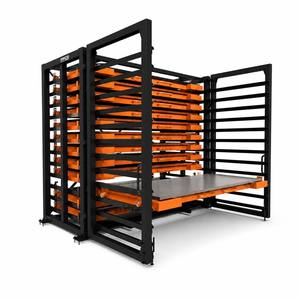
Heavy Duty Roll Out Sheet Metal Plate Drawer Rack
Heavy structural steel pull-out drawer mechanism engineered for laser plate and raw metal dies. Safely holds 1,000 kg to 5,000 kg per drawer level with 100% overhead crane access.
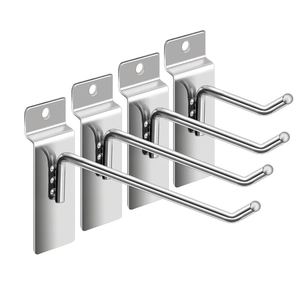
Custom Stainless Steel Pegboard Display & Storage Hooks
Industrial-grade precision-formed steel hanging components and perforated panel hardware for small assembly components, retail fulfillment, and workshop staging boards.
The Technical Architecture of Very Narrow Aisle (VNA) Racking
In modern supply chain engineering, warehouse space is evaluated in cubic volume rather than square area. Very Narrow Aisle (VNA) racking systems compress standard selective aisle corridors down from 3,200–3,800 mm to an ultra-compact 1,500–1,800 mm, unlocking up to 90% floor area utilization.
Volumetric Density Optimization
By eliminating dead aisle space, VNA designs boost effective pallet capacity by 45% to 60% compared to conventional selective configurations. The structural design extends up to 18 meters in height, exploiting building eaves while retaining 100% individual pallet selectivity.
Guidance Rail Mechanics
VNA turret trucks operate at high travel speeds within tight tolerances. Facilities deploy either heavy-duty low-profile mechanical guide rails (structural C-channel or welded angle steel anchored at 500 mm centers) or sub-floor inductive wire guidance systems emitting low-frequency electromagnetic guidance signals.
Dynamic Load Deflection Control
Operating beyond 12 meters requires rigid deflection criteria. Engineered to European FEM 10.2.02 and EN 15512 specifications, our beam and upright profiles limit horizontal frame sway and vertical deflection to under L/200 to L/400, preventing mast collisions during high-reach movements.
| Storage Racking Category | Aisle Width (Clear mm) | Vertical Elevation Limit | Spatial Footprint Utilization | Pallet Selectivity | Guidance Requirement |
|---|---|---|---|---|---|
| Wide Aisle Conventional Racking | 3,200 mm – 3,800 mm | Up to 9.0 Meters | 35% – 42% | 100% Direct Access | Manual Counterbalance / Reach |
| Very Narrow Aisle (VNA) Systems | 1,500 mm – 1,800 mm | Up to 18.0 Meters | 58% – 68% | 100% Direct Access | Low-Profile Steel Rail / Inductive Wire |
| Double-Deep Selective Racking | 3,000 mm – 3,400 mm | Up to 10.5 Meters | 45% – 52% | 50% Immediate (LIFO batch) | Pantograph Reach Truck |
| Radio Shuttle Automation Racking | Lane Dependent | Up to 16.0 Meters | 70% – 82% | Bulk Lane Retrieval (FIFO/LIFO) | Automated Internal Rail Shuttle |
Superflat Floor Tolerances (DIN 15185 / VDMA) & Seismic Analysis
A VNA high-bay racking system is not merely steelwork; it is an integrated structural apparatus where civil engineering, dynamic mast oscillations, and floor slab tolerances converge. Minor slab deviations translate into significant mast displacement at 15 meters.
DIN 15185 & TR34 Compliance
To safely operate man-up turret trucks at elevated levels, floor slabs must comply with DIN 15185 or British Concrete Society TR34 (Class DM1/DM2). Transverse level differences between truck wheel tracks must not exceed 1.0 mm to 1.5 mm to prevent dangerous mast sway and mast-to-beam contact.
Baseplate Shear & Point Loads
Concentrated point loads under high-bay VNA columns often exceed 120 kN to 220 kN per upright. We deploy CNC laser-cut structural baseplates with double-gusset stiffeners and chemical drop-in anchors (Hilti / Fischer) tested for high dynamic pull-out and concrete slab shear resistance.
Seismic Engineering (UBC / IBC)
For installations in earthquake-prone belts (such as the Pacific Rim, Indonesia, Philippines, Japan, and Western GCC regions), our structural calculations calculate Peak Ground Acceleration (PGA) forces. We adjust spine bracing, vertical K/X bracing cross-sections, and upright profile gauge thickness accordingly.
Guangzhou HEDA Shelves Co., Ltd.: 25 Years of Heavy-Duty Engineering
Established in 2001 in Guangzhou, China, HEDA Shelves operates as a primary OEM/ODM manufacturer of industrial storage racking systems, delivering turn-key storage architecture across Asia, Europe, the Americas, and the Middle East.
Certified Quality Rigor
Every fabrication batch undergoes strict verification. We maintain European CE Certification No. 2435-CPR-8605159, ISO 9001:2015 Management Certification (No. 18624Q00169R0M), and European RoHS powder coating compliance certificates for high-spec international tenders.
Continuous Roll-Forming Lines
Our facility houses 18 automated cold roll-forming production lines featuring progressive punching stations. Upright profiles (up to 140 mm width, 2.5 mm – 3.2 mm wall thickness) are roll-formed in single-piece lengths without welded splices to guarantee absolute structural verticality.
9-Stage Surface Pre-Treatment
To resist corrosion in tropical and coastal environments, all steel components pass through an automated 9-stage sequence: chemical degreasing, ultrasonic water washing, rust-stripping pickling, and micro-crystalline phosphating before electrostatic curing at 200°C.
South China Shipping Gateway
Located near major ocean terminals (Guangzhou Nansha and Shenzhen Yantian), we leverage container load optimization modeling to maximize cubic sea-freight packing, minimizing freight cost per pallet location to ASEAN, the Middle East, Europe, and the Americas.
Future Technology Trends in VNA Warehouse Racking Systems
Intralogistics is shifting from static steel storage frames toward dynamic, automated cyber-physical systems. Engineering procurement managers must specify modular racking capable of accommodating automated hardware transitions.
1. Autonomous VNA AGVs & Robotics
Manual man-up turret trucks are increasingly superseded by driverless VNA-AGVs (Automated Guided Vehicles). Modern racking installations incorporate floor reflectors, LiDAR targets, and top-of-rack optical positioning strips to support driverless 24/7 dark-warehouse operations without structural retrofits.
2. IoT Strain Gauges & Digital Twins
Structural health monitoring is moving from periodic manual inspections to real-time IoT strain-gauge telemetry. Integrated sensors embedded inside baseplates and critical cantilever joints monitor cyclic fatigue, dynamic impacts, and beam deflection, feeding predictive maintenance platforms directly into cloud WMS systems.
3. High-Yield Micro-Alloy Steel Metallurgy
Advancements in micro-alloy hot-rolled coil chemistry (such as Q355B and Q460 cold-rolled formulations) allow manufacturers to achieve higher yield strengths with reduced dead-weight profiles. This reduces seismic inertial mass while preserving high live-load safety factors ($>1.65$).
Future Procurement Trends: Total Cost of Ownership (TCO)
Enterprise procurement directors evaluate racking suppliers on lifecycle Total Cost of Ownership (TCO) rather than simple FOB steel tonnage rates. Factoring shipping cube optimization, on-site installation time, structural durability, and local building approvals ensures project ROI.
Factory-Direct Sourcing vs. Intermediaries
Contracting direct with tier-1 Chinese manufacturers like HEDA Shelves eliminates multi-tier distributor markups (typically 20% to 35%). Direct engineering interaction speeds up CAD approval turnarounds, layout revisions, and structural calculation sign-offs by certified engineers.
Modular Standardisation & Future-Proofing
Procuring standardized upright pitch patterns (50 mm / 75 mm increments) with tear-drop or standard European connector tabs ensures facilities can reconfigure beam levels without structural replacement. As SKU heights change, modular systems prevent stranded asset obsolescence.
Container Logistics & Packaging Science
Sea freight efficiency impacts delivered cost per pallet spot. HEDA Shelves uses specialized bundle-packing jigs, custom steel dunnage, protective foam separation, and 3D container loading simulation software to ensure maximum 40ft High Cube container fill rates without surface abrasion.
HEDA Quality Assurance & Fabrication Sequence
Raw Material Verification
Certified prime hot-rolled coils undergo spectroscopic chemical composition analysis and tensile stress testing prior to decoiling and continuous slitting.
CNC Cold Profiling
Automated punch presses stamp upright adjustment slots with ±0.1 mm pitch tolerance, followed by progressive continuous 24-station cold roll-forming lines.
Robotic Welding & Curing
Dual-torch multi-axis robotic arms weld beam connector tabs. Components undergo ultrasonic acid pickling and phosphating, followed by polyester powder spraying.
Pre-Assembly & Export QA
Beam-to-column connector testing, coating adhesion cross-hatch checks, and container nesting under stringent packing list documentation for smooth customs clearance.
VNA Racking Technical Procurement FAQ
Common structural, operational, and commercial questions answered by HEDA Shelves' lead structural application engineers.
What are the structural differences between standard selective pallet racking and VNA racking?
While both systems use vertical upright frames and horizontal load beams, VNA racking systems require higher structural rigidity and tighter manufacturing tolerances. In standard wide-aisle configurations (3.2 m to 3.8 m aisles), reach trucks turn inside the aisle corridor. In VNA systems (1.5 m to 1.8 m aisles), specialized articulated or turret trucks do not turn within the aisle; only the fork head rotates 180 degrees left and right.
Consequently, VNA racking demands: (1) Bottom guide rails or inductive floor wire guidance to keep turret trucks aligned; (2) Tighter allowable sway tolerances under FEM 10.2.02 and EN 15512 to eliminate mast oscillation; (3) Stiffer upright sections with thicker baseplates and chemical anchoring to withstand elevated eccentric shear loads; and (4) Floor flatness matching DIN 15185 or TR34 DM1/DM2 specifications.
How do mechanical guide rails compare to inductive wire guidance systems?
Mechanical guide rails consist of structural steel angles (typically $100\times 75\times 8$ mm or heavy C-channels) bolted to the concrete slab on both sides of every aisle. Guide rollers on the turret truck make physical contact with the steel rail, providing positive mechanical positioning. Advantages include straightforward installation and high durability, though bottom pallet levels must be elevated on support beams or the rail must be low-profile (50 mm) to clear outriggers.
Inductive wire guidance systems involve slot-cutting a 3 mm wide by 15 mm deep channel into the center of the concrete aisle, laying an antenna wire energized with a low-frequency AC current (typically 5 to 10 kHz), and sealing it with epoxy. Sensors beneath the VNA truck follow this electromagnetic field. Wire guidance leaves the floor completely unobstructed, allowing pallets to sit directly on the floor at ground level, but requires precise floor cutting and electromagnetic continuity maintenance.
What warehouse floor flatness standard is required before installing VNA racking?
Operating VNA trucks at heights above 10 to 18 meters requires adherence to international superflat floor specifications, primarily DIN 15185 or TR34 (Concrete Society, UK) classifications DM1 or DM2. Standard industrial slabs (DIN 18202 Group 3) are inadequate because minor slab depressions (2 mm to 3 mm) amplify into horizontal mast lean at 15 meters, risking beam strikes and structural failure.
If an existing concrete floor does not meet superflat criteria, precision laser grinding along the narrow aisle wheel paths must be performed before putting the system into operation. HEDA Shelves provides free consultations to review your slab survey reports before final layout sign-off.
What engineering information is required to receive a comprehensive 2D CAD and 3D quote?
To produce an accurate structural design, load calculation report, and formal quotation, our engineering team requires:
- Warehouse Architectural Drawing: CAD or PDF showing column grids, clear eaves height, building bracing, overhead obstructions, fire sprinkler drops, and dock door locations.
- Pallet Characteristics: Pallet dimension ($W \times D \times H$), pallet entry orientation, maximum gross weight per unit load, and overhang dimensions.
- Material Handling Equipment (MHE): Specific turret truck make and model (e.g., Jungheinrich, Linde, Crown, Hyster), mast collapsed height, maximum lift height, and overall chassis width.
- Environmental Loads: Local seismic code parameters (such as UBC zone or peak ground acceleration factor) and cold room/sub-zero operational temperature requirements.
Can VNA racking be engineered for high seismic risk regions?
Yes. Guangzhou Heda Shelves Co., Ltd. regularly engineers and delivers seismic-certified high-bay racking systems across earthquake-active territories, including the Philippines, Indonesia, Japan, New Zealand, and western Latin America. Our structural department executes dynamic modal response spectrum analysis in full compliance with EN 16681 and RMI MH16.1.
Engineering countermeasures include enlarging upright column cross-sections, using high-tensile micro-alloy steels (Q355B / Q460), implementing heavy-duty spine bracing networks, installing heavy box-beam back stops, and fitting expanded structural baseplates anchored with seismic-rated chemical adhesive injection systems.
What is the typical production and delivery lead time for an overseas VNA project?
Standard manufacturing lead times range from 20 to 30 working days following formal approval of engineering layout drawings. Large installations exceeding 2,000 to 5,000 pallet positions are phased over coordinated rolling container schedules.
Shipping from our South China production base (via Guangzhou Nansha or Shenzhen Yantian ports) provides short ocean transit times: 4 to 8 days to Southeast Asia (Singapore, Vietnam, Thailand, Malaysia, Indonesia), 14 to 22 days to Middle Eastern ports (Jebel Ali, Dammam, Jeddah), and 25 to 35 days to European and North American destination ports. Full packing lists, mark-coded component bundles, and 3D installation blueprints accompany every dispatch.
What surface treatment is applied to protect steel profiles against corrosion in humid or cold environments?
All HEDA Shelves components undergo a 9-stage industrial pre-treatment process: alkaline spray degreasing, ultrasonic immersion washing, acid pickling to strip mill scale, micro-phosphate coating for adhesion bonding, and passivating rinses. Components then receive an electrostatic powder coating cured at 180°C–200°C, producing an abrasion-resistant finish 60 to 90 microns thick.
For outdoor industrial yards, high-humidity coastal distribution centers, or blast-freezer cold storage facilities (down to -30°C), we offer continuous hot-dip galvanized finishes complying with ISO 1461, ensuring decades of rust-free service life.