What specific international structural engineering standards do your slotted pallet racks comply with?
+
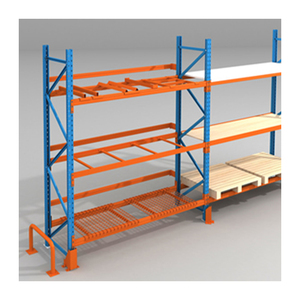
Our pallet rack systems are engineered to satisfy the European standard EN 15512:2020 (Steel static storage systems – Adjustable pallet racking systems – Principles for structural design), the American ANSI MH16.1 standard issued by the Rack Manufacturers Institute (RMI), and Australian AS 4084:2012. We hold official CE Factory Production Control certification (Certificate No. 2435-CPR-8605159) alongside ISO 9001:2015 quality management accreditation (Certificate No. 18624Q00169R0M). Every project includes structural calculation books specifying beam vertical deflection under live service load ($\delta \le L/200$), safety factors for material yield ($\gamma_M \ge 1.1$), and global overturning stability criteria.
How does your factory engineer slotted pallet racks for seismic-prone regions?
+
For seismic projects located across active geological faults (e.g., Japan, the Philippines, Indonesia, New Zealand, or the US West Coast), our engineers adjust racking parameters per EN 16681 and FEMA 460 guidelines. We increase upright gauge thickness (from 1.8mm to 2.5mm or 3.0mm), expand the cross-sectional geometry from 80mm to 100mm–120mm profiles, enhance diagonal and horizontal bracing patterns, and enlarge column baseplates from standard $100\times100\text{ mm}$ to $180\times220\text{ mm}$ with double M16/M20 chemical capsule or mechanical wedge anchors. Non-linear time-history and response spectrum analyses account for spectral ground acceleration ($S_s, S_1$), soil shear wave classifications, and pallet mass participation factors.
What chemical surface finish is optimal for hot, humid tropical climates or cold storage?
+
In humid tropical climates (such as Southeast Asia, the Gulf Coast, and the Caribbean), standard spray painting without chemical pre-treatment fails rapidly through filiform corrosion and peeling. We deploy a multi-stage automated phosphating immersion pre-treatment that removes all oil, mill scale, and microscopic oxides, creating an inert crystalline phosphate surface layer. We then apply an electrostatic epoxy-polyester copolymer powder cured at 200°C to achieve a durable 70–90 micron coating. For sub-zero cold storage facilities with condensation cycles or coastal facilities with airborne chlorides, we supply hot-dip galvanized components certified under ISO 1461 / ASTM A123 with a minimum zinc coating thickness of 65–85 microns, delivering over 25 years of maintenance-free corrosion resistance.
How do you maximize volumetric container loading to minimize international ocean freight costs?
+
Ocean shipping economics are vital in structural steel procurement. Upright frames are shipped knocked-down (unassembled) into tightly banded nested bundles. Upright posts, diagonal bracings, and baseplates are separated to fit maximum steel weight into high-cube containers (40ft HC). Box step beams are stacked with protective corrugated edge boards and nylon strappings, utilizing automated 3D container packing simulations to reach the maximum 26–28 metric ton legal container payload. For overseas contractors with limited field assembly teams, we can also supply factory-bolted frames nested with specialized timber dunnage.
What essential parameters must clients supply to receive an engineering layout and commercial quote?
+
To generate an accurate 2D/3D layout and structural bill of materials (BOM), please provide:
- Warehouse Architectural Floor Plan: Architectural CAD or dimensional sketch indicating clear height under roof joists, column grids, fire protection sprinkler lines, and overhead roller door positions.
- Pallet Load Profile: Overall pallet width, depth, height including cargo overhang, and gross weight per unit.
- Material Handling Equipment (MHE): Forklift model, turning radius, mast lowered height, and maximum mast lift reach height.
- Environmental Conditions: Operating temperatures (ambient, chill, or -25°C blast freezer) and project country/city for seismic load indexing.
Can your factory manufacture custom OEM/ODM profiles to match an existing installed rack system?
+
Yes. We regularly supply international logistics distributors and rack maintenance contractors with OEM/ODM fabricated frames, beams, and replacement components that interface seamlessly with legacy installations. Our CNC tooling division can engineer custom punching dies and roll-forming cassettes to replicate European 75mm/50mm profiles, American teardrop configurations, or proprietary Japanese/Korean column pitches. Clients simply send a 300mm physical sample of the upright post and beam end connector for metallurgical and dimensional reverse-engineering.
What are the on-site installation and field verification protocols?
+
Every shipment arrives with comprehensive, step-by-step CAD isometric erection drawings, itemized packing manifests with color-coded part numbers, and torque specification tables for all frame assembly bolts (standard grade 8.8 structural fasteners). For major commercial projects, we provide remote video installation guidance with our bilingual project engineers or deploy certified installation supervisors to your jobsite to oversee assembly, manage laser alignment, test anchor torque resistance, and issue load capacity warning plaques.