Featured Industrial Steel Racking & Storage Systems
Engineered to strict FEM, RMI, and AS4084 standards using high-tensile Q235B and Q355B cold-rolled steel. Explore our flagship heavy-duty storage configurations ready for worldwide export.
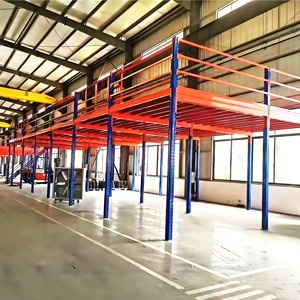
Customized High Density Storage Mezzanine Floor Platform
- Capacity: 300–1000 kg/sqm
- Steel Grade: Q235B / Q355B Cold Rolled
- Structure: Multi-Tier Integrated Picking
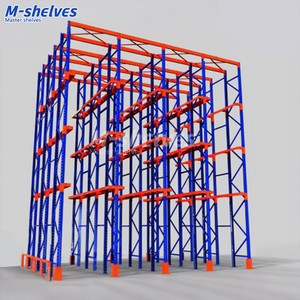
Large Scale E-Commerce Pallet Racking System
- Beam Load: Up to 4,500 kg/level
- Pitch: 50mm / 75mm Adjustable
- Standard: ISO 9001, CE, AS4084
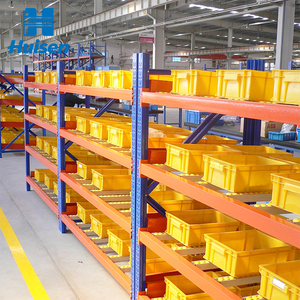
Industrial Carton Gravity Flow Storage Racking
- Track: Aluminum alloy / Sheet roller
- Coating: Anti-Rust Phosphatized
- Efficiency: 40% picking speed uplift
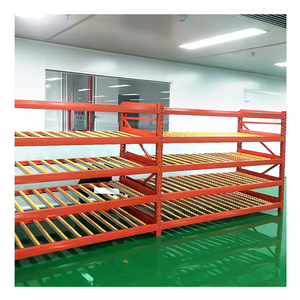
Adjustable Pallet Flow Rack with Roller Tracks
- Pallet Mass: 500–1,500 kg/pallet
- Brakes: Speed controller dampened
- Ideal: Cold room & fast-moving FMCG
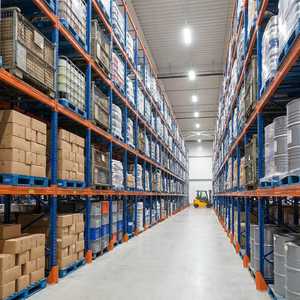
Heavy Duty Adjustable Selective Pallet Racking
- Accessibility: 100% direct pallet access
- Upright Frame: Omega section cold formed
- Safety: 3/4-claw connector locking pins
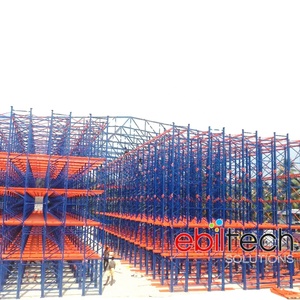
Rack-Clad Building Commercial Construction System
- Structural: Rack supports wall & roof
- Height: Up to 40 meters tall
- Civil Cost Savings: 20% to 35%
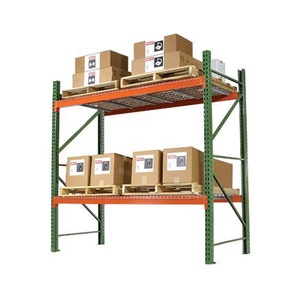
Galvanized & Powder Coated Heavy Pallet Racks
- Finish: Hot-dip galv or epoxy powder
- Application: Freezers, chemical, outdoor
- Salt Spray Rating: Exceeds 500 hours
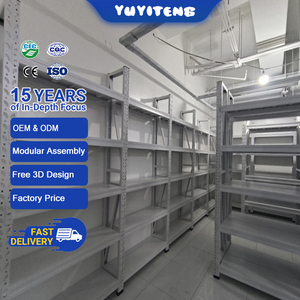
Commercial Shelving Units & Industrial Storage Racks
- Configuration: Boltless modular design
- Shelf Capacity: 200–800 kg/tier
- Flexibility: Reconfigurable steel decking
Engineering Integrity of Heavy-Duty Steel Pallet Racking
Understanding metallurgy, continuous roll-forming tolerances, structural deflection coefficients, and European vs. American design standards when sourcing from China.
The Core Engineering Thesis: Beyond Commodity Steel
In modern high-throughput intralogistics, a steel pallet racking system is not merely passive shelving; it is a dynamically loaded, unbraced or semi-braced slender structural steel frame. Sourcing from a premier Chinese manufacturer requires evaluating cold-formed thin-walled steel profiles, beam-to-column semi-rigid connection moment resistances, perforated column residual stresses, and global seismic resilience governed by FEM 10.2.02, EN 15512, RMI MH16.1, and AS4084-2023.
Certified Metallurgy: Q235B & Q355B
Top-tier Chinese manufacturers utilize prime cold-rolled carbon steel coils sourced directly from major steel conglomerates such as Baosteel, Ansteel, or Shougang. Q235B yields a nominal 235 MPa with high elongation ductility, while low-alloy high-strength Q355B delivers 355 MPa minimum yield strength, allowing slender upright designs to support up to 30,000 kg frame capacities without buckling under eccentric axial compression.
Progressive Cold-Forming Lines
Uprights are manufactured via automated continuous progressive roll-forming machines with 18 to 26 forming roll stations. This multi-pass forming prevents excessive localized work-hardening and micro-fissuring along bend radii, ensuring precise Omega (Ω) profile geometry, tight straightness tolerances (<1/1000 length), and consistent beam connector mechanical interlock across multi-tier bays.
Surface Pre-Treatment & Salt Spray
Long-term durability in high-humidity or sub-zero environments depends entirely on automated surface pre-treatment. Components undergo continuous 7-stage immersion or spraying: degreasing, twin water wash, acid pickling, zinc phosphating, and final passivation before electrostatic thermosetting polyester powder coating (60–90 µm), delivering >500 hours ASTM B117 salt spray resistance.
| Structural Parameter | Selective Pallet Rack | Drive-In Racking | Carton / Pallet Flow | Radio Shuttle ASRS | Rack-Supported Mezzanine |
|---|---|---|---|---|---|
| Steel Grades Applied | Q235B / Q355B | Q235B / Q355B High-Tensile | Q235B Cold Rolled | Q355B Precision Formed | Q235B / Q355B Hot-Rolled Joists |
| Standard Unit Capacity | 1,000–4,500 kg/level | 800–1,500 kg/pallet | 200–1,500 kg/lane | 500–2,000 kg/pallet | 300–1,200 kg/sqm floor load |
| Storage Density Index | Baseline (100% Selectivity) | High (+60% vs. Selective) | Very High (+75% FIFO) | Maximum (+85% LIFO/FIFO) | Floor Space Doubling (+100%) |
| Floor Area Utilization | 35%–40% | 60%–70% | 65%–75% | 75%–85% | 100% of mezzanine footprint |
| Deflection Limits (Beam) | L/200 standard (L/250 ASRS) | Cantilever Rail L/300 | L/250 roller profile | L/300 automated tolerance | L/300 primary; L/200 secondary |
| Safety Pin Dislodgement Force | > 5,000 N vertical shear | Integral high-tensile bolts | 5,000 N locking pins | Locking pin + guide anchors | Structural Grade 8.8 bolts |
Guangzhou HEDA Shelves: 25 Years of Global Racking Leadership
Since 2001, Guangzhou Heda Shelves Co., Ltd. has stood at the forefront of China's heavy-duty industrial storage manufacturing sector, bridging high-capacity metallurgical fabrication with precision international engineering.
Rigorous International Certifications
Procurement directors and general contractors require unassailable compliance documentation for port customs, safety audits, and municipal building permits. Guangzhou HEDA Shelves operates under verified CE Certification (No. 2435-CPR-8605159) for structural steel components, ISO 9001:2015 Quality Management System (Certificate No. 18624Q00169R0M), and environmental RoHS compliance for zero-heavy-metal electrostatic powder coatings.
Turnkey 3D CAD & Finite Element Design
Our in-house design engineering department of over 30 structural engineers delivers custom 2D AutoCAD layout drawings, 3D structural visual renders, and detailed bill of materials (BOM) within 24 to 48 hours. Using advanced Finite Element Analysis (FEA) software (ANSYS and ETABS), our team verifies static deflection, dynamic seismic response, and sway rigidity before sheet metal ever touches a roll-former.
Export Packing & Ocean Freight Optimization
Shipping air inside containers is the primary failure mode of unoptimized international racking procurement. HEDA’s logistics engineers construct custom nested bundling schemes, protective corner protectors, and steel strapped seaworthy skids that maximize container cubing (CBM) inside 40ft High Cube (40HQ) containers. This saves overseas importers up to $35–$60 per pallet position in international ocean freight costs.
10,000+ Completed Warehouses Globally
With systems operational across Southeast Asia (Vietnam, Thailand, Indonesia, Philippines, Malaysia), the GCC (UAE, Saudi Arabia, Qatar), Europe, and North America, our manufacturing plant provides deep familiarity with regional building codes. From seismic adjustments in the Pacific Ring of Fire to high-humidity salt-fog coatings in coastal logistics corridors, HEDA engineers durability directly into every order.
Future Procurement Trends in Industrial Steel Racking
Macroeconomic shifts, land acquisition costs, automated intralogistics, and geopolitical supply chain restructuring are transforming how enterprise logistics leaders procure racking systems.
1. Automation-Ready Hybrid Infrastructure
Procurement teams are moving away from single-purpose selective racking toward "Automation-Ready" hybrid frames. Warehouses designed today must support future retrofits of Autonomous Mobile Robots (AMRs), Automated Guided Vehicles (AGVs), and 4-way radio shuttles. This requires tighter manufacturing tolerances (+/- 1.0mm upright deviation), higher column load factors, and integration of floor-level guidance rails and sensor mounting bracketry during original factory fabrication.
2. Dynamic Total Cost of Ownership (TCO)
Procurement metrics have shifted from pure Ex-Factory Purchase Price per Ton to Lifecycle TCO. Sophisticated global procurement managers evaluate cold-formed steel's yield strength efficiency, impact resistance on lower upright sections, corrosion life expectancy, and reconfigurability costs. Systems manufactured with Q355B high-tensile steel decrease steel weight while maintaining load capability, directly mitigating container freight expenses.
3. Direct Mill-to-Site Supply Chain Integration
Intermediary traders are increasingly bypassed in favor of direct engineering partnerships with verified Chinese manufacturers like HEDA Shelves. Direct factory communication eliminates design translation errors, guarantees structural mill test certificates (MTC Type 3.1), provides live video production auditing, and shortens engineering lead times from initial CAD conceptualization to port embarkation down to 20–25 days.
4. Cold Chain & Sub-Zero Expansion
With the global boom in pharmaceuticals, biotechnology, and fresh grocery delivery, cold chain storage demand is compounding at over 14% CAGR. Because running sub-zero storage (-25°C to -30°C) consumes massive electrical power per cubic meter, procurement focuses heavily on ultra-dense Drive-In and Radio Shuttle systems that eliminate aisle space, combined with specialized anti-embrittlement steel formulations and galvanized coatings.
5. Seismic-First Mandates in Developing Hubs
Warehousing expansion across seismic corridors (Indonesia, Japan, Philippines, Western Latin America, Middle East) has triggered stringent municipal building code audits. Buyers can no longer deploy generic uncalculated racking. Modern procurement contracts require full finite-element modal analysis, baseplate anchor pull-out verification, dynamic ductility testing, and seismic load calculation reports certified by chartered structural engineers.
R&D Evolution in Steel Racking Manufacturing
How Chinese manufacturing plants are deploying Industry 4.0 automation, advanced cold-forming physics, and structural safety innovations to redefine durability.
Multi-Bend Omega Profiles
Traditional C-section columns are obsolete for heavy loads. Advanced roll-formers produce multi-flanged Omega (Ω) sections featuring 12 to 16 cold-rolled bends. These return bends shift the centroid, elevate the radius of gyration, and substantially increase both torsional and flexural-torsional buckling resistance under extreme axial loading.
Robotically Welded Box Beams
Beam load capacities depend on end connector weld integrity. Robotic 6-axis MAG/MIG welding cells produce continuous, deeply penetrated, zero-splatter fillet welds joining twin interlocking C-channels into hermetically sealed box beams. This eliminates structural notch fatigue and human welding inconsistencies.
Laser CNC Punching Lines
Upright column pitch uniformity (50mm or 75mm) is achieved via high-speed progressive mechanical presses and fiber laser cutting units. Tolerance precision within 0.1mm along a 12-meter upright profile ensures fault-free beam connector claw engagement and uniform vertical load transfer to the base foundation.
High-Impact Upright Protectors
Forklift impacts cause over 80% of warehouse rack collapses. Innovations include cold-forged spring-steel column deflectors, wrap-around poly-urethane impact buffers, and dual-anchored floor-mounted end-of-aisle structural crash barriers designed to absorb 10–15 kJ kinetic collisions without transferring deflection into upright frames.
Frequently Asked Questions for Global Buyers
Technical, contractual, logistics, and engineering guidance direct from our chief structural design engineers and export project directors.
What essential architectural & operational data are required to generate an optimized CAD warehouse layout?
- Warehouse CAD Drawing (.DWG / .DXF) or Dimensioned Layout: Including clear internal ceiling heights, column grids/dimensions, emergency egress routes, building bracing, overhead sprinkler pipe drops, and industrial door openings.
- Pallet & Unit Load Specifications: Exact pallet dimensions (Width × Depth × Height, including product overhang), total gross weight per pallet (nominal and maximum), and pallet style (Euro EPAL, standard US 40×48", GMA, perimeter base, or plastic runner skids).
- Material Handling Equipment (MHE): Forklift model, minimum aisle clearance requirement (AST - Aisle Stock Transfer width), maximum mast lift height, collapsed mast height, and turning radius.
- Environmental & Geotechnical Parameters: Operating ambient temperature (dry ambient vs. -25°C cold chain), slab thickness and concrete compressive strength (e.g., C25/30, 200mm slab), and local seismic hazard zone coefficient.
How does Q235B steel compare with Q355B in heavy-duty pallet rack engineering?
Q355B (equivalent to ASTM A572 Grade 50 or EN 10025 S355JR) provides a 355 MPa yield strength (+51% higher mechanical strength) and tensile strength of 470–630 MPa. We engineer upright columns using Q355B for high-bay installations (over 9–12 meters tall), heavy automated AS/RS clad-rack warehouses, drive-in systems with long unbraced column heights, and rack-supported multi-tier mezzanine floors where compressive axial loads exceed standard limits.
What international structural engineering standards do your racks conform to?
- European Standards (FEM / EN): EN 15512 (Steel static storage systems - Adjustable pallet racking systems - Principles for structural design), EN 15620 (Tolerances, deformations and clearances), and FEM 10.2.02.
- American Standard: RMI (Rack Manufacturers Institute) MH16.1 - Specification for the Design, Testing and Utilization of Industrial Steel Storage Racks.
- Australian / Oceanian Standard: AS 4084-2023 - Steel Storage Racking.
- Seismic Design: Eurocode 8 (EN 1998) and ASCE 7-22 structural dynamic calculation methodologies for high seismic zones.
How is rust and corrosion prevented for racks installed in tropical, coastal, or freezer environments?
- Indoor Climate-Controlled: 7-stage chemical pre-treatment (pickling and zinc phosphating) followed by automated electrostatic polyester-epoxy powder coating (dry film thickness: 60–90 microns). Cured in continuous convection ovens at 180°C–200°C for superior impact resilience, passivating against normal humidity.
- Sub-Zero Cold Chain Warehouses (-25°C to -30°C): Specially formulated plasticized epoxy coatings that prevent thermal embrittlement, peeling, or cracking under rapid condensation temperature cycling.
- Coastal / High-Humidity / Chemical Warehouses: Continuous Hot-Dip Galvanizing (HDG) in accordance with ISO 1461 / ASTM A123. The cold-formed steel is immersed in molten zinc (450°C), creating an iron-zinc alloy metallurgical bond with a minimum 70–100 micron (500–600 g/m²) coating that resists salt spray environments exceeding 1,000 hours.
How do you optimize container packing to reduce international ocean freight costs?
- Upright Frames: Nested in paired back-to-back bundles secured with high-tensile steel strapping and heavy corrugated edge board buffers, preventing transit abrasions while fitting maximum tonnage into 40HQ containers.
- Horizontal Beams: Bundled in uniform rectangular packs with non-marking corrugated interleaving and protective dunnage underneath for rapid forklift unstuffing at destination ports.
- Small Hardware: Anchor bolts, locking pins, baseplates, shims, and beam brackets are packed in marked heavy-duty wooden crates or banded steel cages, preventing loss during intermodal multi-leg transit.
Can structural load certification reports and material test certificates (MTC) be provided?
- Mill Test Certificates (MTC Type 3.1): Verifying exact chemical composition (Carbon, Manganese, Silicon, Phosphorus, Sulfur) and mechanical tensile/yield test results for raw steel coils traceable to heat batch numbers.
- Structural Calculation Reports: Comprehensive static and seismic engineering documentation outlining member capacities, deflection limits (e.g., L/200 for beams), connection stiffness coefficients, and baseplate pressure loads against the concrete floor slab.
- Factory Acceptance Test (FAT) & QC Logs: Coating thickness inspection reports, cross-hatch adhesion test results (ASTM D3359), and dimensional tolerance verification.
What is the standard production lead time and FOB/CIF delivery process from Guangzhou?
Located in Guangzhou near the Pearl River Delta maritime nexus, shipments embark from major deepwater container ports: Nansha (Guangzhou), Yantian/Shekou (Shenzhen), or Hong Kong. We handle full export customs clearance, export documentation, certificate of origin issuance (CO, Form E, Form R), and supply CIF/CFR sea freight insurance to any major commercial port worldwide.
Do you provide on-site installation guidance, supervisor dispatch, or assembly drawings?
- Comprehensive Installation Package: Every shipment includes step-by-step 3D assembly guides, bay numbering diagrams, anchor bolt torque charts, and component identification tags.
- On-Site Senior Installation Supervisor: For complex, multi-tier mezzanine floors or large-scale automated shuttle installations, we dispatch experienced bilingual HEDA installation supervisors to overseas job sites to oversee local rigging and labor teams.
- Remote Video Engineering Support: Live video engineering walk-throughs with our structural team during beam leveling, vertical plumbing, anchor torquing, and initial load testing.
Accelerate Your Warehouse Project with Direct Factory Engineering
Connect with our technical design team in Guangzhou today. Send your floor plan or pallet requirements to receive a complimentary 2D AutoCAD layout, 3D structural visual model, and an itemized factory-direct commercial quotation within 24 hours.