NFPA Fire Safe
Waterfall Wire Mesh Decking Selective Pallet Rack
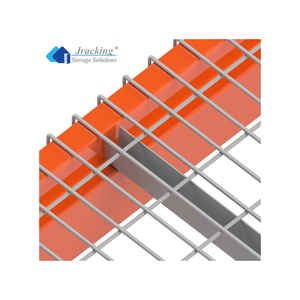
Enhanced overhead fire safety with flared waterfall borders. Prevents pallet drop-through, improves overhead sprinkler water penetration, and fits all step-down beams.
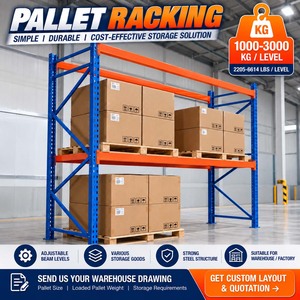
Custom structural engineering designed to handle unit loads up to 3,000 kg per level. Cold-formed Q235B/Q355B high-tensile steel, robotic weldments, and multi-stage anti-corrosion chemical treatment for mission-critical logistics facilities worldwide.
NFPA Fire Safe
Enhanced overhead fire safety with flared waterfall borders. Prevents pallet drop-through, improves overhead sprinkler water penetration, and fits all step-down beams.
3000 kg/Level
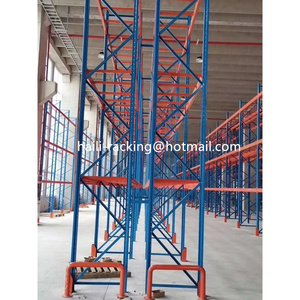
Engineered upright sections with teardrop or diamond slotting. Twin-C closed-box beam profile with 4-5 claw connectors to eliminate beam rotation under heavy industrial payloads.
Retail Automation
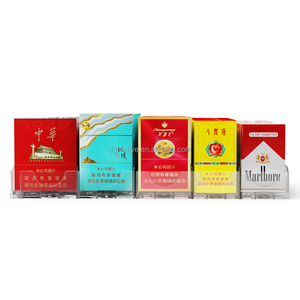
Integrated gravity and spring feeding mechanism for precision item dispensing, automated inventory replenishment tracking, and ultra-high-density micro-logistics picking lines.
EN 15512 Cert
Engineered to exact FEM 10.2.02 and EN 15512 European deflection baselines. Optimized for reach truck handling, Automated Guided Vehicles (AGV), and standard EUR/EPAL pallet networks.
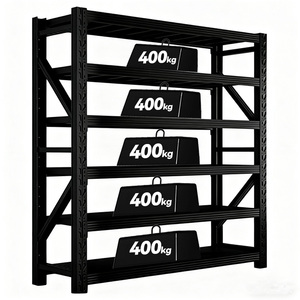
400 kg/Level
Medium-duty longspan framework featuring boltless slot-in construction. Solid cold-rolled steel shelves reinforce torsional rigidity for manual parts fulfillment centers and workshops.
100% Selectivity
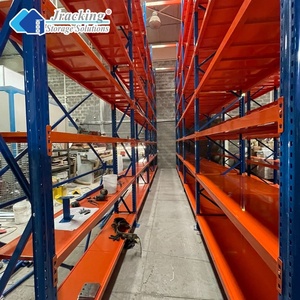
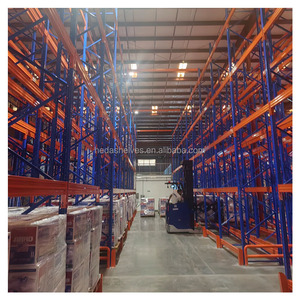
The global benchmark for multi-SKU inventory accessibility. Seamlessly configurable with counterbalanced forklifts, turret trucks, and reach stackers across warehouse clear heights up to 14m.
Structural Anchor
Maintains mandatory flues between back-to-back rack runs while transferring lateral seismic forces. Manufactured from heavy plate steel to prevent structural displacement during impacts.
Boltless Quick-Fit
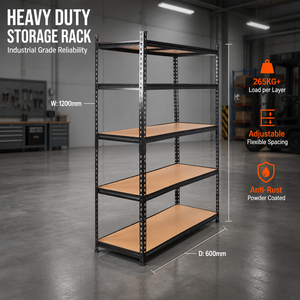
Rapid field assembly boltless shelving framework with double-rivet locking beams. Delivers rugged, vibration-proof performance for distribution hub staging zones and archive storage.
Procuring warehouse racking directly from a Tier-1 Chinese manufacturer requires verified steel metallurgy, traceable quality standards, and precision civil calculation. We deliver turnkey certainty.
Full CE certification (No. 2435-CPR-8605159) and ISO 9001:2015 traceability. All profile designs are calculated under ANSI MH16.1, FEM 10.2.02, and AS 4084 engineering safety load limits.
From prime cold-rolled steel coil slit lines to automatic 24-station continuous roll forming and robotic CNC laser tube profiling, each beam and upright is formed with dimensional tolerances inside ±0.5mm.
Components undergo an automated 7-stage chemical pre-treatment process—including degreasing, ultrasonic acid pickling, and zirconium phosphating—before static thermo-set polyester powder baking at 200°C.
Specialized baseplate calculations, deep-flange footings, and structural steel selection suited for active seismic belts (zones 3–4) and sub-zero blast-freezing environments down to -30°C.
How automation, warehouse real estate costs, and supply chain disruptions are reshaping warehouse rack engineering requirements through 2026 and beyond.
Modern distribution centres are shifting away from purely manual forklift systems toward semi-automated 4-way Radio Pallet Shuttle systems, Automated Storage and Retrieval Systems (ASRS), and AGV high-bay narrow aisles. Specifying tighter beam deflection limits (L/200 down to L/300) and laser-calibrated rail levels has become a non-negotiable procurement requirement.
With warehouse land costs rising across North America, Europe, and Southeast Asia, procurement managers are prioritizing vertical density over horizontal footprint. Multi-tier rack-supported mezzanine systems, push-back systems, and very narrow aisle (VNA) systems up to 18 meters allow operators to double their usable pallet capacity within existing building footprints without taking on expensive civil expansion projects.
Procuring directly from primary OEM Chinese manufacturers allows tier-1 logistics operators to bypass domestic distributor markups of 30% to 50%. Direct engineering collaboration also enables custom beam sizing, exact floor-load calculations, tailored container packaging diagrams, and comprehensive certification packs required for regional building authority approvals.
Direct technical answers addressing structural calculations, load capacities, steel grades, and customs freight clearance for project engineers and procurement heads.
To design an optimized 2D/3D racking solution, our engineering team requires: (1) Building architectural CAD drawings detailing clear building height, column grids, fire exit doors, overhead utility runs, and slab expansion joints; (2) Concrete slab specification (thickness, compressive strength, rebar depth, and sub-base stability); (3) Unit load specifications including pallet type (EUR, ISO, GMA), exact payload dimensions (Width × Depth × Height including product overhang), and maximum weight; (4) Material handling equipment (MHE) turning radius, minimum aisle width, mast lift height, and closed mast height.
All structural upright and beam sections are modeled using finite element structural analysis (FEA) based on international standards including European EN 15512 / FEM 10.2.02, American RMI ANSI MH16.1, and Australian AS 4084. For projects located in seismic zones (e.g., Japan, Philippines, West Coast USA, Turkey), our engineers increase the gauge of upright steel columns, engineer heavy-duty ductile baseplates with dual anchor systems, and incorporate heavy horizontal and vertical spine bracings to absorb lateral seismic acceleration without progressive structural collapse.
We use certified high-yield structural steel coils—primarily Q235B (yield strength ≥ 235 MPa) for light-to-medium components and Q355B (yield strength ≥ 355 MPa) for heavy-duty columns and heavy box beams. Surface finishing follows an automated 7-stage pre-treatment line (chemical degrease, descale, iron/zirconium phosphating, triple DI water rinse) followed by electrostatic powder coating with lead-free, RoHS-compliant thermoset epoxy-polyester powder baked at 200°C (minimum dry film thickness of 60–80 microns). For blast freezers, outdoor yards, or corrosive chemical environments, components can be specified with hot-dip galvanization to ASTM A123 / ISO 1461 standards, achieving a zinc layer thickness ≥ 85 microns.
Every shipment is planned with specialized 3D container packing software to maximize sea container volume (40ft High Cube) and prevent bent upright frames or warped beams during ocean transit. Uprights are bundled with protective dunnage and heavy strapping, while beams are packed in nested steel cages. Every exported system comes complete with detailed installation manuals, component marking codes corresponding directly to CAD drawings, piece counts, torque wrench ratings, and safety load plaques for field sign-off.
Initial 2D CAD layouts and load calculations are delivered within 24 to 48 hours of receiving warehouse blueprints. Upon drawing sign-off and order confirmation, our 30,000 m² facility manufactures a standard 500-to-2,000 pallet-position project in 15 to 25 business days. With deep-water ocean berths near Guangzhou and Shenzhen ports, ocean freight transit ranges from 7–14 days across East & Southeast Asia, 20–28 days to Middle Eastern and European ports, and 18–28 days to the US West Coast.
Send your building dimensions, pallet specs, and handling requirements directly to our Guangzhou engineering team. Receive an optimized 2D layout, 3D render, and factory-direct quotation within 24 hours.