Hypermarket Retail
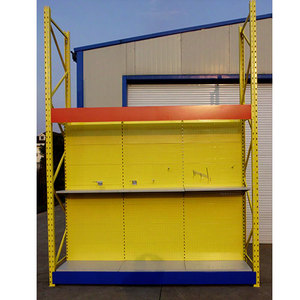
Integrated Hypermarket Shelving & Back Racking System
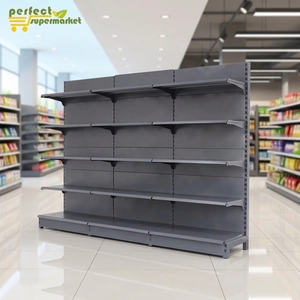
- Perforated Backplate Display Setup
- Capacity: 500–1,200 kg per tier
- Corrosion-Resistant Powder Coat
Engineered from premium Q235B and Q355B cold-rolled structural steel, every system is fabricated in our 30,000 m² Guangzhou production facility, providing maximum structural load-bearing performance and rigorous seismic integrity across demanding distribution environments.
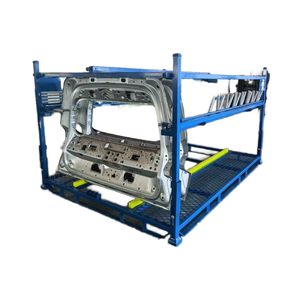
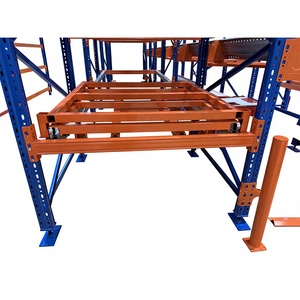
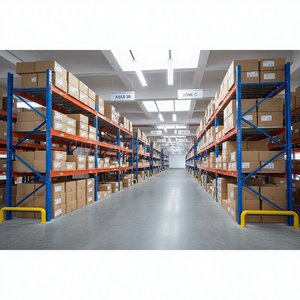
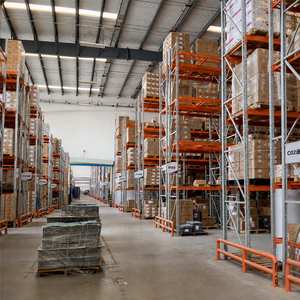
In modern distribution logistics, Back-to-Back racking systems serve as the engineering foundation for multi-SKU warehousing. By coupling two parallel runs of single selective pallet racks through engineered rigid row spacers, facilities realize exceptional structural stability, optimized flue space fire suppression compliance, and maximum pallet storage density.
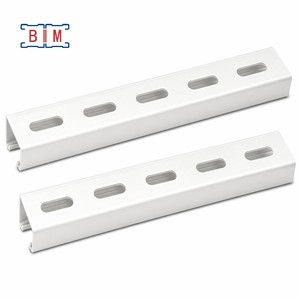
By connecting adjacent single rows back-to-back using heavy-duty C-channel or boxed row spacers (spaced at 200 mm to 450 mm), horizontal sway stiffness increases by up to 34%. This interconnected geometry effectively distributes cross-aisle kinetic forces, dampens forklift impact resonance, and reduces upright profile buckling tendencies under maximum rated payloads.
Global fire safety standards, including NFPA 13, FM Global datasheets, and EN 15512, mandate uniform longitudinal flue spaces. Back-to-back configurations engineered by HEDA Shelves integrate mechanical pallet stops and fixed row spacers to maintain a clear 6-inch (150 mm) vertical chimney flue, ensuring unhindered in-rack sprinkler penetration and vertical thermal plume venting.
Conventional selective pallet racks require dedicated forklift handling aisles for every single rack depth. The back-to-back configuration consolidates two storage lines between shared travel aisles, instantly cutting operating aisle floor footprint by 30% to 42% while preserving 100% immediate selectivity for every single stored pallet position across every level.
With 25 years of structural engineering lineage since 2001, Guangzhou Heda Shelves Co., Ltd. operates as a true factory OEM/ODM powerhouse. Our full-cycle vertical manufacturing guarantees complete process ownership—from continuous automated roll-forming to robotic carbon-dioxide shielding welding.
Unlike regional brokers who outsource manufacturing to unregulated subcontractors, HEDA maintains rigorous quality assurance across every component. Our 10-step line includes:
HEDA warehouse systems are engineered to withstand rigorous seismic and dynamic load demands across global jurisdictions:
Evaluating warehouse racking topologies requires balancing capital expenditure per pallet position against cycle selectivity and operational throughput velocity.
| System Architecture | Selectivity Index | Floor Space Utilization | Operating Aisle Width | Pallet Depth | Relative CAPEX / Pallet | Ideal Application |
|---|---|---|---|---|---|---|
| Back-to-Back Selective | 100% Direct | 40% – 45% | 2.8m – 3.2m (Counterbalance) | 1 Deep (x2 coupled) | Baseline ($) | Multi-SKU 3PL, FMCG, General Distribution |
| Double Deep Racking | 50% (Requires Pantograph) | 55% – 60% | 2.9m – 3.3m (Reach Truck) | 2 Deep (x2 coupled) | 1.15x – 1.25x | Medium SKU, Dry Grocery, Manufacturing Buffers |
| Push-Back Rack (Carts) | LIFO (Per Lane) | 65% – 70% | 2.8m – 3.0m (Standard) | 2 to 6 Deep | 2.2x – 2.8x | Cold Storage, Batch Production, High Turnaround |
| Drive-In Pallet Racks | Strict LIFO / Bulk | 70% – 75% | Specialized Narrow Channel | Up to 10+ Deep | 1.4x – 1.7x | Homogeneous Raw Materials, Beverage Plants |
| Radio Shuttle Automation | LIFO / FIFO Automated | 80% – 85% | Forklift Interface at Lane Face | Up to 30 Deep | 3.0x – 4.2x | Deep Freeze Chiller, High-Throughput Hubs |
Supply chain infrastructure is evolving rapidly. Forward-thinking procurement teams and EPC contractors must evaluate racking suppliers through modern structural, environmental, and technological criteria.
As autonomous mobile robots (AMRs) replace manual counterbalanced forklifts, back-to-back aisle spacing tolerances are shifting from broad manual drive lanes to laser-guided sub-millimeter precision tracks. Upright baseplates now integrate flush floor anchors and guide-rail clearances engineered specifically for SLAM navigation sensors.
Global logistics operators are actively tracking Scope 3 embodied carbon. HEDA Shelves addresses this through certified low-carbon electric arc furnace (EAF) steel sourcing, high-spangle zinc coatings with zero chromium runoff, and VOC-free powder coats, enabling facilities to achieve LEED and BREEAM industrial building accreditations.
Rigid legacy installations are being superseded by bolt-together modular frames with uniform 50mm/75mm upright slot arrays. Every HEDA project includes BIM / TEKLA structural digital twin models, enabling warehouse managers to simulate weight distribution changes, load transfers, and seasonal reconfigurations in advance.
Purchasing warehouse steelwork from overseas requires stringent verification protocols. International procurement heads must demand quantifiable metallurgical and mechanical documentation prior to bill-of-lading issuance.
Never approve full manufacturing release without reviewing:
Common manufacturing shortcuts among low-tier suppliers to actively monitor:
Expert answers addressing structural design, sea freight logistics, floor anchoring, seismic codes, and international installation protocols directly from HEDA Shelves' chief engineering team.
Standard row spacer dimensions range from 200 mm to 450 mm. The precise dimension depends on pallet overhang (typically 50 mm to 75 mm on each side) and local building fire codes. For warehouses operating under NFPA 13 sprinkler regulations, row spacers are specifically sized at 300 mm to 400 mm to guarantee an unblocked longitudinal flue space of at least 6 inches (150 mm).
For installations across seismic regions including Southeast Asia (Indonesia, Philippines), Japan, New Zealand, and the Americas, our structural engineering department performs finite element dynamic seismic response calculations. We configure enlarged footprint baseplates, dual-hole M12/M16 high-tensile anchor bolts, heavy-duty K-type vertical back bracing, and reinforced column foot inserts compliant with Eurocode 8 and ASCE 7-16.
HEDA utilizes certified Q235B and Q355B cold-rolled structural sheet steel sourced directly from premier Chinese state-owned mills. Q235B provides a minimum yield strength of 235 MPa and ultimate tensile strength of 370–500 MPa, ideal for ambient standard beams. Q355B provides a minimum yield of 355 MPa and tensile strength of 470–630 MPa, utilized for ultra-tall uprights, heavy seismic spans, and sub-zero cold room environments down to -30°C.
Upright frames and horizontal beams are nested, banded with heavy-duty steel strapping, and protected by corrugated edge guards and multi-layer stretch shrink film. Timber dunnage blocks and anti-friction rubber padding are installed beneath upright bundles to prevent metal-on-metal abrasion inside 40ft High Cube (40HQ) containers. Small hardware (bolts, safety pins, footplates) is crated in reinforced steel-banded plywood cases with container weight-distribution balance plans.
Yes. As a full-tier OEM/ODM factory, HEDA provides precision teardrop punch patterns (standard US compatibility), 50mm pitch European diamond punching, and 75mm/76.2mm British box slotting. Send us an existing upright or beam profile sample or CAD drawing, and our tooling engineers can match section profiles, gauge thickness, and connector configurations seamlessly.
Preliminary 2D warehouse CAD layout schematics, pallet position counts, and 3D architectural views are supplied within 24 to 48 hours. Upon design freeze and deposit confirmation, standard factory production for a 20-container back-to-back project is typically completed in 18 to 25 business days. Transit time from South China ports (Guangzhou / Shenzhen) averages 4–10 days to ASEAN, 18–25 days to the Middle East and Europe, and 22–32 days to North America.