Featured Industrial Racking & Modular Systems
Precision roll-formed cold steel infrastructure designed to optimize vertical clearance, floor footprints, and stock throughput across global warehousing operations.
Years Manufacturing & Engineering
Consolidated Guangzhou Production Hub
Monthly Structural Steel Throughput
Enterprise Warehouses Engineered Globally
Comparative Matrix: Tier 1 Industrial Racking Architectures
Evaluating load dynamics, cubic utilization rates, selectivity, and operational cycle times for modern distribution centers.
Selecting an industrial pallet storage infrastructure dictates the physical footprint, handling machinery requirements, and fulfillment velocity of a logistics terminal. The engineering trade-off is consistently anchored between direct SKU accessibility (selectivity) and high-density volumetric saturation (cubic space efficiency).
| Racking Topology | Storage Density Index | SKU Selectivity Rate | Inventory Flow Logic | Primary MHE Integration | Optimal Operational Sector |
|---|---|---|---|---|---|
| Selective Pallet Racking | Baseline (40% - 50%) | 100% Direct Access | FIFO / Continuous | Standard Counterbalance / Reach Trucks | Fast-Moving Consumer Goods (FMCG), 3PL Multi-Tenant Hubs |
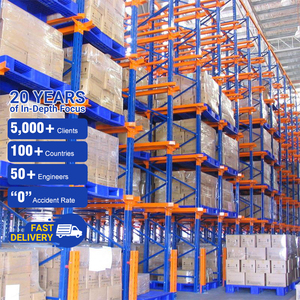
| Drive-In / Drive-Through | High (70% - 80%) | Low (Lane-Restricted) | LIFO (Drive-In) / FIFO (Drive-Thru) | Specialized Narrow-Chassis Counterbalance | Cold Storage, Seasonal Produce, Low-SKU Volume Batches |
| Gravity Pallet Flow | Maximum (80% - 85%) | Medium (Lane Frontage) | Strict FIFO Flow | Standard Loading and Retrieval MHE | Perishable Foods, Pharmaceuticals, Time-Sensitive Goods |
| Radio Shuttle Automation | Extreme (85% - 90%) | Programmed SKU Allocation | Hybrid (LIFO / FIFO Automated) | MHE Transfer + Independent Shuttle Carrier | High-Volume Manufacturing, Deep-Lane Frozen Cold Chains |
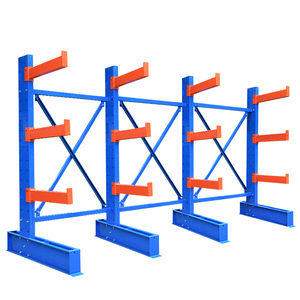
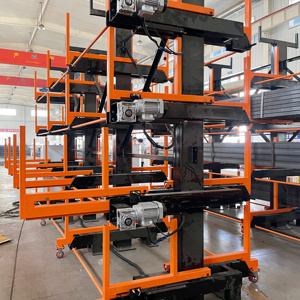
| Cantilever Racks | Variable (Linear Metric) | 100% Unobstructed Face | FIFO / Direct Hook/Fork | Side-Loaders, Multi-Directional Forklifts | Extruded Aluminum, Structural Steel, Timber, Tubing |
| Multi-Tier Mezzanines | Doubled/Tripled Footprint | 100% Piece/Bin Level | Manual Sortation / Conveyor Driven | Forklift Pallet Gates, Vertical Reciprocating Conveyors | E-Commerce Fulfillment, Automotive Spare Parts Distribution |
Under international engineering codes (including EN 15512 and RMI ANSI MH16.1), the selection of cold-rolled high-tensile structural coil (e.g., Q235B, Q355B) combined with finite element beam-to-column connector analysis ensures that seismic deflection margins, shear stresses, and torsional buckling remain within verified tolerances under full load.
Future Procurement Trends Shaping Pallet Racking Investments
Capital allocation strategies are shifting from basic unit-cost steel buying toward holistic total cost of ownership (TCO) lifecycle engineering.
Shift to Carbon-Indexed & High-Yield Structural Steels
Facility developers increasingly mandate Q355B and micro-alloyed ultra-high-yield steel sections over conventional thicker low-grade steel. This reduces deadweight loads on concrete slabs by up to 18%, significantly lowering maritime freight container emissions while preserving equivalent structural elastic limits.
Native BIM Integration & Digital Twin Validation
Procurement contracts now explicitly require complete 3D Building Information Modeling (BIM) structural files (Revit/IFC) prior to roll-forming. This eliminates spatial clashes with ceiling-level ESFR (Early Suppression, Fast Response) fire sprinklers, HVAC ducting, and automated guided vehicle (AGV) navigational corridors.
Demand for Automated Cold-Chain Optimization
Escalating electrical power costs for refrigerated logistics hubs across Southeast Asia and the Middle East are accelerating the phase-out of traditional manual cold rooms. Procurement is pivoting towards automated high-density radio shuttle racks, slashing refrigerated cubic volume waste by over 40%.
Technological Frontiers in Industrial Racking Systems
Examining structural innovations, surface chemistry breakthroughs, and cyber-physical automation interfaces.
Surface Chemistry: Tri-Cationic Phosphating & Anti-Corrosive Coatings
Standard decorative powder coatings fail prematurely when subjected to tropical humidity or cold-room condensation cycles. Advanced plants deploy robotic 10-stage immersion pre-treatment featuring tri-cationic zinc-phosphate chemical bonding, followed by electrostatic epoxy-polyester copolymer coatings to prevent sub-film rust creep.
Seismic Dissipation & Dynamic Damping Baseplates
Warehousing in high-intensity seismic belts (such as Japan, the Philippines, Indonesia, and coastal Pacific fault lines) requires structural ductility. Advanced racking integrates non-linear hysteretic damping anchor systems and multi-bend upright omega columns capable of absorbing kinetic ground acceleration without brittle weld fractures.
IoT Structural Health Monitoring (SHM) Telemetry
Next-generation rack installations feature strain-gauge and MEMS wireless vibration sensors embedded in high-risk aisle upright columns. These modules monitor real-time micro-deflections and impact kinetics from Material Handling Equipment (MHE), instantly alerting operations managers to out-of-plumb safety risks before catastrophic collapses occur.
Guangzhou HEDA Shelves: Global Engineering & Factory Prowess
Direct factory manufacturing transparency with end-to-end accountability from raw coil processing to turn-key commissioning.
25+ Years of Dedicated Roll-Forming Mastery
Established in 2001, Guangzhou Heda Shelves Co., Ltd. has expanded into a premier 30,000 square meter manufacturing infrastructure equipped with automated continuous cold-bending, precision column punching lines, and robotic welding stations producing up to 30,000 tons of structural components monthly.
Certified Compliance & Structural Accreditation
Our products and processes operate under strict, audited European and global structural safety certifications, including official CE Certification (Certificate No. 2435-CPR-8605159), ISO 9001:2015 Quality Management (Certificate No. 18624Q00169R0M), and environmental RoHS-compliant surface coatings.
Free Structural Calculation & 3D CAD/BIM Layouts
Every facility design receives full engineering due diligence: dimensional CAD layout schemes, 3D photorealistic renderings, column cross-section structural checks, and localized seismic dynamic evaluations delivered within 24 to 48 hours to streamline architectural review and municipal permitting.
Global Export Footprint & Precision Maritime Logistics
Operating strategically out of Guangzhou's deep-water logistics hubs, HEDA Shelves engineers and delivers high-cube container loading plans for distributors, commercial enterprises, and 3PLs across Southeast Asia, South Asia, the Middle East, Europe, and the Americas. Detailed step-by-step structural erection blueprints and dedicated engineering support ensure flawless localized installations in over 120 countries worldwide.
Frequently Asked Questions for Warehouse Project Planners
Crucial engineering, safety, and logistical details to review before issuing a Request for Quotation (RFQ).