Medium-Duty
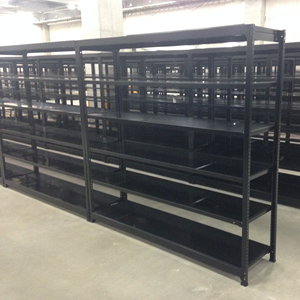
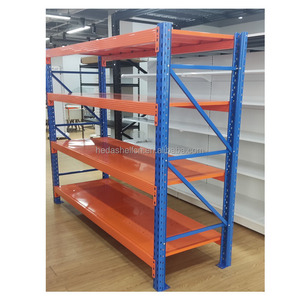
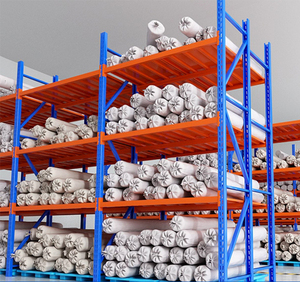
Customized Medium-Duty Warehouse Steel Rack Shelf
- 200-800 kg/tier
- Cold-Rolled Q235B
- Powder Coated
Explore our certified, factory-direct industrial racking portfolio engineered to handle extreme mechanical loads, dense SKU storage, and high-velocity automated or forklift picking workflows.
Operating since 2001 in Guangzhou, we merge extensive mechanical engineering expertise with high-capacity automated production to eliminate intermediaries and structural compliance risks.
Founded in 2001, we have engineered over 10,000 turn-key warehouse installations globally. Our team tailors roll-forming profiles, base plates, and connector lugs to bespoke architectural layouts.
Spanning 30,000 m², our facility features 10-stage automated processing: precision steel slitting, CNC punching, roll-forming lines, robotic MIG welding, and continuous electrostatic powder coating.
Strictly compliant with EN 15512, ISO 9001:2015, CE Certificate No. 2435-CPR-8605159, and RoHS finish regulations. We provide certified FEA load calculation reports for local regulatory filing.
Send us your warehouse CAD drawing. Our senior structural designers deliver high-precision AutoCAD layouts, 3D parametric renderings, and load simulations within 24 to 48 hours without upfront commitments.
In modern high-velocity logistics hubs, industrial storage racking has transitioned from passive structural steel framing to an active, mission-critical interface for robotics, material flow automation, and load analytics. Selecting an industrial rack manufacturer requires analyzing dynamic structural behavior, cold-formed steel metallurgy, load redistribution under seismic excitation, and the total cost of ownership (TCO) across 10-to-20-year lifecycles.
The foundation of reliable industrial racking lies in the structural steel chemistry and roll-forming tolerances. Our facility exclusively uses certified Q235B and Q355B cold-rolled structural steel coils with controlled yield strengths (exceeding 235 MPa and 355 MPa respectively). Unlike hot-rolled structural steel beams, cold-roll formed upright sections introduce work-hardening along the bend radii, yielding higher rigidity-to-weight ratios.
Our upright columns are fabricated with continuous computerized cold-roll forming lines featuring up to 24 roller passes. This multi-stage progressive deformation avoids microscopic surface tears and internal stress localization. Combined with precision CNC punching dies maintaining an axis tolerance within ±0.1 mm, the beam connection lugs lock into upright teardrop or diamond perforations with tight geometric mechanical interlocks. This eliminates unbraced play and drastically reduces frame sway in tall installations (exceeding 12 meters).
Warehouse humidity, coastal air, and temperature cycling in cold storage facilities accelerate galvanic and atmospheric rust. Standard dipped paints are insufficient for durable industrial use. Our automated finishing lines execute a stringent chemical pretreatment protocol:
Stage 1 - Hot Alkaline Degreasing: Removes all lubricants and oil films from cold rolling.
Stage 2 - Acid Pickling: Chemically strips microscopic mill scales and surface oxidation.
Stage 3 - Zinc Phosphating: Deposits a micro-crystalline zinc-phosphate conversion layer to prevent lateral rust propagation under mechanical scratching.
Stage 4 - Electrostatic Powder Coating & High-Heat Curing: Premium thermoset polyester powder is applied uniformly (60–90 μm thickness) and baked at 180°C–200°C. For sub-zero cold room installations down to -30°C or chemical facilities, heavy-duty hot-dip galvanization (HDG) conforming to ASTM A123 / ISO 1461 is applied, guaranteeing decades of rust-free operation.
Selecting the optimal storage configuration requires matching density metrics against accessibility rates. The following matrix illustrates the performance spectrum engineered by our design office:
| Racking Topology | Pallet Density | Selectivity Rate | Inventory Principle | Forklift Equipment Match | Optimal Industry Application |
|---|---|---|---|---|---|
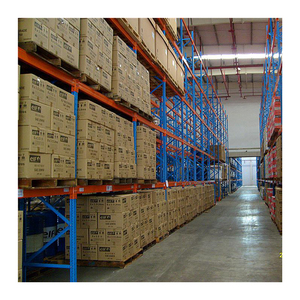
| Selective Pallet Racking | Standard (40-50%) | 100% Direct Access | FIFO / LIFO | Standard Counterbalance / Reach | E-commerce, 3PL, Multi-SKU Distribution |
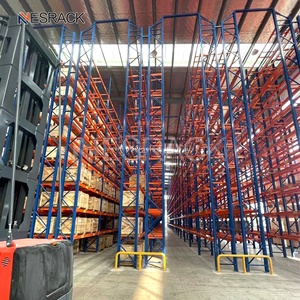
| Drive-In Racking | High (70-80%) | Low (Per Lane) | LIFO (FIFO with Drive-Thru) | Counterbalance / Narrow Cab | Cold Chain, Raw Materials, Seasonal Batches |
| Push-Back Racking | Moderate-High (65%) | 2-6 Pallets Deep | LIFO | Standard Reach Truck | Buffer Zones, Manufacturing Staging |
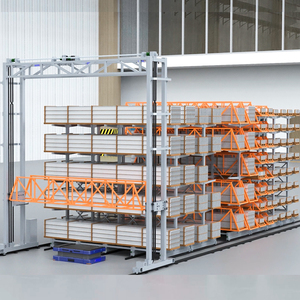
| Radio Shuttle System | Ultra-High (85%+) | High Automation | Automated FIFO / LIFO | Shuttle Cart + Forklift Interface | Beverage Bottlers, High-Density FMCG, Chillers |
| ASRS High-Bay Racks | Maximum (90%+) | 100% Computerized | Programmable WMS/WCS | Automated Stacker Crane / Shuttles | Pharma, Smart Manufacturing, Mega Hubs |
Procurement directors and facility heads are actively redesigning material handling strategies. When formulating 2025–2030 supply chain investments, three macro trends dictate racking specifications:
Warehouses are increasingly deploying Autonomous Mobile Robots (AMRs) and Automated Storage & Retrieval Systems (ASRS). Traditional tolerances (±3mm) lead to robotic optical sensor faults. Procurement contracts now demand tight deflection limits (L/300 to L/500 under full load) and laser-guided plumbness under ±1mm across vertical runs.
Seismic events in active geographical zones (e.g., Southeast Asia, Pacific Rim, Middle East) demand non-linear structural design under EN 16681 and RMI standards. Buyers mandate heavy ductile base plates, reinforced back-to-back ties, dynamic portal bracing, and finite-element modeling verification to prevent catastrophic structural cascade failure during ground acceleration.
Skyrocketing industrial rents are driving high-density vertical expansion over horizontal footprint growth. Procurement teams are specifying pre-engineered, bolt-assembled structural mezzanines that can be dismantled, reconfigured, or relocated without hot work or structural concrete modifications.
Clear, engineering-backed answers addressing the most common technical, logistical, and commercial inquiries from international project managers.