Featured Heavy-Duty & Custom Cantilever Systems
Discover factory-direct, load-certified storage racks manufactured to withstand demanding industrial weights up to 5,000 kg per arm level with zero frontal column obstruction.
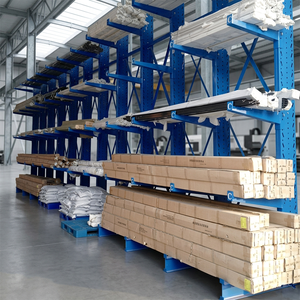
Industrial Cantilever Racking System Heavy Duty 5000kg High Capacity Steel Storage Rack Long Pipe Warehouse
Fabricated with structural hot-rolled Q355B H-beams, delivering unmatched rigidity for oversized steel pipes, bar tubes, and heavy foundry stock.
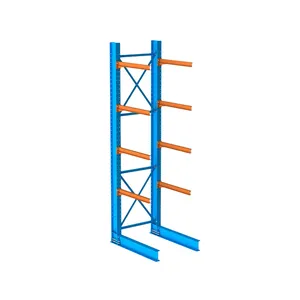
Best Selling Lumber/wood/tube/pipe Storage Cantilever Racks
Versatile double/single-sided configuration engineered for timber yards, PVC extruded profiles, and non-standard industrial bundle handling.
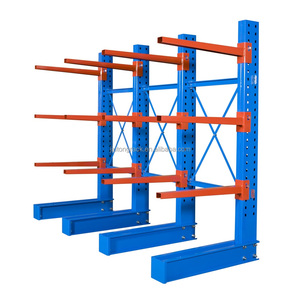
China Factory Economical Cantilever Racks Modular Steel Span Storage System For Wood Storage
Cost-efficient cold-formed modular steel system featuring continuous adjustment pitches for high-density carpentry and millwork warehousing.
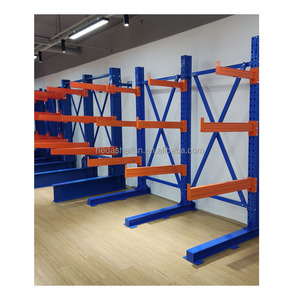
Single Sided Cantilever Rack Industrial Racks and Shelving Heavy Duty Cantilever Racks for Sale
Designed for warehouse perimeter walls to transform idle wall clearances into ultra-rigid vertical load-bearing storage corridors.
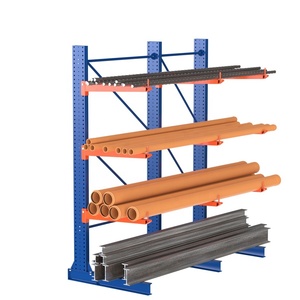
Cantilever Rack For Car Accessories/Pipe/Lumber Storage
Optimized arm tapers and deck cross-bars developed for vehicle body panels, exhaust mufflers, roll-cage tubing, and bulky components.
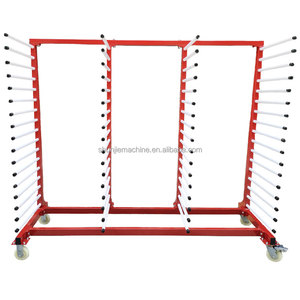
Customizable 2 Meter Length Durable Cantilever Storage And Drying Rack With Four Wheels For Lightweight Panels
Integrated with high-durability industrial polyurethane casters and soft contact cushions for mobile finishing lines and architectural sheets.
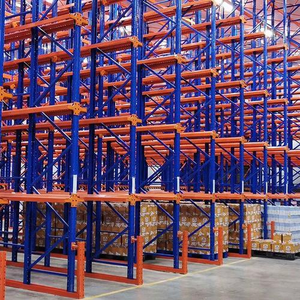
EBILMETAL 5 Steel Very Narrow Aisle Pallet Racking | OEM/ODM Adjustable Heavy Duty VNA Warehouse Racking Factory Direct Price
Engineered for ultra-dense pallet consolidation up to 15 meters clear height, interfacing seamlessly with wire-guided narrow turret trucks.
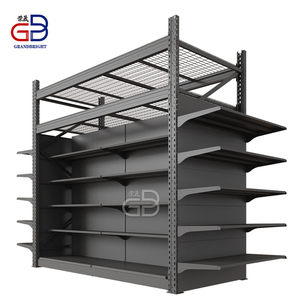
Custom Member Supermarket Shelves Heavy Duty Warehouse Rack And Supermarket Shelf Match Black Gondola Shelving
Commercial-grade hybrid racking merging heavy back-room pallet storage structural capacity with front-facing retail merchandising aesthetics.
Guangzhou HEDA Shelves: 25 Years of Manufacturing Mastery
Established in 2001, Guangzhou Heda Shelves Co., Ltd. has developed into an internationally recognized powerhouse in structural engineering, automated cold-forming, and large-scale warehouse fabrication.
30,000 m² Production Facility
Our dedicated South China manufacturing hub integrates fully autonomous steel coil slitting, high-tonnage robotic punch presses, and multi-roller CNC cold-bending profile lines to guarantee micron-level tolerances.
Rigorous International Certifications
Certified under CE Certification No. 2435-CPR-8605159, ISO 9001:2015 Quality Management (No. 18624Q00169R0M), and environmentally tested RoHS surface compliance for non-toxic industrial coatings.
Global Export & Seismic Engineering
Successfully delivered 10,000+ warehouse projects across 120+ countries. Our dedicated R&D engineering department custom-calculates base anchors, moment stiffeners, and upright bracings for high-intensity earthquake zones.
Structural vs. Roll-Formed Cantilever: Engineering Comparison
Choosing between structural I-beam hot-rolled steel and cold-formed C-profiles dictates your facility's ultimate yield deflection, forklift impact tolerance, and total life cycle investment.
| Engineering Parameter | Roll-Formed Steel (C/Omega Profile) | Structural Hot-Rolled Steel (I-Beam / H-Section) | HEDA Hybrid Optimization |
|---|---|---|---|
| Base Material Grade | Certified Q235B Cold-Rolled Strip Steel | Q355B Heavy Structural Wide-Flange Beams | Q355B High-Tensile Columns with Q235B Arms |
| Deflection Ratio Allowance | L/180 to L/200 under uniform safe working load | L/300 to L/350 (Ultra-low elastic sag) | Guaranteed ≤ L/250 conforming to ANSI MH16.2 |
| Forklift Impact Resistance | Moderate; localized wall crumpling risk on collision | Exceptional; thick structural flanges absorb impact | Reinforced base boots with gusset plates |
| Arm Connection Physics | Pin-clip mechanism or light friction wedge | High-tensile Grade 8.8 / 10.9 structural through-bolts | Heavy-duty safety bolt-in with 100mm/140mm pitch |
| Ideal Storage Targets | Light PVC pipes, carpet rolls, cardboard tubing (≤800kg/arm) | Solid steel billets, sheet packs, timber bundles (≤5000kg/arm) | Fully custom OEM/ODM mixed-SKU warehouse distributions |
Calculated Tapered Arm Design
Our engineers calculate the moment profile of cantilever arms. By tapering the arm from the column connection to the outer tip, dead weight is minimized while the maximum section modulus aligns directly with the peak bending moment at the root connection. This design prevents tip-sagging and guarantees smooth forklift tines clearance.
Moment-Resisting Base Fixity
Cantilever towers lack frontal upright ties, requiring base connections to act as absolute rigid moment frames. HEDA base plates are welded with continuous submerged arc procedures, reinforced with stiffener ribs up to 20mm thick, and secured using multi-point Hilti mechanical or chemical capsule anchors into high-spec concrete slabs.
Seismic Dissipation & X-Bracing
In accordance with FEMA 460 and European R-Carm guidelines, cantilever bays are tied into unified blocks using heavy cold-formed structural angles in tension-compression X-bracing. This configuration stabilizes the longitudinal warehouse axis, resisting seismic shock waves and dynamic operational braking shears without racking twist.
Future Procurement Trends in Industrial Cantilever Systems
Procurement executives are shifting from transactional purchasing to lifecycle-driven engineered assets. Analyze the macro dynamics shaping industrial cantilever procurement from 2025 through 2030.
1. AGV & Side-Loader Integration
Modern warehouse projects demand cantilever racks engineered with precision guidance curbs and magnetic floor sensor clearances. Procurement plans increasingly mandate optical reflector mounts directly on cantilever columns to accommodate autonomous laser-guided automated guided vehicles (AGVs) and specialized narrow-aisle multi-directional side-loaders.
2. Climate-Adaptive Metallurgy & C5 Coatings
With industrial supply chains expanding across humid tropical belts and coastal industrial zones, simple indoor painting no longer passes procurement audits. High-demand procurement orders require continuous hot-dip galvanizing (ISO 1461 compliant) with minimum 85-micron zinc coating thickness or marine-grade C4/C5 polyester thermosetting resins that prevent rust under 1,000+ hours of continuous salt-spray testing.
3. Modular OEM Private Labeling
Regional rack distributors and material handling integrators across Europe, North America, and Southeast Asia are shifting manufacturing capital off their balance sheets. By partnering with audited OEM/ODM giants like HEDA Shelves, brand owners obtain turnkey white-label supply with custom punching geometries, personalized powder-coat RAL matching, and custom container loading schemes that eliminate empty space.
Technological & Design Advancements in Cantilever Storage
Discover how computational engineering, dynamic metallurgical profiling, and IoT telemetry are upgrading traditional static steel racks into responsive warehouse systems.
Pivot-Pin Safety Impact Absorption
Traditional rigid welded arms suffer catastrophic weld-cracking when hit by uplifting forklift masts. Next-generation HEDA cantilever arms utilize an engineered radial pivot pin with retaining cotters. When an operator accidentally hits the arm from beneath, it pivots upward safely without transferring destructive bending moments to the main tower upright, falling back into position under gravity.
Cantilever Roof & Outdoor Cladding Racks
Rather than building expensive steel buildings, developers are deploying "Rack-Clad" cantilever systems. The cantilever towers double as structural support columns for roof rafters and side wind sheeting. HEDA's specialized outdoor canopy arms incorporate integrated drainage fall slopes, gutter brackets, and wind-uplift anchors engineered to local meteorological codes.
Removable Magnetic Stop Retainers
Handling rounds, pipes, and cylinders presents roll-off safety risks. Modern system designs incorporate spring-actuated, drop-in, or magnetic pipe stop pins that extend 100mm to 300mm above the arm surface. Operators can quickly drop or remove stops without special tooling, maximizing loading productivity while remaining compliant with OSHA and EN 15635 warehouse safety guidelines.
Frequently Asked Technical & Procurement Questions
Detailed answers prepared by senior structural engineers covering load deflections, seismic building approvals, surface pre-treatments, and OEM container shipping.
Cantilever load capacity is not a simple cumulative sum. Arm capacity is calculated on a Uniformly Distributed Load (UDL) assumption across the usable arm length. If the load is concentrated at the arm tip, maximum bending stress doubles, reducing effective capacity by up to 50%. Column load capacity depends on overall height, vertical arm spacing, and single vs. double-sided symmetry. Double-sided columns counteract opposite bending moments when loaded equally, whereas single-sided columns require heavier flange thicknesses to resist continuous eccentric overturning forces.
Yes. In high seismic zones across the Philippines, Indonesia, Japan, and Taiwan, our technical department conducts finite element modal analysis (FEM). We calibrate base plate dimensions, add gusset stiffener plates, specify high-ductility anchor bolts with embedment depths up to 250mm, and introduce continuous heavy diagonal back-bracing systems. Complete structural engineering calculation reports and PE stamps can be supplied for local government building permit applications.
All components pass through an automated 10-stage pre-treatment line: degreasing, water rinsing, acid pickling to eliminate mill scale, secondary rinse, and zinc phosphating to establish an active micro-crystalline anti-corrosion barrier. Following pre-treatment, components enter an electrostatic powder booth where lead-free, RoHS-compliant thermosetting polyester resin is applied at 60 to 80 microns thickness, cured in a 200°C baking tunnel. For extreme coastal or outdoor operations, full hot-dip galvanization conforming to ASTM A123/ISO 1461 is available.
For light roll-formed systems (arm loads ≤ 500 kg), a reinforced slab of 150mm thickness with 25 MPa compressive strength is generally sufficient. For heavy-duty structural I-beam systems (arm loads 1,000 kg to 5,000 kg and column heights ≥ 6,000 mm), concrete thickness must reach 200mm to 300mm with 30 MPa minimum strength, free of expansion joints within 200mm of anchor bolt holes. If the existing foundation does not meet these criteria, our engineers design load-distributing spreader base beams to safely reduce localized soil stress.
Freight cost optimization forms a core component of our export engineering. Cantilever columns, bases, and arms present irregular geometry. We engineer custom nested steel racking cradles that lock profiles tightly, preventing transit friction while allowing fast unloading by forklift. Uprights and arms are bundled using protective non-marking bubble wrap and heavy polyester strapping. A standard 40ft High Cube container typically holds between 22 to 26 metric tons of steelwork, keeping shipping freight cost per pallet position to a minimum.
To generate an accurate engineering drawing and budget breakdown, send us: (1) Warehouse architectural CAD or dimensioned sketch noting clear building height and internal obstacles; (2) Detailed product dimensions (outer diameter, length, minimum/maximum weight per bundle); (3) Forklift model, mast maximum lift height, and minimum turning radius; and (4) Site installation location to verify seismic and wind code parameters. Our bilingual engineering team will provide a 3D visual rendering, column load verification, and itemized factory-direct quote within 24 to 48 hours.
Request Your Custom OEM/ODM Cantilever Layout & Quote
Collaborate with certified Guangzhou HEDA engineers. Receive full 2D CAD floor plans, realistic 3D warehouse renderings, and structural weight calculation sheets designed around your facility dimensions and budget.