Engineered Warehouse Storage & OEM Shelving Systems
Every logistics facility demands tailor-made load capacities, corrosion thresholds, and structural geometry. Explore our core OEM manufacturing series, cold-formed from certified high-tensile structural steel.
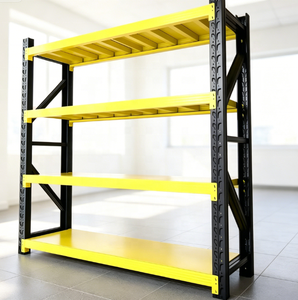
Boltless Adjustable Heavy Duty Load-Bearing 500kg/Layer 4-Layer Steel Storage Shelf Warehouse Industrial Stack Storage Racking
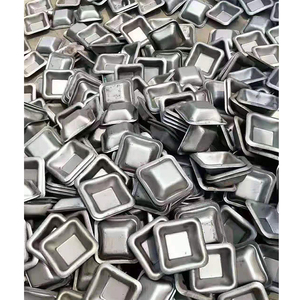
Metal Pallet Feet for Detachable and Foldable Steel Stillage Stacking Racks
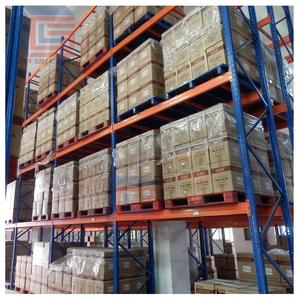
Industrial Heavy Duty Steel Pallet Rack Warehouse Shelving System for Storage, Distribution Center and Factory Use
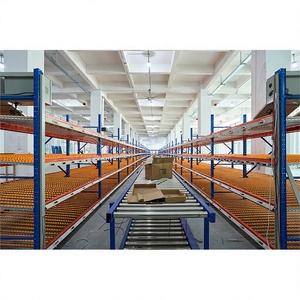
Automated Carton Flow Gravity Racking FIFO Steel Roller Warehouse Storage System Heavy Duty Pallet Live Rack
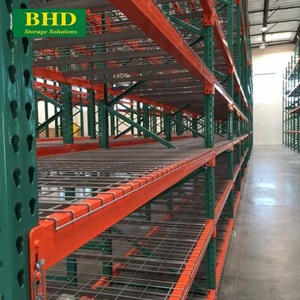
Top Selling Heavy Duty Teardrop Steel Pallet Racking Corrosion Protection for Warehouse Storage Support Bar Row Spacer Inventory
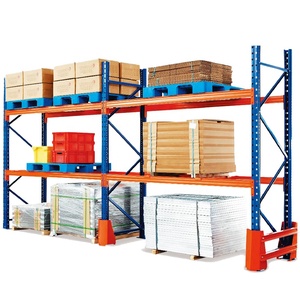
Wholesale Heavy Load Racks Supplier Adjustable Heavy Duty Cold Rolled Steel Powder Coated Warehouse Shelving
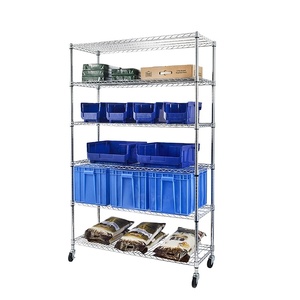
NSF Factory Industrial Warehouse Metal Mobile Storage Wire Racks Shelving Systems
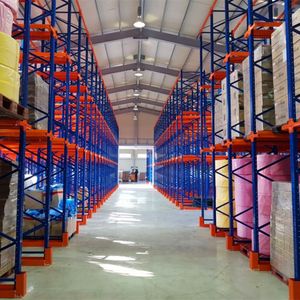
Heavy Duty Steel Drive-In Pallet Racking for Industrial Warehouse Storage Cargo & Storage Equipment
Structural Integrity, Deflection Tolerances & Steel Chemistry
Specifying heavy-duty shelving requires an acute understanding of cold-bent profile mechanics, dynamic beam deflection limits, and steel chemical properties under sustained load.
Metallurgical Selection: Q235B vs. Q355B
We source prime steel coils with certified yield strength ($f_y \ge 235\,\text{MPa}$ up to $355\,\text{MPa}$) and elongation over 26%. This ensures that even under maximum concentrated load limits, upright columns resist local buckling and sudden brittle collapse under seismic conditions.
- Carbon content strictly controlled $\le 0.20\%$
- Phosphorus & Sulfur limits $\le 0.045\%$
- High Charpy V-notch impact toughness for cold storage
Deflection Limits: The L/200 & L/250 Standard
In accordance with FEM 10.2.02 and EN 15512 codes, beam span deflection under maximum design working load (DWL) must not exceed $L/200$ for standard industrial pallet racking and $L/250$ or $L/300$ for automated AS/RS shuttle interfaces to prevent jamming of mechanical handling equipment.
- Continuous roll-formed box and step beams
- Robotic automatic multi-point seam welding
- 3, 4, or 5-claw connectors with integral safety locks
Corrosion Shielding: 10-Stage Surface Treatment
Tropical and high-humidity distribution centers experience accelerated metal degradation. Our facility employs a 10-step pickling, degreasing, and silane/phosphate pre-treatment before applying 60–80 μm electrostatic thermoset polyester powder coating, passing ASTM B117 salt spray tests over 500 hours.
- Heavy-metal-free, RoHS-compliant polymer powders
- Hot-dip galvanized (HDG) coating option $\ge 85\,\mu\text{m}$
- Sub-zero polyurethane formulations for deep-freeze (-30°C)
Structural Comparison Across Warehousing Configurations
Evaluate critical manufacturing specifications across selective, drive-in, live flow, and mezzanine structural systems to ensure optimal capex deployment.
| System Classification | Primary Steel Grade | Upright Column Section | Maximum Bay Load | Floor Space Efficiency | Compliance Standard |
|---|---|---|---|---|---|
| Selective Pallet Racking | Q235B Cold-Rolled | 80×60 to 120×95 mm | Up to 24,000 kg | 40% - 50% | EN 15512, RMI MH16.1 |
| Drive-In / Drive-Through | Q355B High-Yield | 90×70 to 140×100 mm | Up to 28,000 kg | 75% - 85% | FEM 10.2.02, AS 4084 |
| Automated Gravity Flow | Q235B / Alloy Rollers | 100×70 to 120×95 mm | Up to 18,000 kg | 70% - 80% | EN 15620, CE Marking |
| Heavy-Duty Cantilever | Hot-Rolled H-Beam / Q355B | 200×100 to 400×150 mm | Up to 5,000 kg / Arm | Flexible / Outdoor | AISC 360, EN 1993-1-1 |
| Multi-Tier Mezzanine | Q235B / Cold-Formed C-Beam | 100×100 to 200×200 mm | 300 - 1,200 kg / m² | 100% Volume Doubling | IBC 2021, EN 1090-2 |
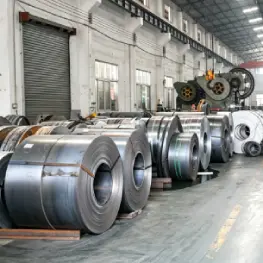
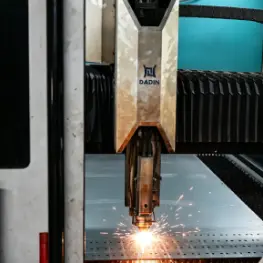
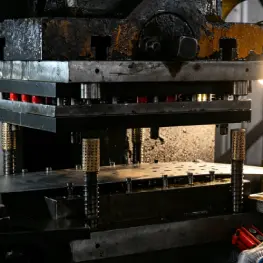
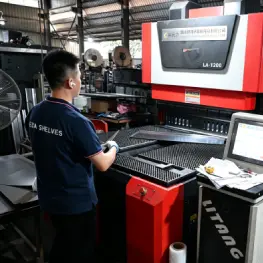
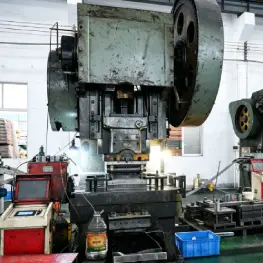
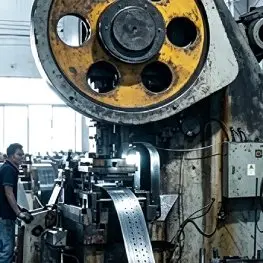
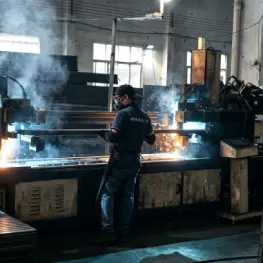
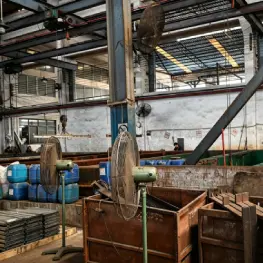
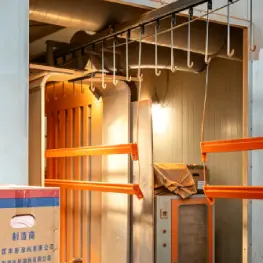
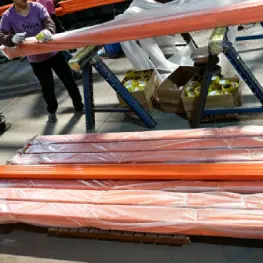
10-Step Automated Production & Quality Control Workflow
From mill-test validated steel coils to ultrasonic weld testing and robotic powder coating lines, our 30,000 m² factory operates under total ISO 9001:2015 traceability.
Future Procurement Trends in Industrial Warehousing & Storage
How evolving macro logistics patterns, rapid automation adoption, and decarbonization mandates are shaping warehouse shelving procurement strategies worldwide.
1. Integration with Autonomous Mobile Robots (AMRs)
Traditional static shelving is transitioning toward hybrid picking bays engineered specifically for AMR and AGV clearance. Warehouse buyers are demanding floor-anchoring baseplates recessed flush to the floor, higher-precision vertical upright alignment (tolerance $\le \pm 1.5\,\text{mm}$ over 12 meters), and bottom-clearance portals engineered for robotic under-chassis transit.
2. Nearshoring & Agile Supply Chain Buffering
Global supply chain volatility has made just-in-time inventory risky. 3PLs and tier-1 manufacturers across Southeast Asia, North America, and Europe are expanding holding capacity by 35% through high-density push-back, radio shuttle, and double-deep racking. OEM modular designs that can be rapidly reconfigured without welding are achieving premium procurement priority.
3. Scope 3 Carbon Reductions & Green Steel
Multinational procurement mandates increasingly evaluate embodied carbon footprints. Factory direct suppliers utilizing electric arc furnace (EAF) processed steel, low-temperature curing thermoset powder coatings, and zero-wastewater recycling closed-loop phosphating systems are winning global infrastructure tenders over legacy high-emission manufacturers.
Emerging Developments in Custom Racking & Shelving Systems
From structural health monitoring sensors embedded in beam joints to extreme seismic dissipation bases, explore what next-generation warehouse racking systems deliver.
Smart IoT Load Sensors & Deflection Telemetry
Industrial racking systems are becoming cyber-physical assets. Next-gen beams are equipped with low-power wireless strain-gauge sensors calibrated to trigger alerts when accidental load concentrations exceed 95% of maximum design capacity, or when forklift collision vibrations threaten column verticality.
Seismic Energy Dissipation Base Plates
For warehouse sites located in active earthquake regions (such as the Pacific Rim, Indonesia, Philippines, and Japan), advanced racking bases now employ dual-stage friction damper assemblies. These bases absorb horizontal shear stress waves during seismic events, preventing upright shear bolt failure and preserving frame geometry.
Nano-Ceramic Zirconium Pre-treatment
Replacing traditional zinc phosphating, advanced factories are adopting nano-ceramic zirconium conversions. This creates a denser inorganic conversion layer (20–50 nm) directly on the cold-rolled steel, offering superior paint adhesion, extreme scratch resistance during pallet sliding, and 30% higher resistance to edge corrosion.
Frequently Asked Engineering & Procurement Questions
Detailed answers to the technical, commercial, and logistical questions most frequently raised by international EPC contractors, facility directors, and OEM buyers.
What engineering data is needed to generate a free 3D CAD racking layout?
To produce an actionable structural plan and load calculation, we require: (1) Architectural DWG drawings indicating clear building height under truss, column pitch, and slab joint positions; (2) Concrete slab load capacity (kN/m² and concentrated point load capacity); (3) Pallet specifications including width, depth, height, and gross weight inclusive of overhang; (4) Handling equipment specifications, especially minimum aisle clearance turning radius (AST) and mast lift height; and (5) Ambient operating temperatures (ambient, chilled, or -25°C blast frozen).
How do cold-formed profile tolerances affect bay structural safety?
In accordance with EN 15512 and RMI standards, cross-sectional thickness variance must not exceed $\pm 5\%$. Under-gauge steel profiles (often supplied by low-cost traders) drastically reduce the column radius of gyration ($r$), leading to premature elastic-plastic buckling under combined axial compression and bending moments. Our factory maintains strict acoustic thickness telemetry on all slitting and roll-forming lines.
What anti-corrosion coating should be chosen for coastal or cold storage sites?
For standard temperature-controlled warehouses ($15^\circ\text{C}$ to $25^\circ\text{C}$), a 60–80 μm electrostatic polyester powder coat over a phosphated base is optimal. For coastal facilities within 5 km of seawater or sub-zero cold storage facilities experiencing condensation cycles, we recommend hot-dip galvanization conforming to ISO 1461 / ASTM A123 (minimum 85 μm zinc thickness) or pre-galvanized coils (Z275 coating mass) to ensure 20+ years of rust-free life.
Can HEDA Shelves provide calculation reports for local building permits?
Yes. Our engineering department uses advanced FEA (Finite Element Analysis) software to generate complete structural calculation packages conforming to Eurocode 3 (EN 1993-1-3), American RMI MH16.1, or Australian AS 4084 standards. These packages include seismic response spectrum calculations, beam deflection curves, and baseplate anchor pull-out shear checks signed by licensed structural engineers for municipal approval.
What are typical OEM lead times, MOQs, and container loading optimizations?
Our standard production cycle is 15 to 25 working days from CAD approval. Minimum order quantities start at one 20ft container (approx. 18 to 22 metric tons), but full 40ft High Cube containers are recommended to minimize ocean freight cost per pallet position. Our dedicated logistics team creates computerized 3D container packing layouts to eliminate transit damage and achieve 98% cubic space utilization.
Can rack-supported mezzanines integrate vertical reciprocating conveyors (VRC)?
Absolutely. When designing multi-tier rack-supported platforms, our engineers integrate dedicated structural shafts, perimeter barrier kick-plates, and reinforced beam load-transfer headers capable of handling the dynamic shock loading of hydraulic or mechanical vertical reciprocating conveyors (VRC), spiral carton chutes, and powered roller conveyor lines.
Request a Structural Engineering Consultation & Full Catalog
Partner directly with Guangzhou Heda Shelves Co., Ltd.—over 25 years of specialized storage rack manufacturing, 30,000 m² factory capacity, and proven installations across 120+ countries. Get an engineered 2D/3D layout and load audit tailored to your facility.
Direct Factory Quotation
Connect with our senior logistics project engineering team for instant technical consultation and comprehensive technical data sheets.
Get Catalog