Commercial Grade
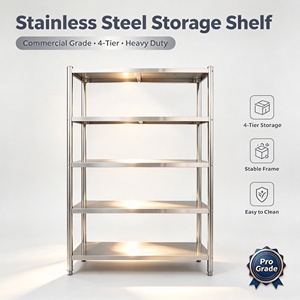
4 Tier Stainless Steel Commercial Kitchen Shelving Unit
Hygienic 304/201 stainless steel; anti-microbial clean design for cold rooms & restaurant warehousing.
Custom-designed and manufactured cold-formed structural steel storage units. Sized to match your dynamic bay heights, specific pallet configurations, and industrial load capacities.
Hygienic 304/201 stainless steel; anti-microbial clean design for cold rooms & restaurant warehousing.
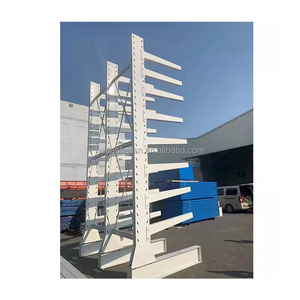
Unobstructed arm access up to 3,000 kg/arm; ideal for lumber, steel tubes, PVC pipes, and long profiles.
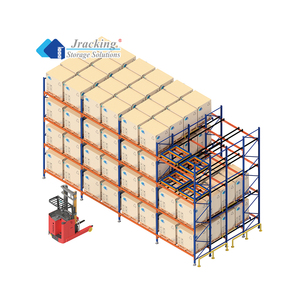
2-6 pallet deep nested cart gravity feeding system, eliminating internal vehicle aisle congestion.
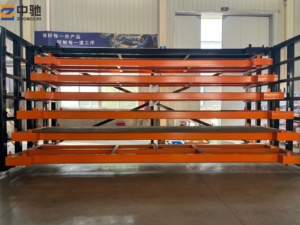
Automated pickling & electrostatic polymer layer; built for high-bay industrial distribution hubs.
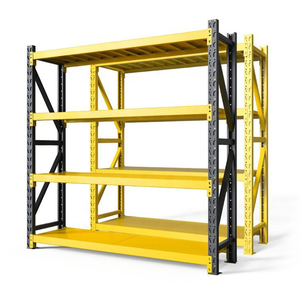
Portable, post-stackable frame engineering suitable for temporary buffers, basements, and seasonal bulk.
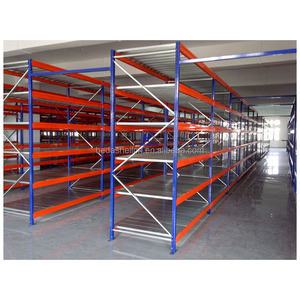
Rapid clip-in interlocking engineering; 200–800 kg/tier capacity without requiring nut-and-bolt hardware.
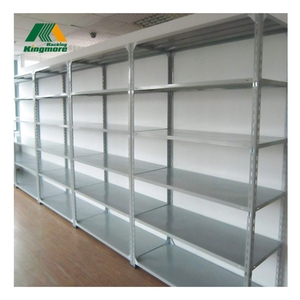
Tailored dimensions for manual parts fulfillment, retail DC buffering, and archive operations.
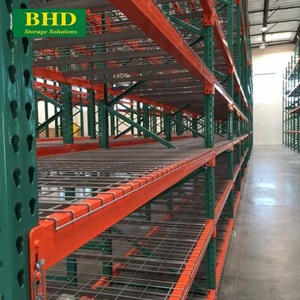
Universal North American teardrop compatibility, reinforced column baseplates, and row spacer bundles.
Established in 2001, Guangzhou HEDA Shelves Co., Ltd. operates a specialized 30,000 square-meter fabrication plant equipped with robotic welding cells, continuous roll-forming lines, automated column perforators, and dual-line electrostatic coating tunnels.
With global logistics real-estate lease prices expanding by 6.8% year-over-year in primary economic zones, logistics engineers and C-level procurement managers can no longer rely on standardized, off-the-shelf static shelving. Strategic warehouse procurement is undergoing structural changes.
Warehouse safety protocols have shifted from prescriptive sizing to rigorous finite-element load calculations. Upright gauge thickness (1.5mm–2.5mm Q235B/Q355B high-tensile steel) and frame depth ratios are precisely calculated against regional seismic acceleration zones (e.g., the Pacific Rim, Indonesia, Philippines, Japan). Baseplates now mandate dual heavy-duty expansion chemical anchor pins to mitigate micro-torsion caused by dynamic seismic pulses.
Traditional selective racking retains 100% pallet accessibility but consumes over 55% of the total warehouse footprint purely in forklift turning aisles. Procurement models are moving toward deep-lane Radio Shuttle and Push-Back configurations. These systems boost storage density by 40% to 75% while minimizing inside-lane forklift impact hazards by utilizing radio-controlled pallet runners.
Standard paint finishes regularly suffer from delamination and subsurface oxidation when installed in Southeast Asia and the Middle East. High-grade OEM specifications now demand an 8-stage pre-treatment phase: high-pressure alkaline degreasing, twin-rinse acid pickling, and dynamic zirconium-iron phosphating prior to 70–90µm electrostatic thermoset powder curing.
Evaluate volumetric footprint, equipment compatibility, capital expenditures (CAPEX), and operational picking speeds across standard configurations.
| Racking Topology | Space Utilization Ratio | Stock Access (FIFO vs LIFO) | Forklift Compatibility | Structural Maintenance Cost |
|---|---|---|---|---|
| Standard Selective Racking | 35% – 45% (Baseline) | 100% Immediate Direct Access (FIFO) | Standard Counterbalance / Reach Trucks | Low (Standard upright protectors) |
| High-Density Drive-In Racks | 65% – 75% High Density | Strict Last-In, First-Out (LIFO) | Narrow Counterbalance / Specialized Reach | Medium-High (Mast collisions inside lanes) |
| Nested Push-Back Racking | 60% – 70% Deep Storage | LIFO (2–6 Pallets per Cart Bay) | Universal Reach Trucks (External Bay) | Low-Medium (Enclosed cart bearings) |
| Radio Shuttle Automation | 75% – 85% Maximum Density | Selectable FIFO or LIFO Programming | Standard Forklifts (External Bay Entrance) | Extremely Low (Trucks never enter bays) |
| Cantilever Heavy Racks | Linear Free-Span Profiling | Direct Crane / Side-Loader Retrieval | Side Loaders, 4-Way Trucks, Combi-lifts | Low (Heavy pivot joint shear-pins) |
Modern distribution facilities are rapidly integrating autonomous robotics, IoT, and hybrid mezzanine structures directly into their physical storage systems.
Future-ready storage units now feature widened clear bottom bays and recessed anchor baseplates designed to accommodate floor-running Autonomous Mobile Robots (AMRs). Rather than manual pallet jack entry, the lowest levels integrate optical floor targets, guide-rail induction, and laser safety stops, turning the racking frame into a high-density vertical sorting depot.
Logistics facilities in high-rent transit hubs (e.g., Hong Kong, Singapore, Dubai) are transforming open air space into productive picking floors. Instead of building separate structural steel platforms, the racking columns double as vertical pillars that support 2 to 4 levels of mezzanine floors, slashing civil engineering costs while multiplying usable floor space without relocation.
Precision roll-forming equipment shapes specialized box-step beams and closed-tube profiles with internal stiffening ribs. These advanced geometries deliver high yield strengths with less raw steel weight, safely maintaining standard deflection ratios (1/200 or 1/180 of clear beam span) even under continuous maximum working loads.
Guangzhou HEDA Shelves Co., Ltd. oversees every stage of manufacturing—from raw steel coil validation to containerized ocean shipping—to guarantee high mechanical precision, clear assembly tolerances, and dependable delivery timelines.
We source certified hot-rolled Q235B and Q355B coils directly from Baosteel and Shougang. Every lot undergoes spectrometer testing, tensile strength analysis, and elongation verification before entering the slit lines.
Upright columns and box-beams are fabricated on continuous CNC multi-roller cold lines. Automated hole punch arrays maintain consistent pitch tolerances (±0.1mm) across 12-meter continuous sections.
Components pass through automated chemical baths for degreasing, de-rusting, acid pickling, and phosphating. This crucial process ensures durable powder coating adhesion and prevents rust under corrosive conditions.
We provide detailed container packing plans to prevent in-transit scratching and transit flex. Every shipment includes step-by-step CAD installation prints and fastener schedules for straightforward on-site assembly.
Clear, practical answers from HEDA Shelves' technical team on load ratings, international certifications, seismic compliance, and layout lead times.
Submit your warehouse dimensions and floor plan to receive a complimentary 2D CAD layout, photorealistic 3D rendering, and structural load analysis from our Guangzhou engineering team within 24 to 48 hours.