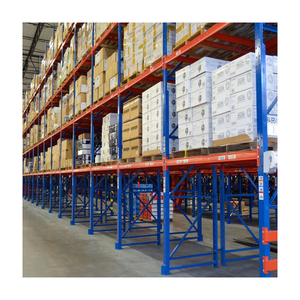
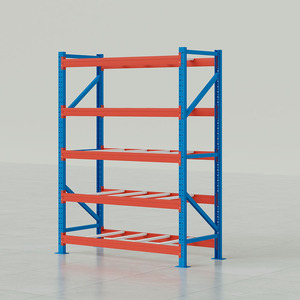
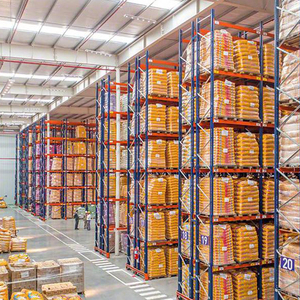
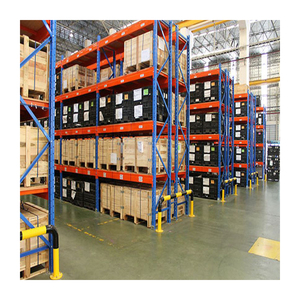
Executive Summary: As modern global supply chains face escalating industrial real estate lease costs, warehouse directors and distribution center planners are transitioning from traditional selective wide-aisle storage configurations (3.2m – 3.8m aisles) toward Very Narrow Aisle (VNA) racking systems operating at clear aisle dimensions of 1.5m to 1.85m. This technical whitepaper dissects the engineering principles, structural calculation methodologies, OEM/ODM manufacturing standards, and material specifications required when sourcing custom narrow aisle pallet racking directly from premier Chinese manufacturing facilities.
1. Kinematic Mechanics & Spatial Volumetric Optimization
Narrow Aisle (NA) and Very Narrow Aisle (VNA) racking systems function as high-density vertical storage architectures that maximize warehouse cubic utilization while retaining 100% immediate selectivity for individual unit pallet loads. Unlike drive-in or shuttle solutions that sacrifice immediate accessibility for block density, VNA systems elevate clear storage heights up to 18 meters while contracting the operating aisle to the physical footprint of specialized material handling equipment (MHE)—predominantly man-down articulated turret trucks, man-up combi-translifters, or automated guided vehicles (AGVs).
By contracting aisle space from standard widths down to approximately 1,600mm–1,800mm, warehouse facilities typically recapture between 40% to 55% of floor surface area, facilitating an equivalent surge in total pallet position capacity without structural building expansions. However, condensing aisle clearances reduces operating margins to mere centimeters. This operational reality demands rigorous manufacturing tolerances from custom OEM suppliers: column plumbness tolerances, cross-aisle deflection thresholds, and floor flatness criteria must align flawlessly with DIN 18202 Class 3, EN 15620, and VDMA 15251 guidelines.
High-Tensile Cold-Formed Sections
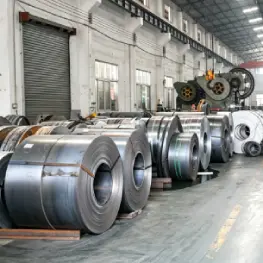
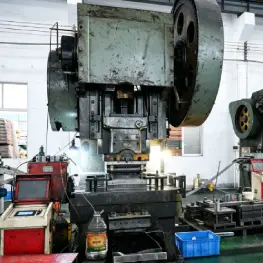
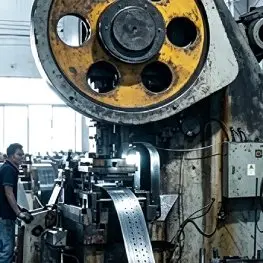
Roll-formed from certified Q235B and high-yield Q355B structural steel coils. Columns feature up to 12 distinct mechanical fold bends to maximize section modulus, torsional rigidity, and resistance against axial buckling.
Mechanical Guidance Interfaces
OEM fabrication of low-profile structural steel mechanical guide angles (such as L100x75x8 or L125x75x10) anchored with chemical studs, engineered to absorb dynamic lateral guide-roller thrusts from laden turret trucks.
Inductive Wire Guidance Ready
Racking frame baseplates and low-level horizontal bracing patterns optimized to leave unhindered clearance for center-aisle low-frequency wire guidance frequency cables embedded within the concrete slab.
2. Engineering Load Calculations & Structural Safety Standards
The elevated heights characteristic of custom VNA configurations introduce pronounced structural sensitivity to second-order P-Delta effects, sway deformations, seismic horizontal dynamic coefficients, and impact vulnerabilities at bottom pick levels. Industrial suppliers must possess in-house structural verification capabilities that comply with international structural design codes, including EN 15512:2020 (European Standard), RMI ANSI MH16.1 (United States), and AS 4084:2023 (Australia).
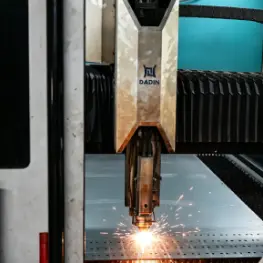
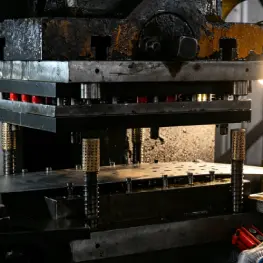
Crucial in narrow aisle engineering is the verification of column upright perforation patterns. While universal teardrop or slotted hole punches provide operational flexibility, cold-work stamping induces localized stress concentrations. Advanced OEM factories utilize finite element analysis (FEA) to calculate the precise yield envelope across slotted upright webs, ensuring that punching dies preserve the integrity of the critical cross-sectional area.
| Engineering Attribute |
Standard Selective Pallet Rack |
Very Narrow Aisle (VNA) Rack |
Double Deep Pallet Racking |
Radio Shuttle Storage System |
| Typical Aisle Width (mm) |
3,200 – 3,800 mm |
1,500 – 1,850 mm |
3,100 – 3,400 mm |
2,600 – 3,000 mm |
| Floor Space Utilization |
35% – 45% |
60% – 70% |
50% – 60% |
75% – 85% |
| Maximum System Height |
Up to 12 Meters |
Up to 18+ Meters |
Up to 11 Meters |
Up to 24 Meters |
| SKU Direct Selectivity |
100% Immediate Access |
100% Immediate Access |
50% (Requires shifting) |
Deep Lane (Batch FIFO/LIFO) |
| MHE Guidance Requirement |
Unassisted Free-Steering |
Mechanical Rail or In-Slab Wire |
Pantograph Reach Mechanism |
Standard Counterbalance Forklift |
| Required Slab Specification |
Standard Industrial Slab |
DIN 18202 Flatness Class 3 / TR34 DM2 |
Standard Industrial Slab |
Standard Industrial Slab |
3. OEM/ODM Customization Matrix: Steel Grades & Connection Design
Direct OEM suppliers empower warehouse developers to customize every component based on specific site loads and fire protection strategies:
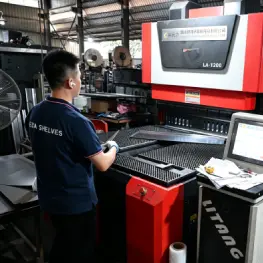
Beam Connectors & Interlocking Pins: VNA load beams utilize high-rigidity 3, 4, or 5-claw end connectors cold-stamped with calculated tapered hooks that engage snugly into upright columns. When loaded, this wedge mechanism generates high rotational joint stiffness, restraining frame sway without the excessive deadweight of thick structural rolled channels. Positive-locking safety pins prevent beam dislodgement under high-velocity vertical turret truck hoisting maneuvers.
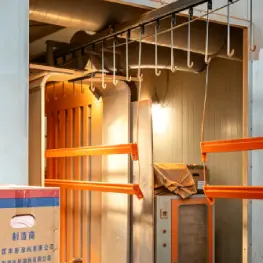
Surface Treatment Chemistry: Racking components are exposed to varying climatic environments across global shipping routes. Premier South China manufacturers run automated pre-treatment cleaning cycles consisting of immersion degreasing, ultrasonic water rinsing, pickling, and zirconium or zinc phosphating. This chemically active substrate is electrostatically layered with 60 to 90 microns of thermosetting epoxy-polyester powder, baked at 180°C–200°C to achieve superior salt-spray corrosion resistance (up to 500 hours neutral salt spray compliance) and scratch immunity.