Cold Chain AS/RS
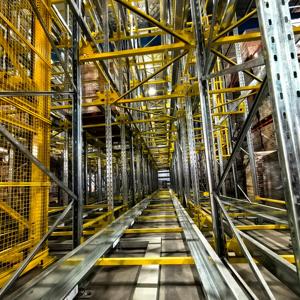
Jracking High-Load Cold Storage 4-Way Radio Shuttle High Bay System
- Operating Temp: -25°C to Ambient
- Payload Capacity: Up to 1,500 kg/Pallet
- Automation Level: Semi-Auto / WCS Ready
Direct from our Guangzhou fabrication facility: fully certified cold-formed structural steel systems designed for very narrow aisle (VNA), automated crane, and multi-tier density applications.
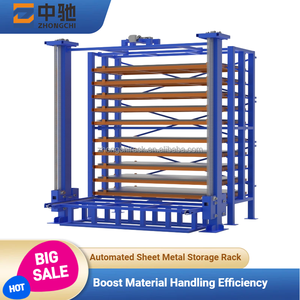
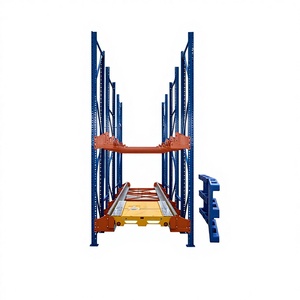
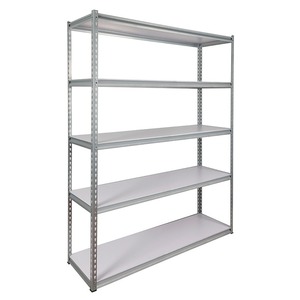
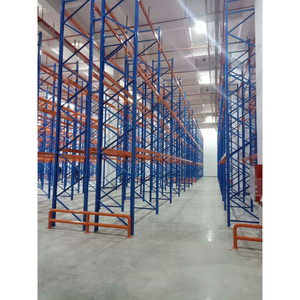
In high-density industrial storage, any vertical framework surpassing 12 meters is classified as an engineered high bay structure. At heights ranging from 15 to 40 meters, racking transitions from simple warehouse furniture into a mission-critical structural engineering discipline. The system must bear not only dynamic live pallet loads but also immense second-order horizontal forces ($P-\Delta$ moments), seismic acceleration, wind shear (for rack-supported clad-rack buildings), and tight operational deflection tolerances demanded by automated material handling devices.
As a premier high bay rack storage manufacturer and factory based in Guangzhou, China, our engineering methodologies strictly follow international structural performance codes including FEM 10.2.02 / 10.2.09 (European Racking Federation), EN 15512 (Cold-formed Steel Storage Systems), RMI MH16.1 (Specification for the Design, Testing and Utilization of Industrial Steel Storage Racks), and AS 4084 (Australian Steel Storage Racking). The difference between catalog shelving and high bay manufacturing lies in micro-millimeter dimensional tolerances, computerized continuous cold roll-forming profiles, and metallurgically verified steel grades.
All high bay upright profiles manufactured in our facility originate from prime cold-rolled structural steel coils, primarily structural grades Q235B, Q355B, or European equivalents S275JR and S355JR. The critical advantage of Q355B grade high-strength steel is its minimum yield strength of 355 MPa, which allows for slender, cold-formed upright sections with multi-ribbed omega ($\Omega$) geometries that provide unmatched torsion resistance and buckling safety margins.
Our computerized roll-forming lines feature up to 26 consecutive roll-tooling stages. This gradual deformation prevents localized microscopic stress cracking along the structural folds of the steel column, ensuring consistent thickness and strict hole-pitch tolerances across seamless 12-meter single-length column sections. For installations reaching upwards of 30 meters, multi-tier spliced connections employ high-grade 10.9 structural bolts and heavy inner splice brackets designed to maintain full cross-sectional moment continuity.
| Technical Parameter | Standard Selective Racking | VNA High Bay System | Automated Crane AS/RS High Bay | Rack-Clad Building (High Bay) |
|---|---|---|---|---|
| Standard Height Range | 4.5m – 9.0m | 10.0m – 17.0m | 16.0m – 32.0m | 24.0m – 45.0m |
| Aisle Width Footprint | 3.0m – 3.8m | 1.6m – 1.9m | 1.4m – 1.6m | 1.35m – 1.55m |
| Space Cubic Utilization | 35% – 42% | 55% – 65% | 75% – 85% | 88% – 94% |
| Deflection Limit (FEM) | $L / 200$ | $L / 250$ (VNA) | $L / 300$ – $L / 400$ | Custom FEM 9.831 / Class 100 |
| Floor Flatness Class | Standard Concrete Slab | DIN 18202 / Superflat | VDMA Guideline / EN 15620 | Engineered Isolated Foundation |
| Civil Building Requirement | Existing Civil Warehouse | Existing Civil Warehouse | Existing High Bay Facility | Racking Forms Building Skeleton |
Global supply chains face rising urban real estate costs, tighter ESG mandates, and escalating logistics automation. Here is how modern warehouse procurement is evolving over the next decade.
With industrial land prices in major transport nodes (Singapore, Dubai, Long Beach, Rotterdam) reaching record highs, corporate capital expenditure is shifting from horizontal expansion to vertical density. Facilities are replacing 8-meter clear-height designs with 20m–35m high bay configurations, quadrupling volumetric pallet capacity without acquiring supplementary real estate.
Manual forklift operations in tall bays introduce significant structural strike risks. Procurement specifications are prioritizing automated shuttle carriers and automated storage and retrieval system (AS/RS) integration. The high bay rack now serves as a high-precision guide rail for mechanical bots, demanding laser-aligned dimensional tolerance down to ±1.0mm per bay.
Logistics operators and general contractors are bypassing regional trading intermediaries to work directly with certified Chinese manufacturing facilities. Direct engagement enables bespoke seismic finite element analysis (FEA), tailored beam profiles, customized powder coat chemistry, and transparent mill test certification (MTC) while delivering 25–40% CAPEX savings.
The global distribution of biologics, perishables, and rapid-frozen proteins requires temperature-controlled environments down to -25°C to -30°C. Cooling chilled cubic airspace is cost-prohibitive. High-density shuttle high bays maximize thermal efficiency, minimize air volume per pallet, and employ specialized steel alloys resistant to low-temperature embrittlement.
Instead of building a concrete or structural steel building and installing racks inside, rack-supported warehouse buildings use the racking columns as the load-bearing pillars for external roof and wall sandwich panels. This architecture halves civil construction timelines, slashes foundation requirements, and optimizes the structural steel tonnage per cubic meter.
Western procurement teams demand strict environmental compliance. Chinese tier-1 factories now deploy closed-loop zero-emission phosphating systems, heavy-metal-free powder finishes conforming to RoHS and REACH directives, and lower-carbon scrap-recycled electric arc furnace (EAF) structural steel feeds to satisfy corporate Scope 3 sustainability targets.
Established in 2001, Guangzhou Heda Shelves Co., Ltd. is an internationally certified warehouse racking manufacturer operating a 30,000 m² heavy fabrication plant in South China.
Every system conforms to CE Standard No. 2435-CPR-8605159 and ISO 9001:2015 Certification (No. 18624Q00169R0M). We adhere to stringent load-testing routines, full material traceability, and RoHS-compliant non-toxic coatings for food and pharma distribution.
We provide full structural verification and certified calculation reports for earthquake-active regions (including the Philippines, Indonesia, Japan, New Zealand, and Chile). Our engineering team designs heavier base plates, ductile moment splices, and customized vertical bracing.
Located in Guangzhou, our plant provides streamlined maritime logistics via Guangzhou Nansha, Huangpu, and Shenzhen Yantian ports. Our specialized packing team uses tailored container loading software, preventing transport abrasion and maximizing 40ft HQ volume.
From raw structural coil verification to final sea-worthy crating, all operations are centralized under one roof in our Guangzhou factory.
Clear, technically detailed answers addressing engineering criteria, pricing variables, installation tolerances, and international import compliance.
A high bay storage system is a primary structural framework subject to dynamic stress. Prior to operational handover and warehouse management system (WMS) live inventory commissioning, every bay undergoes a 4-step structural safety audit based on EN 15635 (Steel Static Storage Systems – Application and Maintenance of Storage Equipment):
Step 1: Torque & Anchorage Verification: All high-tensile floor anchors are torqued using calibrated digital torque wrenches to ensure minimum required pull-out and shear capacities in the underlying slab. Baseplates are packed with non-shrink structural grout if slight sub-slab variances exist.
Step 2: Dual-Axis Laser Alignment: Using optical electronic theodolites, our technicians verify upright verticality across both the cross-aisle and down-aisle axes. In automated AS/RS lanes, total allowable vertical tilt must remain within $\pm h/750$ over the full height of the frame.
Step 3: Deflection & Locking Mechanism Audit: 100% of beam connectors are verified for safety pin engagement. A representative bay from each aisle is subjected to static trial load testing at 100% and 125% of designed operational capacity to measure elastic deflection and confirm recovery after load removal.
Step 4: Load Signage & As-Built Handover: Every row is fitted with an engraved aluminum load plaque indicating safe working loads (SWL) per beam level, maximum total frame capacity, and permissible pallet envelope dimensions to prevent future operational overloading.
Share your architectural warehouse floor plan, ceiling clear heights, and pallet specifications. Our senior structural engineers will prepare a complete 2D/3D CAD layout, load capacity calculation, and direct factory pricing within 24 to 48 hours.