Featured Industrial & Automated Racking Assemblies
Factory-direct structural steel warehouse configurations manufactured from premium Q235B and Q355B cold-rolled profiles, precision-punched with automated CNC tooling.
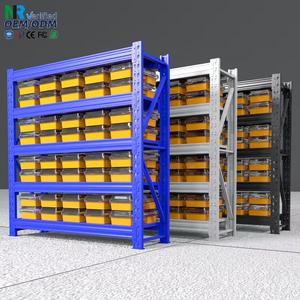 Selective Standard
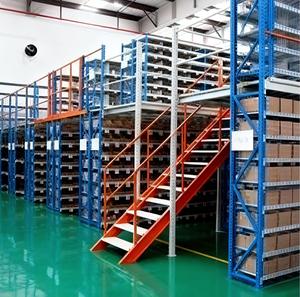 Multi-Tier System
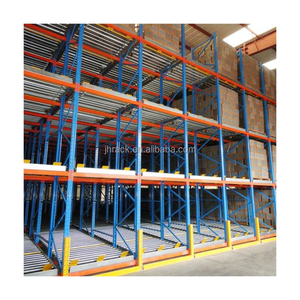 Strict FIFO
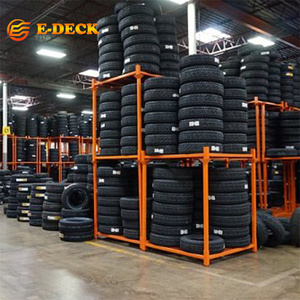 Modular Nesting
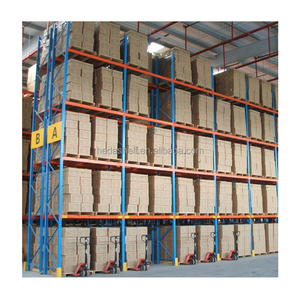 High Load Rating
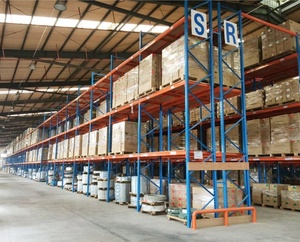 Wholesale Direct
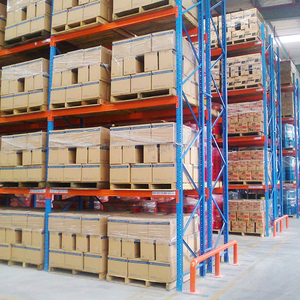 Row Connected
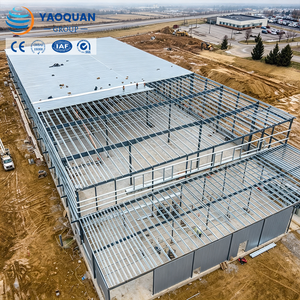
25+
Years Engineering Excellence
30,000m²
Automated Production Facility
30,000T
Monthly Steel Processing
120+
Export Destinations Worldwide
Engineering Principles for Industrial Automation Racking Systems
As intralogistics transitions from traditional static pallet placement to robotic handling, the mechanical thresholds placed upon rack superstructures increase exponentially.
Structural Dynamic Deflection Limits
Unlike manual forklift racking designed under static L/200 deflection tolerances, AS/RS automated crane and high-speed radio shuttle interfaces demand deflection tolerances tighter than L/400 or L/500. When automated cranes travel at speeds of up to 4 m/s and shuttle carriers traverse at 1.5 m/s, minimal deflection protects optic sensor tracking, avoids robotic jams, and prevents rail misalignment.
- FEM 9.831 & FEM 10.2.02 Compliance
- High-grade Q355B Hot-Rolled Strip Steel
Seismic Dissipation & Dynamic Loads
Automated storage structures reaching vertical elevations of 20m to 40m concentrate immense masses inside narrow geometric footprints. Our engineers perform comprehensive Finite Element Analysis (FEA) to verify P-Delta second-order structural effects, calculating baseplate stress profiles, shear anchor configurations, and horizontal seismic bracing schemes calibrated for major seismic belts across the Pacific Rim, Japan, and the Middle East.
- Up to 0.4g Peak Ground Acceleration (PGA)
- Complete Structural Calculation Dossiers
Sub-Millimeter Profile Cold-Rolling
Automated shuttles and stacker cranes depend on perfectly planar guide surfaces. In-house roll-forming production incorporates progressive 24-station rolling dies that maintain linear tolerances within ±0.5 mm across an 11-meter continuous upright section. Automated multi-axis CNC punching ensures vertical slot intervals maintain a pitch precision of ±0.1 mm, preventing beam racking distortion across massive grid layouts.
- Laser-Guided Straightness Verification
- ISO 9001:2015 & CE EN 1090 Audited
Automation Racking Architecture Selection Guide
Compare mechanical footprint densities, throughput performance indices, and capital investment factors across primary automated warehouse storage systems.
| System Typology | Space Utilization | Throughput Capability | Pallet Accessibility | Operating Clear Heights | Cold Chain Suitability | Relative CAPEX / Pallet |
|---|---|---|---|---|---|---|
| High-Bay AS/RS Crane System | 90% - 95% | High (120+ pallets/hr/crane) | 100% (Single/Double Deep) | 18m – 45m | Excellent (-30°C to +45°C) | Tier 3 (High CAPEX / Rapid ROI) |
| 4-Way Pallet Shuttle Matrix | 88% - 93% | Flexible Scalability | High (LIFO & FIFO) | 8m – 24m | Superior (-25°C Cold Rooms) | Tier 2 (Moderate-High) |
| 2-Way Radio Shuttle Deep Lane | 80% - 85% | Moderate (Forklift Dependent) | Batch / SKU Clustered | 6m – 16m | Standard Industry Choice | Tier 1 (Cost-Effective Automation) |
| Automated Pallet Flow (Gravity FIFO) | 75% - 82% | Continuous Gravity Feed | Strict FIFO Rotation | 4m – 12m | Requires Low-Temp Lubricants | Tier 2 (Mechanical Gravity Driven) |
| Multi-Tier Mezzanine Automated Platform | 200% - 300% Floor Gain | AMR / Conveyor Hybrid | 100% Split-Case / Tote Level | 5m – 15m | Ambient to Chilled (+2°C) | Tier 1 (Fast Payback Cycle) |
Future Procurement Trends in Warehouse Automation Racking (2025–2035)
Procurement directors and intralogistics planners face rapid technological and material changes. Below are five macro trends defining modern global tenders.
1. Migration from Rigid Stacker Cranes to 4-Way Multi-Shuttles
Global fulfillment hubs are shifting capital investment from rigid single-crane aisle aisles to flexible, decentralized 4-way pallet shuttle systems. The mechanical racking requirements for 4-way shuttles demand bi-directional high-precision running rails, precision welded crossover intersections, and tighter joint alignment tolerances to prevent micro-vibrations during high-velocity transverse transitions.
2. High-Density Clad-Rack (Rack-Supported Buildings)
Industrial land inflation across metropolitan supply hubs (Singapore, Hong Kong, Dubai, Los Angeles, Rotterdam) has driven the adoption of clad-rack architecture. Instead of erecting a warehouse building and installing racks inside, the automated racking frame acts as the primary structural skeleton supporting wall cladding, insulated roof panels, and wind/seismic shear loads, slashing construction schedules by up to 35% and total building costs by 25%.
3. Ultra-Low Temperature Cold Chain Automation (-30°C)
The global expansion of biologics, mRNA pharmaceuticals, and flash-frozen seafood requires cold-storage automated racking engineered with modified low-temperature impact steels. Standard carbon steel undergoes ductile-to-brittle transitions at sub-zero temperatures. Procurement specifications now mandate Charpy V-notch tested steel profiles and specialized powder coat chemistries that prevent micro-cracking and delamination under continuous freezing temperatures.
4. Smart Uprights with Embedded Strain Gauges & Structural IoT
Intelligent warehouse operations are beginning to require automated structural health monitoring (SHM). By integrating strain gauges, optical deflection nodes, and IoT load sensors directly into ground-level upright profiles and high-bay cross beams, facility operators gain continuous real-time data on frame stresses, accidental impact shockloads from material handling equipment, and seismic displacement warnings.
Technological Evolution of China Racking Manufacturers
China's racking industry has evolved from low-cost manual storage fabrication to high-precision structural manufacturing that powers the world's most intricate automated fulfillment hubs.
1. Fully Integrated Metallurgy & Slitting
By partnering directly with state-level tier-1 blast mills (Baosteel, Shougang), China's premier manufacturers secure guaranteed steel coil chemistries with tight carbon-manganese tolerances, uniform tensile yields, and complete material certification dossiers (MTC EN 10204 3.1). Slitting line precision minimizes coil camber, preventing edge residual stresses that cause upright twisting during roll forming.
2. Nine-Stage Pretreatment & Finishing
Long-term coating durability depends entirely on pre-treatment chemistry. While smaller workshops use basic spray degreasing, industrial automated lines implement a 9-stage full-immersion process: ultrasonic degreasing, double acid pickling, water rinsing, neutralization, surface activation, zinc-manganese phosphating, and deionized water rinsing. This creates an impermeable phosphate conversion layer, passing 500+ hour ASTM B117 salt spray tests before automated electrostatic powder coating.
3. Complete Export Engineering Compliance
China's leading export suppliers produce systems adhering strictly to international engineering codes, providing full design verification calculations for regional building authorisations. This includes EN 15512 (European European Committee for Standardization), RMI ANSI MH16.1 (United States Specification for Industrial Steel Storage Racks), and AS 4084 (Australian Standard for Steel Storage Racking).
Why Global System Integrators Partner with HEDA Shelves
Founded in Guangzhou in 2001, Guangzhou Heda Shelves Co., Ltd. has spent over two decades engineering safe, load-certified storage racks for world-scale logistics hubs.
Turnkey Engineering Support
Our in-house design office of 20+ structural engineers delivers comprehensive 2D CAD floor plans, 3D structural visualisations, and complete beam load displacement calculations within 24–48 hours of initial project brief submission.
Accredited Quality Management
HEDA operates under strict quality standards: CE Certification No. 2435-CPR-8605159, ISO 9001:2015 Certification No. 18624Q00169R0M, and full RoHS compliance across all polyester resin powder coatings.
Tropical & Harsh Climate Hardening
Every structural upright and load beam is prepared with industrial chemical pickling and phosphating before electrostatic curing. For open-yard, coastal, or cryogenic sub-zero environments, we offer high-grade hot-dip galvanised finishes to ISO 1461 standards.
Frequently Asked Technical Questions by B2B Buyers
Clear, definitive answers from our senior engineering team regarding structural tolerances, load safety factors, seismic engineering, and logistics shipping.
What are the exact deflection and tolerance limits for your automation and AS/RS racking?
For high-bay automated storage systems (AS/RS) and automated shuttle configurations, our racking is engineered to meet or exceed FEM 9.831 (Design Principles of Storage and Retrieval Machines) and FEM 10.2.02 deflection criteria. Under maximum working design load, the horizontal deflection of stacker crane guidance top tie-beams is held within H/2000 to H/1000 (where H is total mast height).
Vertical beam deflection under uniform load is limited to L/300 or L/400 (compared to L/200 in manual selective racking) to protect optical beam sensor interlocks and prevent mechanical shuttle bottom-out friction.
Which steel grades and structural testing reports are supplied with each export order?
We build our upright profiles, box beams, and shuttle running rails primarily from premium Q235B and Q355B cold-formed structural steel strips (conforming to GB/T 700 and GB/T 1591, equivalent to European S235JR and S355JR / ASTM A36 and A572 Grade 50). Every production batch is backed by:
1. Mill Test Certificates (MTC EN 10204 Type 3.1) stating chemical composition (C, Si, Mn, P, S) and tensile / yield strength curves.
2. Factory destruct-sample stub column compression test reports.
3. Beam-to-upright connector tab shear resistance test documentation.
How does HEDA engineer racking systems for high-risk seismic zones?
For installations in earthquake-prone regions (such as Indonesia, the Philippines, Japan, Taiwan, New Zealand, and western Latin America), our structural engineers run modal response spectrum analyses using dynamic simulation software following EN 16681 and RMI MH16.1 seismic methodologies.
Structural adjustments include enlarging floor baseplate footprints (up to 16mm thick with dual chemical anchor embedment), upgrading upright profile wall gauges from 1.8mm to 2.5mm or 3.0mm, inserting spine vertical K-bracing and portal cross ties, and integrating spine horizontal bracing planes every 3 to 4 load levels to resist torsional ground acceleration.
What surface treatment is applied to prevent corrosion in tropical and sub-zero environments?
Our automated finishing line uses a multi-stage continuous immersion pre-treatment process: alkaline degreasing, acid scale removal (pickling), zinc phosphating, and pure deionized water wash down. This prepares the bare cold-rolled steel surface for electrostatic deposition of RoHS-compliant thermosetting epoxy-polyester hybrid powder (cured at 180°C–200°C to an average thickness of 60–80 microns), delivering excellent resistance to chipping, scratch abrasion, and relative humidity above 90%.
For open-air yards, sub-zero cold rooms (-30°C), and corrosive chemical handling warehouses, components are treated with a hot-dip galvanized finish conforming to EN ISO 1461, achieving a minimum zinc coating thickness of 65–85 microns.
What information must be submitted to initiate a free 3D CAD layout and structural quotation?
To receive an engineered proposal with exact pallet position capacity calculations, send our engineering department:
• Architectural warehouse floor layout drawing (DWG/CAD format preferred, or dimensioned architectural PDF) with building column grid locations, dock doors, internal offices, and sprinkler clearance height.
• Clear building apex and eves height to underside of roof trusses.
• Pallet load envelope dimensions: Width (entry side) × Depth × Height (including pallet bottom board) and Gross Pallet Weight.
• Intralogistics equipment specification: Forklift model/type, maximum fork lifting height, aisle turn minimum clearance, or robotic shuttle specifications.
• Ambient environmental conditions (ambient, chilled, or -25°C blast frozen storage) and local site location for seismic calculation review.
How are shipping containers packed to prevent transit deformation and optimize ocean freight costs?
Because structural racking profiles are dense, heavy steel shapes, improper container stuffing leads to scratched powder coating, bent flanges, and under-utilized volume. HEDA runs 3D container packing simulations for every export shipment.
Upright frames are strapped in rigid nested bundles separated by wooden blocks and edge protectors; load beams are bundled with steel bands and wrapped in waterproof bubble films; and small baseplates, row spacers, and safety pins are crated in seaworthy fumigated wooden cases. This ensures high volumetric utilization (up to 25–27 metric tons per 40ft HQ container) while protecting components through long intermodal sea freight routes.
Request an Engineered Layout & Wholesale Quotation
Collaborate directly with our Guangzhou structural engineering team. Get comprehensive 2D CAD floor plans, load calculation sheets, and competitive direct factory pricing within 24 to 48 hours.