Featured Push-Back Racking Systems & Engineering Assemblies
Precision roll-formed Q355B structural steel, heavy-gauge nested carriage dynamics, and zero-loss aisle optimization manufactured in Guangzhou, China.
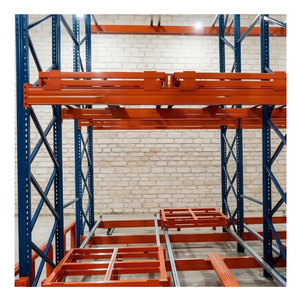
DJ High Density Storage Solution for Warehouse Storage Rack Push Back Rack
- Load: 1,500 kg/Pallet
- Carriages: Telescopic
- Gradient: 2.5% Slope
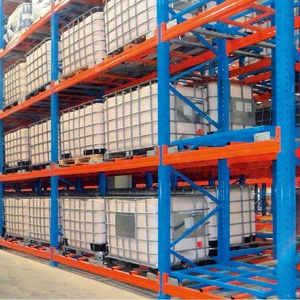
Heavy Duty Steel 5 Push Back Racking System High Capacity Powder Coated
- Configuration: 5-Deep
- Finish: Epoxy Powder
- SKU Variety: Batch Goods
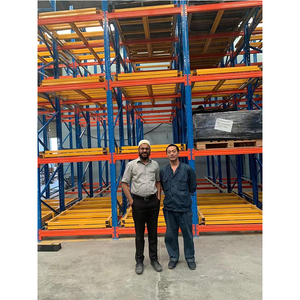
Push Back Racking High Quality Price Ratio Warehouse Storage Racks Customized
- Low-Profile Rail Track
- Steel Wheels / Bearings
- Custom Pitch: 50/75mm
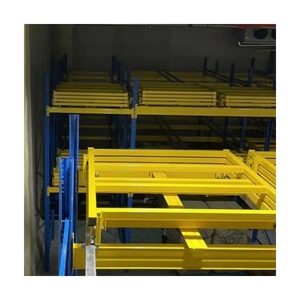
Chinese Manufacturing Supplies Heavy Duty Warehouse Push Back Pallet Racks
- High Bay Density
- CE Certified Structural
- LIFO Channel Flow
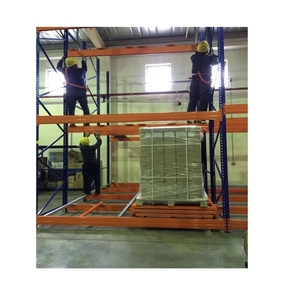
Heavy Duty Push Back Rack Adjustable Warehouse Storage System Metal Pallet Rack
- Beam Locking Mechanism
- Forklift Safety Bumper
- Dynamic Cart Arrestor
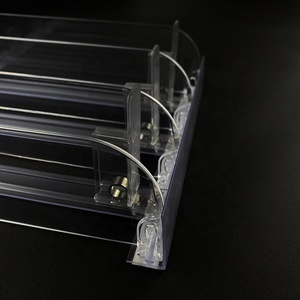
Retail Store Spring Loaded Auto Feed Transparent Plastic Divider Pusher System
- Constant Force Spring
- Polycarbonate Substrate
- Front Facing Automation
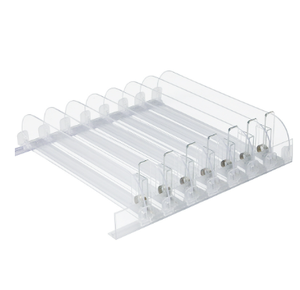
Plastic Hanging Automatic Can Spring-Loaded Beverage Tray Pusher System
- High Cycle Fatigue Life
- Self-Centering Guides
- Rapid Installation Rail
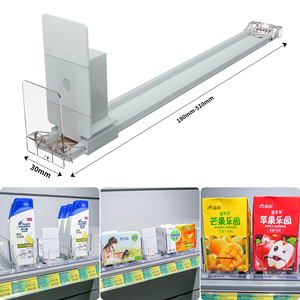
Adjustable Pushing Pusher System Shelf for Store Can Organizer Shelving
- Modular Track Width
- Adjustable Tension
- High Density Display
Push Rack Architectural Dynamics & Structural Mechanics
Unpacking the structural engineering, inclined rail tolerances, and nested carriage mathematics that govern high-performance push-back systems.
Gravitational Incline Geometry
Push-back pallet racking operates along a precisely calculated gravitational gradient between 2.0% and 3.0% (approx. 1.15° to 1.72°). This specific slope satisfies two conflicting kinematic parameters: providing minimal operational push force resistance during forklift deposit while ensuring gravitational roll-down acceleration stays within safe terminal velocities without structural impact hazards.
Telescopic Nested Carriages
Engineered with nested structural steel rolling carts, each bay nests multiple platforms riding on inclined structural channels. In a 4-deep configuration, pallet #1 rests on the topmost nesting cart; as pallet #2 enters, it pushes back cart #1 to expose cart #2 underneath. The terminal pallet always rests directly on the structural guide rails, eliminating redundant carriage mass.
Shielded Flanged Wheel Metallurgy
Every carriage incorporates CNC-machined carbon steel flanged wheels featuring double-sealed deep groove ball bearings (6204-2RS rating). The precision wheel profile mates with rolled C-channel guide tracks, neutralizing axial lateral yaw and ensuring smooth, parallel tracking along the entire lane depth even under uneven off-center pallet weight distributions.
Critical Structural Material Specification: High-Tensile Q355B vs. Q235B
Top-tier Chinese manufacturers utilize Q355B cold-rolled structural alloy steel for main upright frames and load-bearing track beams, providing a minimum yield strength of 355 MPa (51,500 PSI). Compared to commercial-grade Q235B steel, Q355B allows for lighter profile wall thicknesses while dramatically increasing the system’s torsional deflection resistance, seismic ductile capacity, and point-load impact resistance at warehouse loading faces.
Push-Back Racking vs. High-Density Storage Alternatives
Objective architectural comparison across floor utilization, SKU selectivity, collision probability, and operational lifecycle expenditure.
| Evaluation Parameter | Push-Back Rack (Nested Cart) | Drive-In Racking System | Radio Shuttle Racking | Gravity Pallet Flow (FIFO) |
|---|---|---|---|---|
| Inventory Management Rotation | LIFO (Last-In, First-Out per lane) | LIFO (Strict bulk block) | FIFO or LIFO flexible | Strict FIFO (First-In, First-Out) |
| Lane Storage Depth | 2 to 6 Pallets Deep | Up to 10+ Pallets Deep | Deep Lanes (Up to 30+ Pallets) | Up to 15+ Pallets Deep |
| Floor Area Space Utilization | 70% – 75% | 65% – 70% | 80% – 88% | 75% – 80% |
| SKU Selectivity Ratio | High (Every aisle face is unique SKU) | Very Low (Entire tunnel single SKU) | Moderate to High | Moderate (Per lane level) |
| Forklift Mast Collision Risk | Very Low (Forks stay in the aisle) | Extreme (Truck drives inside bays) | Zero (Truck stays in aisle) | Zero (Truck stays in aisle) |
| Throughput Handling Velocity | Fast (Immediate gravity presentation) | Slow (Cautious tunnel driving) | Automated / Semi-Rapid | Rapid continuous flow |
| Initial Capex per Pallet Slot | Moderate ($85 – $140) | Low ($55 – $85) | High ($160 – $240 + Shuttle) | High ($140 – $210 + Braking) |
| Maintenance & Electronic Vulnerability | Zero electronics, pure mechanical | Frame repairs frequent | Lithium battery & PLC repairs | Brake roller wear & tear |
*Data compiled from Guangzhou Heda Shelves engineering test benches and comparative field deployment analyses across 10,000+ logistics projects.
Guangzhou Heda Shelves: Production Integrity & Factory Verification
Backing international warehouse contractors with 25 years of specialized structural fabrication, rigorous quality gates, and automated finishing lines.
The 10-Step In-House Production & Quality Control Pipeline
Raw Materials
Spectrometer alloy validation on prime Q355B coil stock.
Laser Slitting
High-speed fiber laser strip cutting within ±0.2mm tolerance.
CNC Punching
Automated hydraulic continuous pitch column punching.
Cold Roll-Forming
Progressive multi-stage rolling cold-work hardening profiles.
Carriage Stamping
Precision jig-stamped interlocking nested cart frames.
Robotic Welding
Automated multi-axis CO2 gas shielded beam & cart welding.
Shot Blasting
Mechanical surface de-scaling achieving Sa 2.5 profile purity.
Phosphatizing
Multi-stage chemical degreasing & anti-corrosion passivating.
Powder Coating
Electrostatic automated epoxy line cured at 200°C for adhesion.
Load Testing & QC
Full-scale deflection audit and seaworthy steel-strap packaging.
Global Procurement & Technological Evolution (2025–2030)
How automation interfacing, cold chain logistics expansions, and seismic resilience codes are reshaping push rack purchasing contracts.
Sub-Zero Cold Chain Optimization
With global cold chain logistics expanding across Asia and the Middle East, push-back systems are increasingly specified for -30°C freezer facilities. Modern buyers demand low-temperature synthetic polyurea bearing lubricants, structural zinc thermal spray pre-treatments, and embrittlement-resistant steel grades that prevent micro-cracking under thermal contraction cycles.
Automated AMR / AGV Ingestion
The standard push rack pick face is transitioning from manual counterbalance trucks to autonomous counterbalance forklifts (AMRs). Chinese engineering plants are integrating mechanical alignment centering guides, acoustic deceleration targets, and reflective lidar markers on push carriage fronts to enable autonomous robotic pallet positioning without operator visual checks.
Seismic Ductility Engineering
Procurement specifications across seismic regions (Indonesia, Philippines, Japan, West Coast Americas) now enforce strict adherence to ANSI/RMI MH16.1 and EN 15512:2020. Upright frames now feature enlarged seismic base plates, heavy structural back-to-back row spacers, and ductile bolted connections designed to dissipate lateral ground acceleration without frame buckling.
IoT Lane Monitoring & Anti-Jam Sensors
Next-generation installations are piloting battery-free passive RFID transponders and acoustic emission pulse sensors along push rails. These detect carriage deceleration anomalies, micro-vibrations indicative of bearing seizure, and real-time lane occupancy status integrated directly into modern Warehouse Management Systems (WMS).
Push Rack System Procurement FAQ
Authoritative answers to the most common technical, logistical, and structural compliance inquiries asked by international buyers.
What is the maximum practical safe lane depth for nested push-back racks?
While theoretical calculations allow up to 6 pallets deep, 2-deep to 5-deep configurations represent 94% of industrial installations. Beyond 5-deep, the cumulative weight that the forklift must push backward (e.g., pushing five 1,200 kg pallets uphill along a 2.5% incline requires over 250 kg of sustained horizontal thrust) creates severe tyre slippage, mast strain, and increased operator fatigue unless specialized heavy counterbalance equipment is utilized.
Can low-quality or damaged wooden pallets be handled safely in push-back systems?
Yes, highly safely. Unlike pallet flow systems that rely directly on the underside deck boards of wooden pallets rolling directly over exposed skate wheels (where broken bottom boards immediately cause jams), a cart-style push-back rack supports the pallet completely on a solid structural steel nesting carriage. The wooden pallet never contacts the rolling track, entirely eliminating bottom-board hang-ups.
How do Guangzhou manufacturers prevent carriage acceleration and runaway impacts?
Three engineering fail-safes are standard: (1) Low-profile gravity incline matching the natural rolling friction of flanged steel wheels; (2) Mechanical safety stops and capture clips on each nested carriage preventing cart disengagement during seismic shaking; (3) Hydraulic centrifugal velocity governors installed along deep lanes to mechanically restrict terminal gravity rolling speed to under 0.3 m/s.
What warehouse floor slab specifications and clear height tolerances are required?
Because push-back lanes are multi-tiered, floor slab loading must accommodate concentrated point loads up to 8,000 kg per baseplate. Slab concrete strength should meet minimum C25/30 ratings with flatness conforming to DIN 18202 Table 3 Line 3 (or ASTM FF/FL 25/20). Clear building height must account for the cumulative slope rise across deep lanes (approx. 25-30mm vertical rise per meter of depth).
How is shipping volume optimized when exporting heavy structural steel from China?
Heda Shelves utilizes custom nesting CAD software to plan container loading into 40ft High Cube (40HQ) maritime containers. Uprights are bundled back-to-back with custom timber dunnage; nested push carts are nested completely flat within their respective track segments. This achieves up to 26 metric tons per container, minimizing oceanic freight expenditure per pallet storage position.
What documentation and structural calculation reports are provided for local permits?
Every project order includes detailed 2D CAD layout blueprints, 3D structural connection schematics, container packing lists, comprehensive installation torque manuals, and third-party finite element structural analysis (FEA) reports verifying compliance with international building codes (EN 15512, AS 4084, or RMI MH16.1).