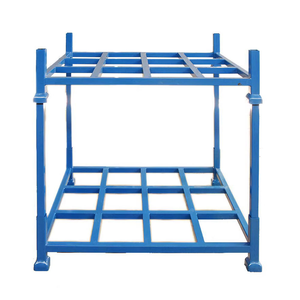
Galvanized Post Storage Pallet Stacking Rack
- Hot-Dip Galvanized
- Modular Detachable
- 1000–2500 kg Cap
Direct from our certified Guangzhou fabrication plant. Cold-formed Q235B/Q355B structural steel, high-durability electrostatic coatings, and custom modular integration engineered to solve severe facility constraints.
Need customized pallet dimensions (EUR, ISO, GMA) or high-seismic calculation models?
Get CatalogAn empirical analysis of volumetric storage efficiency, reach-truck kinematics, and structural deflection thresholds under high-throughput conditions.
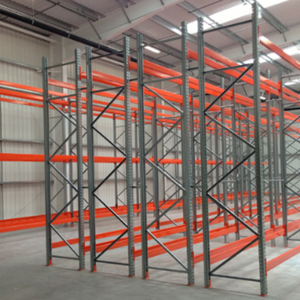
In modern industrial intralogistics, facilities consistently face the friction between selective accessibility and high-cube volumetric storage capacity. While traditional single-deep selective racking systems offer 100% immediate pallet selectivity, they sacrifice up to 60% of floor space to operating access aisles. Conversely, drive-in systems increase storage density at the severe expense of inventory visibility, rotation velocity, and structural honeycombing risks. The Double Deep Pallet Racking System represents the optimum engineering equilibrium for multi-SKU warehousing, providing 50% immediate pallet access alongside a 30% to 40% reduction in dedicated aisle footprints.
Core Structural Formula: Double deep configurations store two pallet loads deep in back-to-back single racks or four deep in double entry systems. By removing every second operating aisle, the warehouse layout achieves an immediate theoretical footprint utilization index of 60–65%, compared to only 35–42% achieved by standard broad-aisle selective configurations.
Operating a double deep installation requires specialized material handling equipment (MHE), typically comprising an electric reach truck equipped with a pantograph scissor mechanism or mechanical telescopic fork tines. As load centers extend from the traditional 600mm to beyond 1200mm for the rear pallet position, the overturning moment increases significantly. Forklift nominal rated capacities must therefore be calculated with substantial de-rating margins:
Our engineering division calculates structural spacing based on mast sway amplitudes, lateral deflection limits under FEM 10.2.02 design codes, and bottom-clearance requirements for outrigger chassis legs. When specifying beam levels, bottom pallets may rest on floor-mounted guide rails, or base beams can be integrated at 200mm elevation to prevent reach truck straddle leg collisions during rear-slot extraction maneuvers.
| Racking Topology | Storage Density (Pallet/m²) | Direct Selectivity | MHE Type & Complexity | Stock Rotation Discipline | Capital Investment (CAPEX/Pallet) |
|---|---|---|---|---|---|
| Double Deep System (HEDA Design) | High (1.6 - 2.1) | 50% Immediate Access | Pantograph / Telescopic Reach Truck | FILO (per 2-deep channel) | Moderate / Optimal ROI |
| Single-Deep Selective | Low (1.0 - 1.2) | 100% Direct Access | Standard Counterbalance / Reach | Strict FIFO Compliant | Low Initial CAPEX |
| Drive-In / Drive-Through | Very High (2.2 - 2.8) | 10% - 15% Accessible | Narrow Chassis Counterbalance | LIFO (Extreme honeycombing) | Moderate / High Frame Fatigue |
| Radio Shuttle System | Maximum (2.8 - 3.5) | Continuous Lane Access | Automated Satellite Shuttle + Lift | Programmable FIFO / LIFO | High (Robotics & Control Tech) |
Double deep racking upright columns absorb intense vertical static compressions compounded by horizontal torsional stresses introduced by rear pallet placement tolerances. Guangzhou Heda Shelves Co., Ltd. specifies high-tensile hot-rolled micro-alloyed structural strip steel grades (primarily Q235B and Q355B complying with GB/T 700 and EN 10025-2 standards). Profiles are cold-roll-formed via progressive 20-station rolling cassettes to maintain cold-working crystal lattice integrity while avoiding localized micro-cracks in 90-degree corner radii.
Beam deflection under full structural load is strictly limited to L/200 (where L is the clear horizontal beam length) under European standard EN 15512:2020. This prevents dynamic sag from binding lower fork clearance spaces when reaching into the rear racking aperture. Uprights feature continuous 50mm or 75mm tear-drop or diamond punched pitches, providing 5-hook cold-forged steel connectors with high-moment rigidity parameters verified by cycle-strain gauge testing.
Global supply chain shocks, real estate yield inflation, and warehouse robotics are actively shifting how procurement officers structure long-term racking contracts.
Driverless Autonomous Guided Vehicles (AGVs) and autonomous reach trucks equipped with SLAM laser navigation require tighter manufacturing tolerances (±1.0mm upright deviation). Traditional human margins for error are closing rapidly.
Monsoon climates in Southeast Asia and harsh maritime condensation in Middle Eastern coastal free-zones demand heavy-duty protection. Procurement is shifting towards pre-galvanized roll-forming coupled with fluoropolymer topcoats.
With ocean freight swings, regional distributors demand optimized flat-pack container loading configurations. Standard modular frames that assemble locally with zero hot-work or welding reduce inland distribution barriers.
Modern mega-DCs increasingly embed wireless strain sensors and impact transponders into bottom upright columns. Structural shifts, overloaded beams, and forklift impacts are logged directly to WMS cloud dashboards.
Founded in 2001, HEDA Shelves integrates end-to-end design, FEA structural calculation, cold-roll forming, automated robotic welding, and powder coating inside our dedicated 30,000 m² facility.
A double deep racking failure can cascade into catastrophic progressive rack collapse. Engineering reliability is not merely a marketing claim—it is a metallurgical guarantee. Every structural consignment exported by HEDA undergoes a rigorous 10-stage quality control process to eliminate defect margins before containerization.
Spectrographic analysis of prime Q235B/Q355B coils checking chemical tensile yields.
Laser and high-speed CNC rotary shearing for burr-free longitudinal edge profiles.
Automatic servo-driven pitch punching ensures slot tolerance uniformity within ±0.1mm.
20-stand continuous cold roll mills contour omega upright profiles without residual stress.
Interlocking seam technology forming box-beam and step-beam structural configurations.
CO2 gas-shielded automated multi-axis welding of beam connector brackets (Zero pores).
Total immersion multi-tank degreasing and pickling to eliminate mill scale completely.
Zinc phosphate micro-crystalline coating for active atmospheric corrosion passivation.
Automated Swiss Gema powder spray line curing at 180°C–200°C for wear-resistant finish.
Steel strapping, corrugated wrap, timber block saddles, and anti-rub protective sleeves.
Rigorous third-party structural validations guaranteeing tender and building compliance across the European Union, Australia, Americas, and the Middle East.
Calculation models adjusted for seismic liquefaction and seismic zones (PGA up to 0.4g). High-yield heavy-duty baseplates and Hilti/chemical anchoring profiles.
No middlemen markups. Our in-house structural engineers evaluate CAD architectural dwgs, clear ceiling heights, and MHE turning radii within 24 to 48 hours.
Objective engineering answers clarifying aisle geometry, floor slab load capacities, fire suppression, and export logistics.
Don't let inefficient aisle geometry restrict your distribution capacity. Provide your warehouse dimensions, ceiling heights, and pallet specifications to receive an engineered layout assessment within 24–48 hours.
Explore comprehensive technical load tables, structural column profiles, and project galleries.
Get Catalog