[email protected] Serving Southeast Asia, South Asia & the Middle East
EN
Industrial Intralogistics Engineering White Paper

China Best Warehouse Storage Shelving Systems Supplier & Exporters

Precision-Formed Q235B/Q355B Steel Structural Assemblies, Finite Element Seismic Validations, and Direct Turnkey Export Engineering for High-Density DC Facilities Worldwide.

Precision Material Handling

High-Performance Storage Assemblies Engineered for High-Throughput Facilities

Direct from our 30,000 m² automated manufacturing facility in Guangzhou, China. Each system is engineered to comply with FEM 10.2.02, RMI, and AS4084 standards, verified through structural FEA simulations.

Technical White Paper

Intralogistics Engineering: The 2026–2030 Global Warehouse Racking Procurement Standard

Navigating escalating warehouse land expenditures, high-acceleration automated material handling vehicles, and cross-border structural seismic compliances.

Executive Synthesis: Industrial warehouse storage systems are transitioning from passive structural shelves to dynamic, semi-automated and fully automated robotic intralogistics interfaces. As international land costs in logistics epicenters (Singapore, Dubai, Los Angeles, Rotterdam) escalate over 35% cycle-over-cycle, warehouse operators are moving toward ultra-tall VNA configurations and multi-tier rack-supported platforms. Modern procurement necessitates structural validation under cyclic fatigue, seismic grounding verification, and high-precision cold-roll manufacturing tolerances.

Finite Element Analysis (FEA) Modeling

Every industrial beam and upright profile undergoes computational stress simulations. Finite element verification ensures maximum deflection does not exceed 1/200th of the span under full load capacity, preventing localized column buckling and structural fatigue over decades of continuous shift operations.

Q235B vs. Q355B Steel Metallurgy

Raw steel coil selection governs yield stress under dynamic live loads. While Q235B steel offers ductile load dampening for general ambient warehousing, high-yield Q355B low-alloy carbon steel provides higher tensile resistance for heavy-duty drive-in uprights, sub-zero cold stores (-30°C), and tall mezzanine columns.

Seismic Dampening & Upright Base Anchoring

Deploying storage installations within active seismic belts (Pacific Rim, Mediterranean, Southeast Asia) requires custom enlarged baseplates with heavy-duty chemical wedge anchors, dynamic rear cross-bracing ties, and moment-resisting portal frames designed to dissipate kinetic lateral sway during earthquakes.

Storage System Architecture Pallet Density Ratio Direct Access / Selectivity Throughput Rotation Logic Optimal Intralogistics Profile
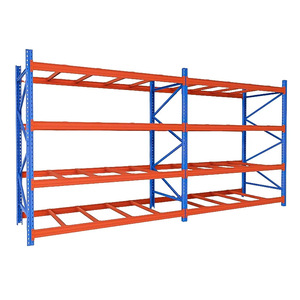
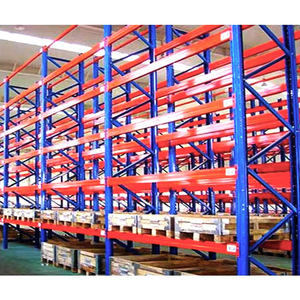
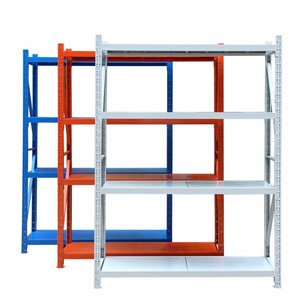
Selective Pallet Racking Baseline (40–50%) 100% Direct Access FIFO / LIFO Flexible High-SKU 3PL logistics, retail distribution hubs, spare parts distribution.
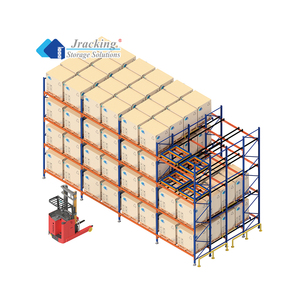
Push Back Racking (2–6 Deep) High Density (75%) Lanes Accessible (LIFO) LIFO (Last-In, First-Out) Batch processing, cold room staging, medium-turnover multi-pallet SKUs.
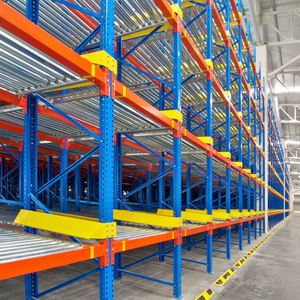
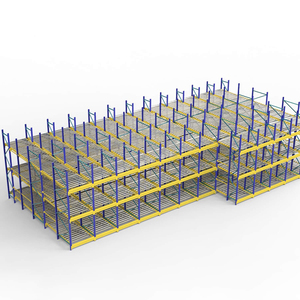
Gravity Pallet Flow Maximum Density (85%) Face Access (Strict FIFO) Automated FIFO Flow Food, beverage bottling plants, pharmaceutical cold chains with expiration dates.
Rack-Supported Mezzanines 200%–300% Cubic Gain Complete Bin Access Manual / AMR Integration Cross-border e-commerce sorting, garment fulfilment, industrial assembly centers.
Future Evolution

The Future Horizon of Warehouse Storage Architecture

ASRS & 4-Way Radio Shuttle Hybridization

Static storage racks are integrating embedded rolling rails for 4-way autonomous radio shuttles. These carrier systems decouple horizontal traverse from vertical hoist lifts, yielding 90%+ cubic storage efficiency without requiring human forklift operations inside rack bays.

Green Intralogistics & Low-VOC Pretreatment

Modern sustainability directives mandate the elimination of heavy chrome treatments. HEDA utilizes automated 9-step pickling, silane/phosphate wash, and electrostatic polyester powder coating cured at 180°C–200°C, producing durable, RoHS-compliant scratch-resistant finishes.

Digital Twin BIM Warehouse Modeling

Procurement projects now utilize detailed 3D Building Information Modeling (BIM). Digital twin models integrate exact slab flatness (DIN 18202 / ASTM E1155), building columns, sprinkler networks, and overhead HVAC ducting prior to roll-forming steel coils.

Industrial Provenance

Why International Supply Chain Directors Partner with HEDA Shelves

Combining 25 years of specialized racking manufacturing with factory-direct export engineering for contractors, 3PL giants, and industrial importers across 120+ nations.

2001
Established in Guangzhou
30,000 m²
State-of-the-Art Factory
30,000 t
Monthly Steel Output
10,000+
Warehouses Delivered Worldwide

In-House End-to-End Control

We do not broker components. From primary coil slit-cutting, automated upright punching, continuous profile roll-forming, robotic welding, to automatic electrostatic powder coating—all manufacturing stages occur in our Guangzhou plant.

Accredited Compliance

Certified to international quality standards including CE Certification (No. 2435-CPR-8605159), ISO 9001:2015 Quality Management (No. 18624Q00169R0M), and SGS-verified steel chemical assay tracking reports.

Free Engineering & 3D Design

Our dedicated structural engineering division produces complete 2D warehouse layouts, 3D spatial renders, and finite load calculations within 24 to 48 hours, eliminating planning discrepancies prior to production.

Direct Port Export Logistics

Located near Guangzhou and Shenzhen deep-water maritime ports, we optimize sea routes across ASEAN, Europe, the Americas, and the GCC. Engineered container strapping and bundle loading maximize freight volume while preventing transit damage.

Due Diligence FAQ

Critical Technical & Operational Racking Procurement Inquiries

Detailed technical guidance from our senior structural engineers for overseas warehouse operators, EPC general contractors, and procurement executives.

How does HEDA guarantee structural stability under high-bay and seismic conditions?
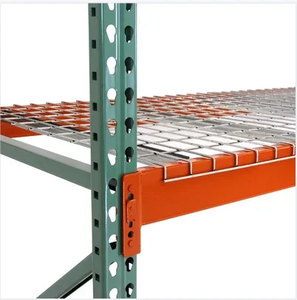
Our engineering team performs structural calculations using FEM 10.2.02 and RMI standards. We analyze local spectral acceleration parameters (Ss and S1 values) for seismic zones like Indonesia, Japan, the Philippines, and the US West Coast. We configure widened baseplates, heavy chemical wedge anchors, heavy-gauge upright omega profiles (90mm to 120mm face), and dynamic cross-bracing frameworks. Structural stress and deflection calculation reports are provided for building permit submittals.
What are the core technical differences between cold-rolled Q235B and Q355B steel in racking?
Q235B provides a nominal yield strength of 235 MPa with balanced ductility, making it a reliable, cost-effective choice for standard selective pallet racking and ambient warehouse shelving. Q355B is a low-alloy, high-strength structural steel with a yield strength of 355 MPa. It is specified for heavily loaded drive-in uprights, tall mezzanine primary I-beams, cantilever arms, and sub-zero cold storage warehouses (-20°C to -30°C) where low-temperature impact toughness is essential.
How does your factory protect steel against corrosion in humid, tropical, or cold store environments?
All roll-formed components undergo an automated 9-stage surface pretreatment process including chemical degreasing, acid pickling, rust conversion, and phosphating. We then apply an electrostatic thermosetting polyester powder coating (60–90 microns thick) baked at 180°C–200°C. For coastal warehouses, open yards, or extreme freezer environments with thermal condensation, we offer full hot-dip galvanization conforming to ISO 1461, ensuring over 50 years of corrosion resistance.
What specific facility metrics must a buyer supply to obtain an accurate layout and engineering quote?
To provide a precise structural layout and pallet-position count within 24–48 hours, we request: (1) Architectural DWG/CAD floor plan with column locations, clear building height to trusses, and door positions; (2) Pallet specifications including dimensions (W×D×H including load) and maximum gross weight; (3) Forklift model, turning radius, and maximum lift height; (4) Total SKU count and throughput velocity; (5) Site seismic and wind load requirements if applicable.
What is the standard manufacturing lead time and export sea packaging protocol?
Standard production lead time ranges from 15 to 25 working days depending on tonnage. For ocean freight, upright frames and beam bundles are wrapped in industrial corrugated protective board and tied with high-tensile steel strapping. Component bundles include customized wood block spacers to prevent scratch friction during maritime transit and simplify forklift offloading at destination ports.

Request Custom Engineering Schematics & Full Catalog

Connect directly with our Guangzhou engineering team. Receive professional 2D/3D warehouse layouts, structural load checks, and factory-direct export pricing tailored to your logistics requirements.