Certified Pallet Racking & Industrial Storage Solutions
Precision roll-formed Q235B/Q355B structural steel, rigorous limit-state mechanical load testing, and fully automated electrostatic epoxy powder coating applied to high-throughput warehouse logistics.
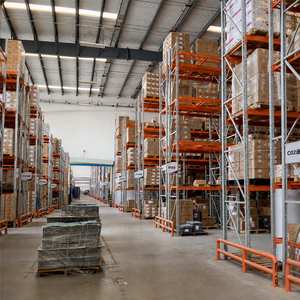
- End-of-aisle structural crash barriers
- High-throughput e-commerce fulfillment
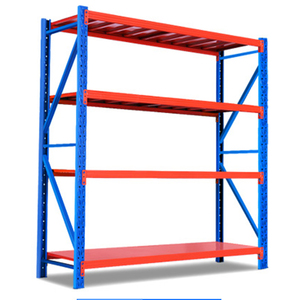
- Fast-interlock tool-free assembly
- Uniform beam dispersion (200kg/tier)
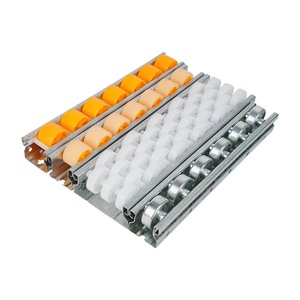
- High-grade polyurethane industrial castors
- Anti-corrosion multi-tier supermarket utility
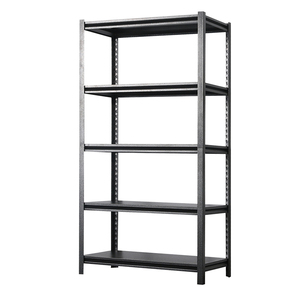
- Strict FIFO stock rotation speed controllers
- Integrated entry guide and end-stop brakes
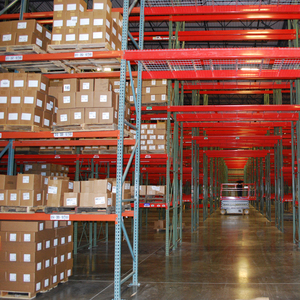
- Optimized for barcode / RFID integration
- High-visibility directional guide numbering
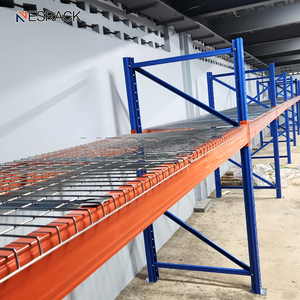
- Cold-drawn steel wire welded reinforcing ribs
- NFPA fire sprinkler water penetration compliant
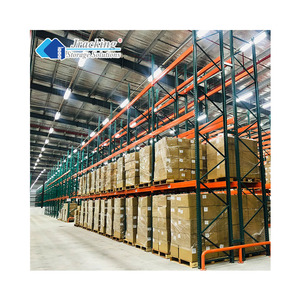
- Standard 2-inch pitch North American teardrop
- High torsion resistance beam connector rivets
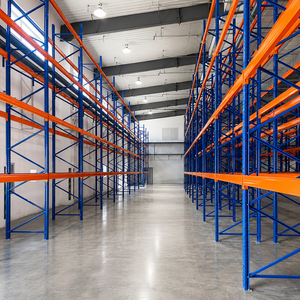
- Reinforced ribbed drop-in solid steel panels
- 100% individual pallet selectivity & access
The Mechanics of Push Back Racking: Telescopic Cart Systems vs. Gravity Incline Kinematics
Push back warehouse racking systems represent the pinnacle of high-density dynamic storage, converting wasted forklift operating aisles into productive pallet cube capacity while preserving selectivity across multiple SKU lanes.
Unlike standard static selective racking—which requires operational aisle space consuming between 50% and 60% of total warehouse floor area—a CE Certified Push Back Racking System operates on a Last-In, First-Out (LIFO) inventory cycle utilizing dynamic nested carriages that travel along inclined structural steel rails. By mounting progressive nested carts on a calibrated gradient of 2.5% to 3.5% (approx. 1.5° to 2.0°), gravitational force smoothly advances pallets forward to the picking face when an anterior pallet is retrieved by a reach truck or counterbalance forklift.
For industrial distribution hubs handling bulk goods, cold storage, and FMCG operations, push back racking offers significant information gain and operational performance advantages over traditional drive-in systems. Drive-in racks demand that heavy material handling equipment (MHE) navigate inside the rack framework, exposing upright columns to severe collision risks and restricting operator speeds. In contrast, push back racking keeps forklifts entirely in the main transfer aisle: the mast only touches the front pallet position, reducing structural collision events by over 82% while cutting pallet cycle entry and exit times by approximately 40%.
Telescopic Carriage Nesting
Manufactured using low-profile, nested steel carts riding on heavy-duty flanged steel wheels. As pallets are loaded, each sled glides backward, exposing the subsequent carriage below with zero binding tolerance.
Volumetric Density Calculus
Achieves up to 75% higher storage density than selective pallet racking. A 4-deep push back configuration consolidates up to 4 consecutive pallet positions per lane across a single operator loading corridor.
Mechanical Anti-Rollback Interlocks
Critical safety stops, positive track detents, and heavy-gauge cart interlocks prevent accidental cart runaway or pallet dislodgement during high-acceleration forklift retrieval maneuvers.
CE Certification Demystified: EN 15512, EN 15620, and Steel Limit-State Engineering
Procuring industrial storage in international markets requires rigorous adherence to European Harmonised Standards and verifiable Certificate of Conformity documentation.
Under European Construction Products Regulation (EU) No 305/2011, free-standing steel warehouse racking systems installed across global jurisdictions require verification under EN 15512:2020 (Steel static storage systems - Adjustable pallet racking systems - Principles for structural design) and EN 15620 (Tolerances, deformations and clearances). As a premier OEM/ODM manufacturer, Guangzhou Heda Shelves Co., Ltd. holds CE Certification No. 2435-CPR-8605159, certifying that our structural steel coils, roll-formed profile geometry, cold-welded joints, and dynamic carriages comply with strict structural safety directives.
Key limit-state analysis performed by our structural engineering department covers three critical failure criteria:
Global Frame Buckling
Finite element modeling of cold-formed perforated upright columns under combined vertical gravity, second-order (P-Delta) sway forces, and horizontal seismic acceleration.
Beam Deflection Ratios
Strict vertical deflection caps set at L/200 for static load beams and L/250 for dynamic push-back cart support beams, preventing track pinching and carriage binding.
Cart Bearings Dynamic Load
Precision-sealed flanged steel rollers tested through 100,000 continuous push-back cycles under maximum rated payload (1,500 kg per pallet cart) without bearing fatigue.
Shear & Punching Capacity
Structural validation of 3-tang and 4-tang beam end connectors with heavy safety spring pins resisting uplift forces exceeding 5,000 N per junction under accidental impact.
Engineering Matrix: 2-Deep to 6-Deep Push Back Configuration Parameters
Select the appropriate lane depth based on SKU density, cycle throughput, forklift mast pushing capability, and vertical floor space clearances.
| Storage Depth System | Track Slope Gradient | Standard Load / Pallet | Max Lane Weight | MHE Pushing Force Req. | Vertical Profile Loss / Bay | Recommended Velocity |
|---|---|---|---|---|---|---|
| 2-Deep Cart Push Back | 2.5% (~1.43°) | 500 kg – 1,500 kg | 3,000 kg | Low (~65 – 90 kgf) | 120 mm – 140 mm | Up to 35 Pallets / Hr |
| 3-Deep Cart Push Back | 2.8% (~1.60°) | 500 kg – 1,400 kg | 4,200 kg | Medium (~110 – 145 kgf) | 150 mm – 175 mm | Up to 30 Pallets / Hr |
| 4-Deep Cart Push Back | 3.0% (~1.72°) | 500 kg – 1,250 kg | 5,000 kg | Medium-High (~160 – 210 kgf) | 190 mm – 220 mm | Up to 26 Pallets / Hr |
| 5-Deep Cart Push Back | 3.2% (~1.83°) | 500 kg – 1,000 kg | 5,000 kg | High (~215 – 260 kgf) | 230 mm – 260 mm | Up to 22 Pallets / Hr |
| 6-Deep Cart Push Back | 3.5% (~2.00°) | 500 kg – 1,000 kg | 6,000 kg | High (~270 – 320 kgf) | 270 mm – 310 mm | Up to 18 Pallets / Hr |
Engineering Note: When designing multi-deep lanes exceeding 4 pallets in depth, operational managers must verify forklift hydraulic relief valve pressures. Pushing 4,000 kg to 5,000 kg of dead-weight steel carriages and laden pallets back up an incline creates back-pressure on the mast. HEDA Shelves engineers optimize carriage wheel diameters with double-shielded, maintenance-free ball bearings to lower mechanical rolling resistance friction coefficients ($\mu \le 0.018$).
Future Procurement Trends in High-Density Dynamic Warehouse Racking
Technological evolution, sustainability regulations, and autonomous logistics are reshaping warehouse storage system architectures worldwide.
1. Autonomous Mobile Robot (AMR) & AGV Hybridization
Traditional push back systems relied exclusively on manual counterbalance and reach truck operators. Leading 3PL and automated distribution centres are now retrofitting push-back lanes with laser-guided AGV interface stops. Low-profile carts equipped with optical reflectors and automated latch release mechanisms allow AGVs with push-plate attachments to execute consistent, micro-aligned deposit and retrieval operations without risk of dynamic cart shock.
2. Cryogenic Steel Metallurgy for Sub-Zero Cold Stores
With global cold-chain pharmaceutical and food logistics expanding rapidly, dynamic storage systems must perform in deep-freeze environments down to -30°C. Standard structural carbon steels become susceptible to brittle notch fractures at these temperatures. Future procurement mandates normalized Q355ND / Q355NE structural steel with verified Charpy V-notch impact toughness values at sub-zero thresholds, paired with synthetic low-temperature wheel lubricants that do not freeze or congeal.
3. Embedded Structural Health & Dynamic Impact Sensing
The transition toward predictive warehouse maintenance is driving the integration of low-power industrial IoT vibration and displacement sensors directly onto push back front-load beams and end-of-aisle upright protectors. These cloud-connected accelerometer nodes detect forklift impacts above 1.5G, measure continuous frame drift, and monitor carriage cycle counts, automatically alerting safety engineers before a microscopic fracture leads to progressive beam failure.
4. Green EAF Steel Sourcing & Zero-VOC Powder Deposition
Global supply chain carbon taxation (including the EU Carbon Border Adjustment Mechanism - CBAM) is incentivizing industrial buyers to evaluate the embodied carbon of racking steel. Future procurement focuses on steel produced via Electric Arc Furnaces (EAF) with high scrap metal ratios, cutting carbon intensity per ton of finished racking by up to 60%. Concurrently, multi-stage nano-ceramic and zinc-phosphate pre-treatment systems eliminate heavy metal sludge while ensuring RoHS compliance.
Why Global Importers Partner with HEDA Shelves for Push Back Projects
Since 2001, Guangzhou Heda Shelves Co., Ltd. has bridged high-precision manufacturing and bespoke structural engineering, supplying certified intralogistics systems to clients in over 120 countries.
A successful push-back dynamic racking installation hinges on millimetric accuracy. A misalignment of merely 3 mm across a deep lane can cause nested carts to jam, derailing warehouse operations. Unlike distributors who outsource individual components across fractured third-party vendors, HEDA Shelves performs 100% of steel slitting, profiling, precision punching, robotic welding, surface passivation, and powder coating inside our wholly-owned Guangzhou manufacturing complex.
Furthermore, our dedicated engineering division delivers complimentary 2D CAD layouts, full 3D BIM rendering models, and structural calculation reports within 24 to 48 hours of project intake. For installations located across high-risk seismic zones—such as Indonesia, the Philippines, Japan, and Taiwan—we calculate upright buckling, shear baseplates, and expansion anchor pull-out ratings strictly aligned with local building codes, guaranteeing smooth regulatory permit approvals.
Our 10-Step In-House Production & Quality Control Protocol
Frequently Asked Questions: Technical Due Diligence
Direct, highly-detailed engineering answers to assist warehouse planners, logistics consultants, and procurement managers in evaluating push back racking.
How does push back racking compare to drive-in racking regarding throughput, pallet selectivity, and asset safety?
While both systems maximize storage density by eliminating operating aisles, push back racking is vastly superior in throughput and selectivity. In a drive-in system, an entire multi-level bay must be dedicated to a single SKU to prevent massive honeycombing and re-handling delays. In contrast, in a push back system, each individual lane operates independently. This means an upright bay with four vertical levels can store four entirely distinct SKUs simultaneously.
From a maintenance and safety perspective, drive-in systems force forklift trucks to navigate deep into structural tunnels, leading to frequent column impacts, beam shearing, and anchor failure. With push back racking, forklifts operate strictly outside the rack framework in standard aisles. Structural crash incidents drop by over 80%, reducing long-term repair expenditures and operator insurance liabilities.
What specific forklift mast specifications and operating clearances are required for push back racking?
Push back systems are designed to interface seamlessly with standard counterbalance forklifts and reach trucks without expensive specialty attachments. However, three key engineering parameters must be verified:
1. Mast Tilt Angle: Forklifts should ideally feature a minimum of 3° to 5° forward mast tilt. When placing a pallet on an inclined cart, matching the 2.5%–3.5% rail slope ensures uniform load seating without binding the cart wheels.
2. Pushing Capacity: Forklift drive axles and hydraulics must provide sufficient horizontal tractive push to overcome cart nesting inertia. For a 4-deep system holding 1,200 kg pallets, the required pushing force reaches approximately 160–210 kgf. Modern 2.0t–2.5t electric reach trucks handle this with ease.
3. Vertical Clearance Overhang: Because the track slopes upward toward the rear, each level loses between 120 mm and 260 mm of total vertical height from front to back. Clear building height must account for this incline profile plus an extra 150 mm top-load clearance to sprinkler heads.
Can weak, damaged, or non-standard wooden pallets be stored safely in push back cart systems?
Yes—and this is a major operational advantage of telescopic cart push back systems over roller-based pallet flow systems. In roller flow racking, pallets must have pristine, unbroken bottom runner boards to roll over wheels without jamming or skidding. If a bottom board is broken or cracked, the pallet arrests mid-lane, creating a hazardous recovery situation.
In a HEDA push back cart system, the pallet sits statically inside a welded structural steel carriage frame. The cart’s heavy-duty steel wheels bear all rolling forces along the precision tracks. As a result, non-standard pallets (including Euro 800x1200mm, Industrial 1000x1200mm, GMA 40x48 inch), plastic pallets, metal skids, and pallets with missing or split bottom runners can be handled safely without risk of mid-lane hang-ups.
How does HEDA Shelves engineer push back racking for seismic zones and tropical monsoon climates?
For installations in earthquake-prone countries such as Indonesia, the Philippines, Japan, and Taiwan, we conduct full dynamic response spectrum structural calculations. We increase upright gauge thickness (up to 2.5 mm or 3.0 mm Q355B steel), enlarge baseplate footprints with multiple M16/M20 chemical capsule anchors, and integrate heavy-duty K-bracing and top horizontal portal ties to prevent harmonic resonance collapse during seismic events.
For tropical monsoon environments with relative humidity exceeding 85%, all steel components undergo our multi-stage chemical immersion process (degreasing, acid pickling, zinc phosphating passivation) before receiving a 70–90 micron electrostatic epoxy-polyester powder coat. For cold stores, walk-in freezers, and coastal sites, we provide hot-dip galvanized finishes (HDG) to EN ISO 1461, providing over 30 years of rust-free service life.
What quality documentation and testing reports are supplied with each export container shipment?
Every commercial project delivered by Guangzhou Heda Shelves Co., Ltd. includes an exhaustive technical compliance dossier required for municipal building permits, customs clearance, and insurance underwriting:
• CE Certificate of Conformity: Under Certificate No. 2435-CPR-8605159.
• ISO 9001:2015 Certification: Certificate No. 18624Q00169R0M.
• Mill Test Certificates (MTC): EN 10204 3.1 certifying steel chemical composition and tensile/yield strength.
• Structural Calculation Report: Certified load charts and deflection analysis signed by structural engineers.
• Detailed Installation Drawings: 3D isometric schematics, part numbering lists, and container loading maps.
Can an existing selective pallet racking installation be retrofitted into a push back system?
Yes. If your current upright frames are structurally sound, undamaged, and possess adequate depth and load-bearing capacity, HEDA Shelves can supply drop-in modular push-back track and cart assemblies. Our engineers review your existing beam levels, column punch hole spacing, baseplates, and floor slab thickness.
However, because push back systems consolidate several pallets into a single vertical column, the total point loads exerted through the front upright baseplate increase significantly. In many retrofit situations, we supply front column reinforcing boots or splice in higher-gauge upright frames to meet EN 15512 safety load factors without requiring a full warehouse overhaul.
How does HEDA optimize container packing to reduce international ocean freight costs per pallet position?
Ocean freight represents a major cost component in global racking procurement. Shipping from our Guangzhou factory directly to major regional ports (such as Singapore, Port Klang, Bangkok, Manila, Jakarta, and Dubai), our logistics division calculates 3D algorithmic container nesting schemes for 40ft High Cube containers.
Uprights are nested in high-density bundles protected by corrugated corner guards and non-marking steel strapping. Dynamic push back carriages are shipped pre-assembled with wheels attached and nested inside one another. By packing dense steel profiles together with lightweight cart frameworks, we consistently achieve over 95% volumetric and gross weight container utilization, slashing freight cost per pallet position by 18% to 25%.
Request an Engineered 2D/3D Push Back Layout Design
Connect directly with our Guangzhou technical engineering department. Share your warehouse floor plan, clear building height, forklift parameters, and pallet load specs to receive a fully dimensioned CAD plan, 3D render, and quote within 24 to 48 hours.
- Free 2D CAD & 3D BIM Layout Design
- CE & ISO 9001:2015 Certified Manufacturing
- Seismic & Cold-Chain Engineering Reviews
- Direct Factory Pricing from Guangzhou, China
Our bilingual structural engineers reply in English within one business day.
Send an Inquiry