CE Certified
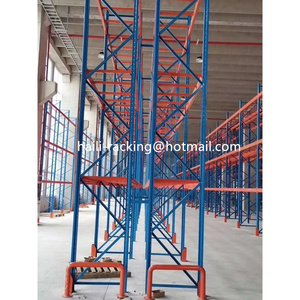
Precision roll-formed, laser-punched, and electrostatically coated back-to-back rack ties tailored for selective, teardrop, narrow-aisle, and seismic industrial racking arrays.
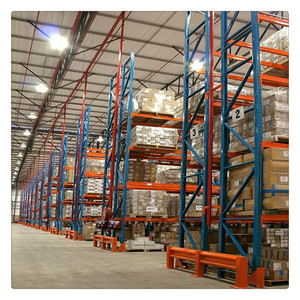
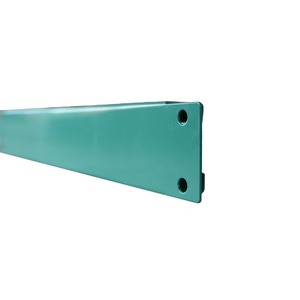
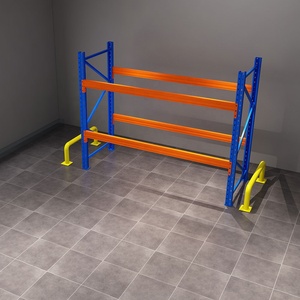
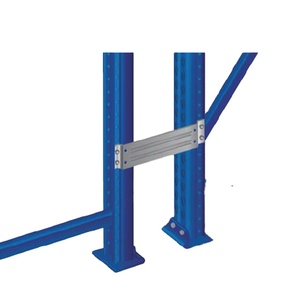
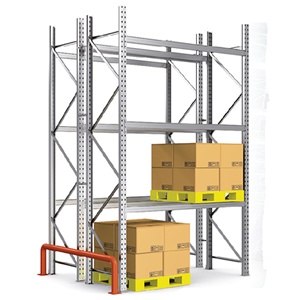
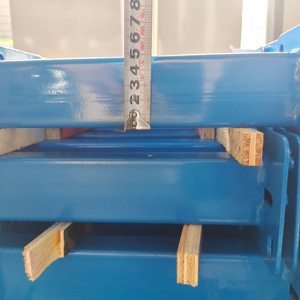
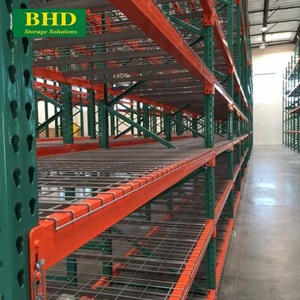
Far more than a simple metal bracket, an engineered row spacer is a vital structural link that converts two parallel single rows into a monolithic, rigid double-row structure, dramatically increasing frame capacity and protecting life safety.
In structural structural analysis according to EN 15512 and RMI MH16.1, an upright column's axial load capacity is governed by its unbraced length ($K \cdot L / r$). Without row spacers, back-to-back racks can sway independently under dynamic forklift impact and operational vibration.
Engineered row spacers effectively tie adjacent columns together, transferring lateral loads across the structural footprint and reducing cross-aisle effective buckling length by up to 35%, allowing higher upright load ratings without upgrading to heavier column sections.
Warehouse fire safety codes (notably NFPA 13, NFPA 230, and FM Global Data Sheet 8-9) mandate a continuous, unobstructed longitudinal flue space (typically 6 inches / 152 mm or up to 300 mm in ESFR configurations) between back-to-back rack runs.
Without mechanically locked, dimensionally accurate row spacers, pallet overhang inevitably encroaches into this chimney space, obstructing vertical fire plume escape and preventing overhead sprinkler water penetration.
In seismically active zones across Europe, Southeast Asia, and the Americas, building codes (such as Eurocode 8 and ASCE 7) classify racking as essential structural installations.
Our heavy-duty, trussed, and moment-resisting row spacers transfer lateral earthquake acceleration forces between the primary and secondary rack structures. By converting parallel uprights into a coupled structural moment frame, ground acceleration shear stresses on individual floor anchor bolts are dissipated safely.
| Row Spacer Configuration | Standard Steel Grade | Span Distance (Flue Space) | Load Classification | Primary Compliance Application |
|---|---|---|---|---|
| C-Channel Rigid Tie | Q235B / Cold-Rolled Carbon | 150 mm – 300 mm (6" – 12") | Light / Medium Duty (< 2,500 kg per bay) | EN 15635 Selective Standard Warehousing |
| Heavy-Duty Tubular Spacer | Q355B / S355JR Structural Steel | 200 mm – 450 mm (8" – 18") | Heavy Duty (> 4,500 kg per bay) | NFPA 13 In-Rack Sprinkler Flue Retention |
| Seismic Truss X-Braced Spacer | High-Yield Low Alloy Steel | 300 mm – 600 mm (12" – 24") | Extreme Seismic / Dynamic Shear | Eurocode 8 / ASCE 7 Seismic Regions |
| Telescopic Micro-Adjustable Spacer | Q235B Zinc-Plated Steel | 180 mm – 350 mm (Adjustable) | Medium / High Accuracy Assembly | VNA / ASRS Automated Plumb Alignment |
| Hot-Dip Galvanized Marine Spacer | ISO 1461 HDG (>65 µm) | 200 mm – 400 mm | Corrosive / Sub-Zero Environments | ISO 12944 C5-M Cold Chain & Chemical Storage |
Driven by automated material handling, robotic reach trucks, and tighter global insurance guidelines, warehouse operators and racking contractors are shifting procurement priorities toward high-precision structural accessories.
As logistics hubs adopt autonomous mobile robots (AMRs) and very narrow aisle (VNA) automated guided vehicles, tolerance for column out-of-plumbness has plummeted from 1/350 to under 1/1000. Facilities now demand precision laser-cut row spacers with slotted micro-adjustment mechanisms that lock rack uprights into dead-straight parallel lines across 100-meter aisle runs.
Fire safety insurers are rejecting warehouse certifications where sprinkler pipes are hung haphazardly from pallet beams. Modern row spacer procurement mandates built-in pipe saddle brackets and protective flue shields, allowing FM Global compliant water riser routing directly inside the dead space between back-to-back racks without consuming valuable storage cubes.
Older single-bolt friction row ties suffered from rotational slippage under localized forklift impacts. Structural engineers and project contractors are standardizing on heavy-gauge wrap-around or twin-hole bolting plates that grip both the front and rear faces of the rack column, creating a semi-rigid joint that prevents column twisting during accidental rack impacts.
Multinational EPCs and institutional 3PL operators increasingly evaluate suppliers based on Environmental Product Declarations (EPD). Sourcing is rapidly pivoting to suppliers who utilize electric arc furnace (EAF) low-emission scrap steel, chrome-free pickling chemistry, and volatile organic compound (VOC)-free thermoset polyester powder coating finishes.
Founded in 2001 in Guangzhou, China, Guangzhou Heda Shelves Co., Ltd. has spent over two decades engineering, fabricating, and exporting certified heavy-duty warehouse storage infrastructure worldwide.
Every row spacer and structural component undergoes end-to-end metallurgical and dimensional verification inside our Guangzhou manufacturing plant before export dispatch.
Spectrometer testing of certified Q235B / Q355B coils for yield strength and chemical purity.
High-speed coil uncoiling and laser-guided edge trimming with ±0.1mm width precision.
Multi-station mechanical press lines punching pitch holes for universal compatibility.
Continuous roller dies shaping C-channels and tubular sections with zero micro-cracks.
Burr-free 3D laser coping and angle miter cutting for high-strength connection flanges.
CO₂ gas shielded automated welding jigs delivering uniform penetration welds (AWS D1.1).
Immersion bath cleaning removing all scale, oxidation, and rolling oils down to white metal.
Micro-crystalline conversion coating creating superior anti-corrosion chemical bonding.
Automated Swiss Gema powder booths curing at 200°C for an impact-proof 80–120 µm coat.
Salt spray testing, pull-off torque checks, and reinforced wooden crating for container dispatch.
Direct answers to critical structural, fire protection, and procurement questions formulated by certified warehouse racking engineers and global procurement heads.
According to EN 15512 and RMI guidelines, row spacer quantity depends directly on upright frame height and seismic hazard rating. For standard non-seismic racks under 4.5 meters (15 ft), a minimum of two row spacers per frame column is required: one positioned near the bottom frame splice/first beam level and one at the uppermost load beam. For frames between 4.5m and 9m, three spacers are specified. For heights exceeding 9m or in high-seismic zones, row spacers must be installed at every alternate horizontal frame node (typically every 1.5 to 2.0 meters of vertical rise) to maintain structural frame coupling.
NFPA 13 mandates a minimum 6-inch (152 mm) clear longitudinal flue space between back-to-back rack runs. Pallets typically overhang the rear beam by 3 inches (75 mm) on each side. Therefore, a standard row spacer must be sized at minimum 300 mm (12 inches) (75mm overhang + 150mm clear flue + 75mm overhang) so that when pallets are seated, the net open chimney space meets or exceeds the required 152 mm clearance. Specifying undersized row spacers (e.g., 200 mm) causes pallet overhang to choke the flue space, leading to automatic fire inspection failure and insurer policy cancellation.
Yes. We engineer universal mounting flanges and multi-pattern mounting plates compatible with standard European 50mm and 75mm upright pitches, American Teardrop configurations, Dexion-type slotted columns, and bolted box columns. By providing your existing upright column depth, front face width, and perforation pitch, our design team produces 2D fabrication drawings guaranteeing 100% bolt-hole alignment without field re-drilling or structural cutting.
Standard C-channel spacers perform well in tension and compression along their longitudinal axis but exhibit low torsional resistance ($J$) when subjected to asymmetrical twisting or lateral racking loads. Closed hollow structural sections (HSS tubular steel) provide up to 400% higher polar moment of inertia, making them vastly superior in seismic applications, high-throughput drive-in racks, and tall automated warehouse bays where rotational rigidity between back-to-back columns is essential.
For cold chain warehouses (down to -30°C) and tropical high-humidity coastal distribution centers, standard electro-galvanizing is insufficient. We offer hot-dip galvanizing (HDG) in accordance with ISO 1461 / ASTM A123 with a minimum zinc coating thickness of 65 to 85 microns. Alternatively, we utilize a 5-stage nanoceramic anti-corrosion pre-treatment combined with zinc-rich primer and heavy thermoset architectural exterior polyester powder coating that achieves over 1,000 hours of neutral salt spray testing without red rust.
Every export shipment from our Guangzhou facility is accompanied by a comprehensive technical compliance dossier: Mill Test Certificates (MTC EN 10204 3.1) verifying steel yield and elongation, CE Declaration of Performance (DoP under EN 1090-1 / CPR No. 2435-CPR-8605159), ISO 9001:2015 QA factory inspection records, coating thickness and cross-hatch adhesion reports, and precise 3D container packing load plans designed to maximize freight efficiency and eliminate transit damage.
Whether you require standard flue spacers, seismic double-row ties, or custom OEM fabrication for your racking project, our bilingual senior structural engineering team delivers free CAD drawings, load calculations, and competitive factory pricing within 24–48 hours.