[email protected] Serving Southeast Asia, South Asia & the Middle East
EN
0%

Warehouse space is becoming more valuable, while product variety keeps expanding. Pallet Storage Racks offer a practical way to use vertical space, improve stock visibility, and support safer material movement. Yet one rack design cannot solve every warehouse problem.

The MHI Annual Industry Report 2024 identifies continued investment in supply chain technology and warehouse modernization. Its findings reflect a clear operational pressure: companies need faster, more flexible, and more measurable storage systems. The 2024 Logistics Managers’ Index also reported sustained concern about warehousing capacity and utilization. These trends make rack selection a business decision, not merely a purchasing task.

Small details matter. A selective rack may provide direct access to every pallet, while drive-in storage can increase density for uniform products. Pallet flow racks may support FIFO rotation, but they require accurate loading and maintenance. Cantilever racks suit long materials, not standard cartons. Warehouse managers must examine pallet dimensions, load weights, aisle widths, forklift turning radii, inventory velocity, and building height before choosing a system.

Safety comes first.

This guide reviews ten common types of Pallet Storage Racks, including selective, double-deep, push-back, pallet flow, drive-in, drive-through, cantilever, mobile, shuttle, and mezzanine-supported solutions. The comparison draws on practical warehouse planning principles, manufacturer specifications, and guidance from organizations such as OSHA and the Rack Manufacturers Institute. Still, specifications vary between suppliers. Even experienced teams can overlook floor conditions or future SKU growth. A careful review, site measurement, and professional structural assessment remain essential before installation.
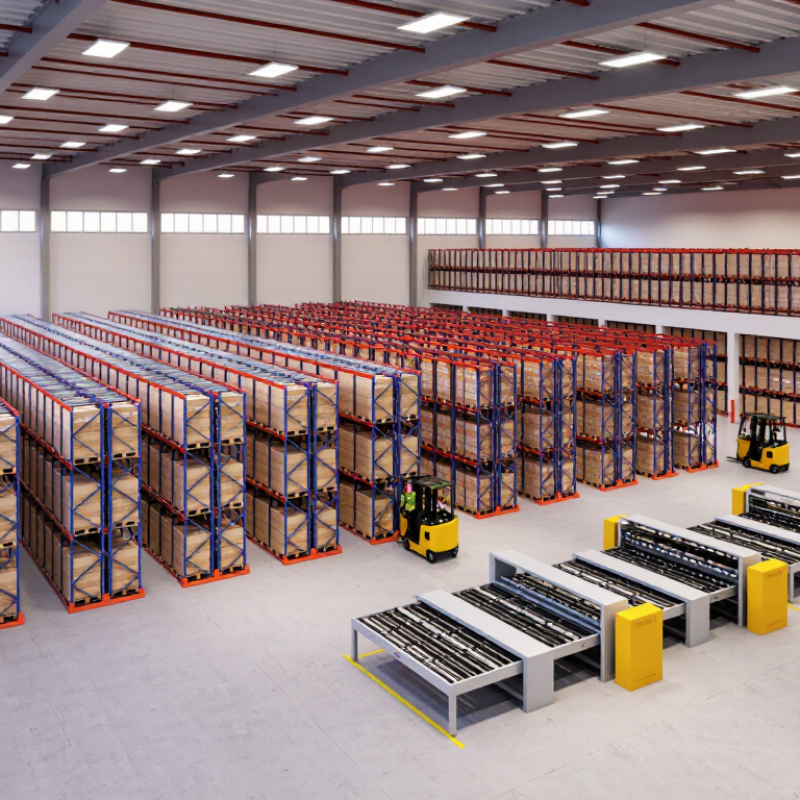
Top 10 Types of Pallet Storage Racks for Warehouses

Pallet Storage Rack Fundamentals: Purpose, Components, and Warehouse Roles

Top 10 Types of Pallet Storage Racks for Warehouses

Pallet storage racks create organized vertical space for loaded pallets. Their main purpose is simple: improve access, protect inventory, and support safer warehouse movement. In daily operations, rack selection depends on pallet weight, dimensions, turnover rate, and available floor space. Space matters. A rack designed for slow-moving reserve stock may hinder workers handling fast-moving goods.

A typical system includes upright frames, horizontal beams, bracing, anchors, and protective guards. Beams carry pallet loads, while frames transfer weight safely toward the floor. Operators should check beam condition, pallet placement, and visible damage during routine inspections. Small details matter. Uneven loading, broken pallets, or missing safety pins can create serious instability. Load signs should remain readable and match the approved configuration.

Warehouses use different rack types for different roles. Selective racks provide direct access to each pallet and suit varied inventory. Drive-in racks increase density but reduce immediate access. Push-back, pallet flow, cantilever, mobile, and double-deep systems address specific storage patterns. Automated options may improve throughput, but they require reliable controls and trained maintenance staff. A layout can look efficient on paper and still slow picking in practice. Real observations from aisles should guide revisions, especially when forklifts turn tightly or workers reach above comfortable limits.

How Inventory Profiles and Layout Constraints Guide Rack Selection

Top 10 Types of Pallet Storage Racks for Warehouses

How Inventory Profiles and Layout Constraints Guide Rack Selection

Rack selection should begin with inventory behavior, not catalog photos. Selective pallet racks suit many stock-keeping units and frequent forklift access. Double-deep racks increase density, but they require deeper inventory and disciplined replenishment. Drive-in racks fit large quantities of similar products with limited rotation. Push-back racks support several pallets per lane, while pallet-flow racks use gravity for first-in, first-out movement.

Fast-moving cartons may need carton-flow sections below pallet positions. Long, irregular materials often require cantilever racks. Mobile racks can release floor space, though their moving aisles demand careful traffic planning. Shuttle systems and automated storage and retrieval systems offer high density, but they require stable pallets, reliable software, and stronger maintenance controls.

The MHI 2024 Annual Industry Report found that 55% of surveyed supply-chain professionals planned to increase technology investment. That does not mean automation fits every warehouse. Layout matters. Measure clear height, column spacing, fire protection, aisle width, floor capacity, and emergency routes before choosing a frame. OSHA reports that powered industrial trucks cause about 35,000 serious injuries and 85 fatal injuries annually in the United States. Poor aisle decisions can become expensive safety problems.

Inventory data also deserves skepticism. ABC classifications may hide seasonal peaks, damaged pallets, or slow-moving stock. I have seen dense layouts reduce travel distance while creating awkward replenishment queues. Leave adjustment room. A rack plan should reflect today’s demand, tomorrow’s volume, and the warehouse’s imperfect habits.

Top 10 Types of Pallet Storage Racks for Warehouses - How Inventory Profiles and Layout Constraints Guide Rack Selection

No. Pallet Rack Type Best-Fit Inventory Profile Layout and Building Constraints Selection Guidance Storage Density Pallet Accessibility Typical Load Pattern Space Characteristics Main Limitations
1 Selective Pallet Rack High-SKU inventories with frequent replenishment and order picking from individual pallet locations. Works with standard forklift aisles and most rectangular warehouse layouts. Requires clear aisle planning and upright protection. Choose when every pallet position needs direct access and inventory rotation is more important than maximum density. Medium Direct access to every pallet. Generally one or two pallets deep per location. Uses vertical height efficiently but leaves more aisle space than compact systems. Lower cube utilization than drive-in, pallet flow, or mobile systems.
2 Double-Deep Pallet Rack Moderate-SKU inventories where each SKU has several pallets and selective access is still required. Needs a reach truck or equipment capable of placing pallets two positions deep. Requires sufficient row depth and aisle clearance. Useful when increasing storage density without moving to a highly compact, low-selectivity system. Medium-High Direct access to the front pallet; rear pallet access requires moving the front pallet. Two pallets deep per lane. Reduces the number of aisles compared with single-deep selective rack. May create inventory access conflicts and is less suitable for many low-volume SKUs.
3 Drive-In Pallet Rack Low-SKU, high-volume inventories with many pallets per SKU and controlled product rotation. Requires forklift entry into rack lanes, adequate building height, and carefully managed floor flatness and traffic flow. Best when density is more important than immediate access and products can be stored by lane. High Limited; pallets are accessed from one side in a last-in, first-out arrangement. Multiple pallets deep and high, with rails supporting pallet loads. Minimizes aisles and uses floor and vertical volume efficiently. Lower selectivity, greater forklift skill requirements, and potential product rotation concerns.
4 Drive-Through Pallet Rack High-volume products requiring compact storage with access from both ends of a rack lane. Needs a through-lane layout, suitable aisle space on both sides, and coordinated inbound and outbound traffic. Consider when loading and unloading from opposite sides supports a first-in, first-out workflow. High Access from both ends, but not to every pallet position simultaneously. Multiple pallets deep with forklifts traveling through the lane. High cube utilization with reduced aisle count compared with selective rack. Requires more floor area for access aisles and provides less selectivity than pallet flow systems.
5 Pallet Flow Rack Perishable, date-sensitive, or batch-controlled goods requiring first-in, first-out rotation. Requires a loading side and a picking or unloading side. Floor slope, rack alignment, and pallet quality are important. Ideal when controlled rotation and high throughput justify a dedicated flow lane. High Front pallet access on the picking side; pallets move forward by gravity rollers or wheels. Multiple pallets deep, normally loaded from the rear and picked from the front. Compresses storage into lanes while preserving organized product flow. Higher initial cost and greater sensitivity to pallet condition, load consistency, and maintenance.
6 Push-Back Pallet Rack Medium- to high-volume inventories with several pallets per SKU and a last-in, first-out operating model. Requires staging space at the aisle and equipment that can safely place pallets into inclined lanes. Choose when more density is needed than selective rack while maintaining access to the front of each lane. High Front access to each lane; rear pallets are reached after forward pallets are removed. Usually two to several pallets deep on nested carts or inclined tracks. Reduces aisle requirements and can use vertical space effectively. Not suited to strict first-in, first-out rotation and requires compatible pallet sizes and loads.
7 Mobile Pallet Rack Low- to medium-SKU inventories where storage density is critical but direct pallet access is still needed. Requires a reinforced, level floor and coordinated mobile bases, controls, safety sensors, and aisle positioning. Suitable for buildings with limited floor area or high real-estate costs and relatively stable access patterns. Very High Direct access is available by opening the required aisle. Typically single-deep or double-deep rack mounted on powered mobile bases. Eliminates most permanent aisles and can significantly increase floor utilization. Higher capital cost, slower simultaneous access, and dependence on mechanical and control systems.
8 Narrow-Aisle Pallet Rack High-SKU inventories with frequent access where building height can support increased vertical storage. Requires narrow-aisle lift equipment, precise floor tolerances, aisle guidance, and careful column protection. Use when vertical capacity is available and warehouse operators can support specialized trucks. High Direct access to each pallet location. Usually single-deep selective rack arranged in closely spaced rows. Improves cubic utilization by reducing aisle width while retaining high selectivity. Specialized equipment and tighter operating controls can increase training and maintenance needs.
9 Very Narrow-Aisle Rack Large SKU ranges with high transaction activity and a strong need for direct access at maximum vertical height. Requires very narrow aisles, high-lift equipment, highly accurate rack alignment, and a smooth floor. Best for tall warehouses where vertical storage and direct access outweigh equipment complexity. Very High Direct access to each pallet position, subject to aisle and equipment availability. Single-deep or specialized high-density configurations. Maximizes vertical cube while keeping individual pallet locations accessible. High equipment cost, slower truck maneuvering, and limited flexibility if layout changes.
10 Automated Pallet Storage and Retrieval System Predictable, high-throughput pallet inventories requiring controlled storage, traceability, and reduced manual travel. Needs sufficient clear height, stable floors, automation infrastructure, safety zoning, and integration with warehouse software. Consider for high-volume operations where labor reduction, accuracy, and consistent throughput justify major investment. Very High System-controlled access; operators do not normally enter storage aisles. Dense multi-level storage served by cranes, shuttles, or other automated handling equipment. Uses vertical space efficiently and can reduce manual aisle requirements. High capital cost, integration requirements, and dependence on system availability and maintenance.

Access-Focused Systems: Selective, Double-Deep, Narrow-Aisle, and Mobile Racks

Access-focused pallet racks shape how safely and quickly warehouse teams retrieve inventory. Selective pallet racking offers direct access to every pallet. It suits varied stock keeping units and frequent order changes. A clear aisle, sturdy upright frames, and visible load labels support daily inspections. In my warehouse planning experience, this system often remains the most flexible choice. It also uses more floor space than denser designs.

Double-deep racking stores one pallet behind another. It increases storage density but reduces immediate access to rear pallets. Inventory rotation must be planned carefully, especially for dated products. Narrow-aisle racks use tighter lanes and taller frames. They can improve cubic capacity within the same building footprint. However, operators need suitable lifting equipment and disciplined traffic control. Small steering errors can damage loads or rack components. Measure turning radii on the actual warehouse floor.

Mobile racks move along floor rails, closing unused aisles between access events. This design can create substantial density gains in temperature-controlled or high-value storage areas. Yet movement speed, emergency access, floor strength, and maintenance deserve close review. I once underestimated how delays during aisle opening could affect picking targets. That assumption needed correction. Storage density is not the only performance measure. Track retrieval time, inspection findings, worker movement, and pallet damage before changing the layout. Be practical. Safety evidence should guide the final selection.

Top 10 Types of Pallet Storage Racks for Warehouses

Access-Focused Systems: Selective, Double-Deep, Narrow-Aisle, and Mobile Racks

The chart compares representative aisle-width requirements for four access-focused pallet rack systems. Selective and double-deep racks commonly require wider forklift aisles, while narrow-aisle and mobile racks can achieve higher space utilization with specialized handling equipment or rail-mounted movement. Actual requirements vary according to forklift type, pallet dimensions, load height, building design, and local safety standards.

Density-Focused Systems: Drive-In, Drive-Through, Push-Back, and Flow Racks

Density-focused pallet racks help warehouses store more pallets within limited floor space. Drive-in racks use one loading face and deep lanes, making them practical for large quantities of identical goods. Forklifts enter the structure and place pallets on support rails. This saves aisles. But access is limited. Older pallets may remain buried longer than expected.

Drive-through racks have openings on both sides. They support a first-in, first-out workflow when loading and unloading occur from opposite ends. This layout can improve stock rotation, although it needs careful traffic control. Push-back racks use nested carts or rollers, allowing several pallets per lane. Operators load from the front, while stored pallets move backward. Flow racks use inclined rollers, so pallets travel toward the picking side by gravity. They suit frequent turnover. Still, damaged rollers can interrupt movement.

Tips: Measure pallet dimensions, load weights, aisle widths, and forklift turning paths before selecting a system. Test the design with real pallets. A drawing can hide problems. Check beam deflection, rack protection, and inspection routines regularly. High density is not automatically efficient; slow retrieval can erase space savings. Storage decisions should match SKU variety, rotation rules, and operator skill.

Specialized Solutions: Cantilever, Automated, and Safety-Centered Rack Systems

Top 10 Types of Pallet Storage Racks for Warehouses: Specialized Solutions

Cantilever racks suit long, uneven loads such as timber, pipes, and metal profiles. Their open fronts allow forklifts to approach without fighting upright frames. In a working warehouse, operators can see load edges clearly. That small detail reduces awkward handling.

Automated pallet racks add another layer of control. ASCM’s 2024 supply chain research identifies automation and digital visibility as major investment priorities. Automated storage and retrieval systems can also improve location accuracy, though poor data still creates expensive mistakes.

Safety-centered rack systems need more than bright warning signs.

OSHA estimates that forklifts cause about 85 worker deaths and 34,900 serious injuries annually in the United States.

Rack layouts should separate pedestrians, forklifts, and emergency paths. Upright guards, load plaques, mesh decking, and regular inspections help protect the structure.

I have seen a damaged frame remain in service because production pressure felt urgent. That decision was risky, and honestly, common.

Designers should match rack depth, beam capacity, pallet condition, and ceiling height. Automated systems need sensors, backup procedures, and trained maintenance staff. Cantilever systems require careful arm spacing, especially when loads vary by length.

MHI’s 2024 Annual Industry Report shows continuing investment in robotics, automation, and digital tools across material handling. Technology helps, but it cannot repair weak training or overloaded beams.

A practical audit should record bent uprights, missing pins, unstable pallets, and blocked exits. Minor defects deserve attention before they become operational failures.

FAQS

How should a warehouse begin selecting pallet racks?

Start with inventory behavior, not attractive catalog images. Check SKU variety, pallet weight, turnover, and forklift access. Real demand can be messy.

When are selective pallet racks a practical choice?

Selective racks suit warehouses with many SKUs and frequent forklift access. They provide direct access to individual pallets. This flexibility may reduce storage density, but retrieval is usually simpler.

When can drive-in racks improve storage capacity?

Drive-in racks work well for large quantities of identical products. Forklifts enter deep lanes and place pallets on support rails. Fewer aisles save floor space. Buried pallets may age unnoticed.

What is the difference between drive-in and drive-through racks?

Drive-in racks have one loading face and support last-in, first-out movement. Drive-through racks open at both ends. They can support first-in, first-out handling. Traffic control remains important.

When should a warehouse consider push-back or pallet-flow racks?

Push-back racks store several pallets in each lane, using carts or rollers. Pallet-flow racks use gravity and inclined rollers. They suit frequent turnover and organized picking. A damaged roller can stop movement.

Can high-density storage always improve warehouse efficiency?

No. High density can reduce aisles but create slower retrieval and replenishment queues. A tightly packed layout may look efficient from above. Operators might disagree.

What measurements should be taken before installing pallet racks?

Measure clear height, column spacing, aisle width, pallet dimensions, and floor capacity. Check forklift turning paths, fire protection, and emergency routes. Use real pallets during testing. Drawings can hide awkward corners.

When are automated or mobile storage systems suitable?

Mobile systems can release floor space, but moving aisles require careful traffic planning. Automated systems need stable pallets, reliable software, and strong maintenance controls. Technology investment alone does not solve poor layout decisions. Sometimes, simple racks work better.

Conclusion

Pallet Storage Racks are essential warehouse systems designed to organize, protect, and provide efficient access to palletized inventory. Their main components typically include upright frames, horizontal beams, decking, and safety accessories, while their configuration should reflect product characteristics, stock rotation, load requirements, aisle space, and available building height. Selecting the right rack type helps warehouses improve storage capacity, handling efficiency, and workplace organization.

Access-focused options such as selective, double-deep, narrow-aisle, and mobile racks support different levels of inventory accessibility and space utilization. Density-focused systems, including drive-in, drive-through, push-back, and flow racks, are suitable for operations that prioritize compact storage and planned product movement. Specialized solutions such as cantilever racks can handle long or irregular items, while automated and safety-centered systems improve consistency, monitoring, and operational protection. By matching rack design to inventory profiles and layout constraints, warehouses can create a safer, more productive, and adaptable storage environment.

Seraphina

Seraphina

Seraphina is a highly skilled marketing professional dedicated to helping businesses understand complex products, identify meaningful opportunities, and build lasting relationships with their audiences. With a strong understanding of the company’s solutions, she transforms technical features and......